Paul Boone had 3 Sons…Following the Census Trail, Part 1


pboonandsons

As mentioned in the previous post, Paul Boone (1832-1917) was married 3 times. He had 3 sons with his first wife, Nancy Estle (1835-1896). His son’s names were Cornelius Arlonzo, Alva Lorenzo and Aldes Sanford. This picture shows Aldes and Alva in the back with Cornelius and Paul in the front.

Census records from Ancestry.com follow the families through the decades.

1860pb

1860 US Census, Paul Boon

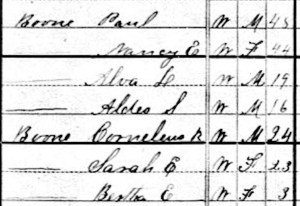
In 1860, Paul is listed in the US Census with his wife Nancy and son Cornelius, in Washington Twp, Hamilton Co., IN. Cornelius was born in 1858. The next family group on the census belongs to his Mother-in-law, Alice “Elsie” Estle.

1870pb

1870 US Census, Paul Boone


The 1870 Census shows his family has grown with the addition of Alva and Aldes. He is still in Washington Twp, Hamilton Co., IN. Alva was born in 1861 & Aldes in 1868.

1880cenpboone

1880 US Census, Paul Boone


By 1880, Paul had moved to Marion Twp of Boone Co, IN.

Cornelius has gotten married to Sarah E. and shows up as the next family on the census with their daughter, Bertha E.


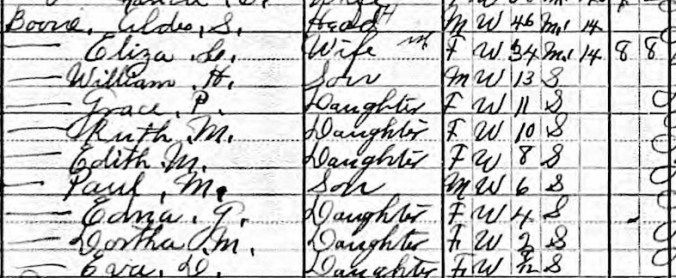
The 1890 Census was destroyed by fire, so there is a 20 year gap until the next US Census records. By 1900, Paul’s sons had all married and started their own families. Some of their children were also married and starting families.

Cornelius Arlonzo Boone

Following Cornelius Arlonzo’s trail: From Census and other records I have the information that he was known as “Lon.” He and his wife, Sara Ellen “Ellie” Glaze had 4 children: Bertha E., Bessie M., Edgar M., and Blanche M.

1900lonb

1900 US Census, Cornelius Boone

Cornelius shows up in the 1900 Census as “R’lonzo.” Searching for him by his first name doesn’t get us anywhere. Bertha is already out of the house. His second daughter, Bessie doesn’t even show up in the Census records for his family. So we had to find information about her from other sources. Lon and his family are now in Jackson Twp, Hamilton County, IN which is where they appear in the remaining Census records.

1910cboone

1910 US Census Cornelius Boone

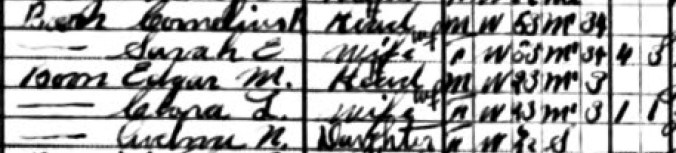
By 1910, the girls are out of the house, Edgar shows up as the next family in the Census with his wife and daughter. The family name is spelled “Boon.” Note that Sarah E has a “4/3” after her name. This indicates that she had 4 children and only 3 are still living. Other records show that daughter, Bessie, has died.

1920corneliusb

1920 US Census, Cornelius Boone

1930cboone

1930 US Census, Cornelius Boone

The final 2 Census records from 1920 and 1930 have Cornelius and Sarah living on their own. They own a house and he is a “groceryman.” Note that Cornelius has an R after his name in 1920—I suppose this is for “R’lonzo.” Then 1930, his middle initial looks like an “O.” Lon died in 1936.

I’ll continue with the other 2 sons, Alva and Aldes next time…

© MJM 2017

Paul Boone had 3 Wives…

But not all at the same time.

paulboonecrop

Paul Boone

Paul Boone was my GGG-Grandfather. He was born in Randolph County, Indiana April 8, 1832. He died November 4, 1917 at the home of his son in Deming, Hamilton County, Indiana. His parents were John Boone, Jr (1798-1875) & Sarah Pierson (1794-1875). Paul was one of 10 children. He lived his entire life in Indiana.

He is listed in the Peoples Guide of Hamilton Co., Indiana; by Cline & McHaffie; Indianapolis, 1874; on page 247 in the section on Washington Twp.: “Boone, Paul; farmer & mechanic; 2 m S E Westfield. Born in Indiana 1832; settled in Hamilton Co. 1839. Republican, Wesleyan Methodist.” Another note I have says he was a blacksmith. I’m not sure where that information came from.

He shows up in the 1850 US Census in Washington Twp, Hamilton Co., IN in his father’s home with his parents, his grandfather, John, and his sister Eunice.

img172marriage-license-paul-boon-nancy-estle-copy

Paul Boone & Nancy Estle Marriage record

He married Nancy Estle, daughter of Joseph P. Estle and Alice Crawford, on November 1, 1855 in Hamilton Co. Indiana. Their marriage record indicates they were married by Isaac Stanton, Justice of the Peace. Paul & Nancy had 3 sons: Cornelius Arlonzo (1858-1936), my GG-Grandfather–Alva Lorenzo (1861-1945) and Aldes Sanford (1864-1931). Nancy died in 1896 at the age of 61. Paul was 64.

After Nancy died, he married 2 more times. When Grandma gave me her notes on the family, we had no clear idea who the other two wives were. Through the years, I have found more information to clarify the situation.

1900paulboonecrop

1900 US Census Boone Co, IN

The 1900 US Census has Paul in Marion Twp., Boone Co., Indiana with wife, Loucinda. They had been married less than a year. She is 60 years old and it indicates her birth month and year are May 1840. She has 4 living children.

Ancestry.com’s Indiana Marriage Collection (1800-1941) has Paul marrying Lucinda (Compton) Carnine on Februrary 6, 1900 in Marion County, Indiana. She was probably in her 50’s but there is conflicting information in some of the records. She is listed as being 40 years old in 1880 on the US Census. At that time, she was married to Abram N. Carnine. They had 4 children. Lucinda died May 30, 1903 of stomach cancer. Her Death Certificate has her age as 58.

1910paulboonecrop

1910 US Census Hamilton Co, IN

In 1910, Paul is listed in the US Census with another wife, Malinda. She is 75 years old, has been married 5 times, gave birth to 5 children, with none living. She and Paul had been married for a year. They are living in Sheridan, Hamilton Co., IN. There is also a “step-daughter” listed in the family, Anna McMurtry.

Paul married Malinda (Keyste/Kist) McMurtry on March 12, 1909 in Hamilton Co. Indiana. She was 74 and he was 77. According to the newspaper announcement, they got married at her home on East 4th Street in Sheridan, IN. The application for marriage indicates that she was married 4 times before marrying Paul. Her obituary from the Sheridan News, in 1914 lists her husbands as Permaneas Beam, William Young, William Higbee and David McMurtry. She had a total of 3 sons and 2 daughters from these marriages, all of whom preceded her in death. The obit also mentions 7 step-children. So I guess Anna McMurtry was one of those step-children.

So there we have it, Paul Boone’s 3 wives: Nancy Estle, Lucinda (Compton) Carnine & Malinda (Kist) McMurtry. While he was married 3 times, he only had children with his first wife, Nancy.

© MJM 2017

What’s in a Name?…

So what is so important about a name? To genealogists and family historians, names are the building blocks of our research. If the name is wrong, then the trail it takes us on is also wrong.

For instance, since I have the actual Army discharge papers for my ancestor, Allen Erp, I know that any official records for the Civil War would have him listed as “Allen Urp.” The Earp genealogy book that I used to connect the line to Wyatt Earp actually has my ancestor, Allen, listed as a Confederate soldier. So the authors didn’t know to look for the “Urp” spelling. I did send them a correction.

Clark Millikan is listed as Millican on his Civil War papers. This is not quite as drastic of a spelling difference, but it may also affect finding all of the correct records. (Yep, there is a story there…)

arzamillikan

Arza Millikan

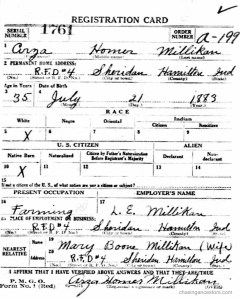
The most challenging spelling difference is for my Great-Grandfather, Arza Millikan. In 1907 the Rev. Gideon Tibbetts Ridlon compiled a genealogy of Millikan and other related families. The book, History of the Families Millingas and Millanges of Saxony & Normandy, is the go-to reference for anyone researching the Millikan line. However, there are no sources listed in this book. My assumption is that Ridlon probably sent notices to as many people as he could with the Millikan and similar surnames and asked for them to return family information to him. The section of the book that includes my direct ancestors is “The Posterity of William Millikan.” I always know when someone has used this source for their Millikan research when they list my G-Grandpa’s name a Arza Hamer Millikan (p.713 of the Ridlon book). I mentioned this to my Grandmother, who very adamantly said “his name was Arza Homer, not Arza Hamer!” However, all of the records, notes and letters I had for him only had Arza H. So how do I prove that his name was Homer? Finally, I found a few records that gave his full name, the record of Union Grove Friends Meeting in Hamilton County, IN; his marriage record and his WWI draft registration. So I finally had evidence of what the family knew all along.

millikanquakerlist

Union Grove Friends record

arzaww1cardp1

Arza Millikan WWI Draft Card

Now that we know his proper name, who was this guy? Well, Arza was my paternal Great-Grandfather. He was born near Sheridan, Hamilton County, Indiana on July 21, 1883. His parents were Lewis Elwood Millikan (1855-1959) and Martha Ellen “Mattie” Barker (1858-1932). He had one sister, Edna (1886-1966). Arza grew up on the family farm on Mulebarn road. He also worked on his Grandfather, Clark Millikan’s farm, which was nearby. He spent his entire life (except for about 1 year) on the farm. From what I can tell, he didn’t graduate high school. He did attend Farmer’s Extension classes at Purdue University.

He had a few girlfriends that I know of, as my grandmother kept some of the letters from these ladies. She also kept some of his journals as well. Seems like he was quite the “lady’s man.” Maybe it was that he was considered quite the catch being a successful farmer. Arza was a dairy farmer, winning prizes for his bulls and cows. He was also a bee-keeper. He had an orchard on the farm & grew corn and other crops as well. So farm life was quite busy for him and his family. He helped establish the Farm Bureau in Adams Township, Hamilton County, IN.

He married Mary Geneva Boone (1897-1992) in Noblesville, Indiana November 22, 1916 when he was 33 years old and Mary was 18. They set up housekeeping on the family farm, with Arza’s parents moving into town. Arza and Mary had 4 children: Margaret Pauline(1917-2007), my Grandmother; Miriam Frances(1918-), Betty Lou (1921-1990), and Arza Clark (1925-1975).

He and his family were members of the Society of Friends. He started in Union Grove meeting, then moved to Lamong Meeting when Union Grove dissolved. Arza died November 24, 1964. He was 81 years old. He is buried with family members in the Union Grove cemetery near Sheridan, not very far from where he lived. Arza was an interesting character & I expect there are a few stories to tell of him…

©MJM 2017

Uncle Edwin’s Story, Part 5…on to Germany

The start of 1945 had Edwin Boone still in Europe with the 415 Medical Collecting Company. The Allied forces were pushing hard against the Germans. Edwin was probably still part of the medical support for Patton’s 3rd Army. His letters are up-beat, reassuring his family that he is fine, eating well & not doing much. January 20, 1945, he wrote “The War News now is sounding awfully good. Maybe I’ll get to see you by “Corn-plantin’” time!” On January 29, he said the snow was a foot deep with talk of the “worst winter in Europe for a good many years, but where I am it compares with a mild winter back in Indiana.” February 1, it had quit snowing & with warmer weather “the snow is practically all gone. And just as I had finished building a new toboggan, too! We built one and used it the last day there was snow. Had a nice long slide, and was really fun, even for an old man!” By February 4 the snow had melted and the rain started again.
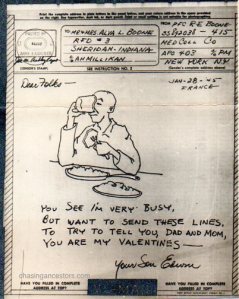
reboonevalentineHe made a Valentine card for his parents.

Later in February, his APO address changed to 339, which connected him to the 9th Army. He wrote from Holland. He told of seeing “some of the war’s desolation” on the trip to Holland. The soldiers were staying in a schoolhouse & subject to regular inspections “just like we had back in the States.” February 11, he tells that he has been permitted to get a room in a private home. He is staying with the Baan family. Professor Baan teaches English in one of the local schools. “I don’t think the folks in America have ever showed the hospitality that these Dutch do.” He says the Dutch people are “very friendly” and are learning English. “They have taken us into their home & can’t seem to do enough for us.”

March 4, 1945, Edwin writes from Germany. He says, “finally we’re getting to see some of the sights that lots of people say they’d like to see. A Germany that has seen some of the ravages of war. I’m sure that these people are beginning to wonder why they ever followed their “leaderreboonefatigues.”” Allied forces were continuously bombing targets in Germany, causing significant devastation. On March 7, US forces of the 1st Army crossed the Rhine River at Remagen over a railroad bridge that the Germans had failed to destroy.
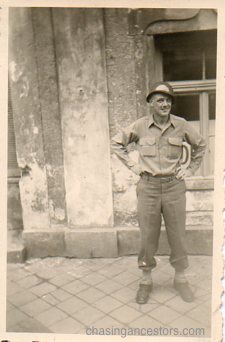
Later in March he mentions the Red Cross and “making arrangements.” He is working on trying to get home to help take care of his parents.

March 29, they have moved again.On March 24, the 9th US Army forces crossed the Rhine River at Dinslaken. “This part of Germany isn’t so well serviced with electricity as the last area was, but they may have it functioning before long. We had lights, radio & electric irons on the other side of the river.”

May 1, Edwin writes that he took a 3 day pass to Holland & “by the time I got back 8 days had passed.” The Company had moved while he was gone and they had difficulty getting transportation to catch up. He said he spent a night “in a real castle, which is being used as Battalion Headquarters.”

Back home, on May 2, his parents, Alva and Allie Boone, had a sale of their personal property. This is the announcement:boonefarmsale1945

May 6, Edwin writes of expecting the war to be over by the time his letter gets to the folks at home. On May 8, 1945 (VE Day) the Germans surrendered and the war in Europe was officially over.

He changed APO address mid May & connected again with the 3rd Army. He said they had traveled several hundred miles in about a week. “We are located within a quarter of a mile of one of these camps filled with displaced persons Polish, Russian & Italian. It’s certainly an odd assortment of humanity. It’s really pitiful to see so many of these people who have been, either voluntarily or otherwise—mostly otherwise!, taken from their homes and used as laboreboonearmycasualrers here in Germany.” He talks of the point system for discharge from the Army and is frustrated that he has less than half the points needed. Also, he indicates he is not getting much help in trying to get home to help care for his father, Alva.

June 4 he is in Deggendorf, Germany, sleeping in an office building. He’s on 24hr guard duty—2hrs on then 4hrs off for 24hrs at a time. He also writes that he is painting signs. He mentions the sale at home and the eventual sale of the farm. He indicates that even though his father expected one of his sons to carry on with the farm, he’s not sure what he will do when he gets out of the Army. There are rumors of possibly the older soldiers being d/c soon. June 25, he sent a photo home.

July 5 he mentions he is riding with a truck driver all over the area, transporting German hospital patients from one hospital to another. Still talking about discharge points and that he has 3 battle stars, which added to his points. “The fact that I have 3 doesn’t mean that I, personally, was in 3 battles! They are for the arenas of the Ardennes, in Belgium, the Rhineland and Central Europe. We had our Company spread out so we got credit for all of them!”

At the end of July he sent drawings of Deggendorf:

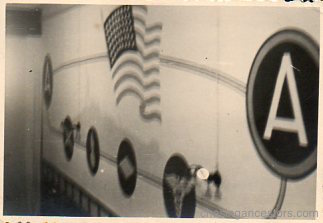
August: He was busy painting and decorating the various clubs for the battalion—the Non-Com’s club Officer’s club and Enlisted men’s club. He considers getting back into painting when he returns home or trying dental work, which may pay pretty well.

Edwin probably contributed to the decor on this wall.clubdecor
The US dropped the first atomic bomb on Hiroshima, Japan on August 6, 1945. Then on August 10, Nagasaki was bombed. The war in the Pacific was coming to an end. August 14, Emperor Hirohito agrees to surrender terms but the formal ceremony didn’t take place until September 2, 1945.The war was finally over.

Aug 19 Edwin tells of a report that soldiers who were at least 38 yrs old were being discharged from the Army. August 31, he writes from Etampes, Franreboonearmyce, in process of returning home. Sept 7, from Compeigne, France, he mentions being bounced from camp to camp, while still awaiting the trip home. Sept 12 he is part of the 16th Reinforcement Depot in Pierrefonds, France, continuing to wait. Sept 19, his name has been read off and he plans his return trip on the 21st.
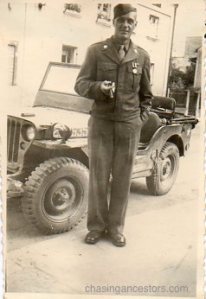
This was the last of Edwin’s letters. He did get home to Indiana and was given his discharge papers at the Separation Center at Camp Atterbury, IN on October 13, 1945. His papers indicate that he departed for the European Theater on October 4, 1944, arriving October 12. He departed for home Sept 28, 1945 and arrived October 9, 1945.

Sadly, his father, Alva Boone, died of pneumonia on October 6.

Edwin returned to Indianapolis with is wife, Pauline. They lived there for the rest of their lives. Edwin did work as a dental technician and continued with art as a hobby. He died in 1980, and Pauline died in 1997. They did not have children.

So, that’s most of Uncle Edwin’s story. I’m sure he was involved in more than just KP, guard duty and sign painting with his time in the Army in Europe during the final stages of WWII. But that’s all that he shared with his family. There is one more tangent to his story to be shared at a later date.

© MJM 2016
Uncle Edwin’s Story, Part 4…Going to War

(The business of the Christmas season has interrupted my ability to post stories regularly, hopefully I can get back on track now.)

On September 23, 1944, Private Edwin Boone left Camp Bowie, TX with the 415 Medical Collecting Company under concealed orders, destination unknown. His address was APO 17100 New York, NY. (APO stands for Army Post Office)

At the same time on the home front, his parents, Alva and Allie Boone, were getting on up in years & starting to have trouble managing the farm. His nephew, Arza Clark Millikan, a US Marine, was in a hospital in California with pneumonia.

Edwin’s first letter after he left was from “somewhere in the Eastern USA” dated September 28. He wasn’t allowed to write about where he was or where he was going. He could only write about “the food, the weather & recreation.” So “the food is excellent, the weather is a little cloudy… & I took a walk to the movies last night.” The next letters gave no more news until mid October.

October 19, 1944, Edwin sent a letter from “somewhere in France.” He commented on the constant rain and the “people are mud splattered & hungry.” He also mentioned how much he appreciated the “picturesque buildings” of France. He stated that most of the towns they hiked through were “practically ghost towns.”

By this time, the Allied forces had progressed from the D-day landing to liberating Paris in August. The forces were moving on toward the German border.

Edwin’s letters tell very little of what he is involved in. He said they spent time cutting & gathering wood for their fires. They constructed a stove out of empty meat cans. They had church services in the field. He asked his Mother to teach his wife, Pauline, how to knit sox so they could send him some. He interacted with a young French boy who taught him the ABC’s in French. He showed much concern for the plight of his parents. By November they had moved in with his sister, Mary.

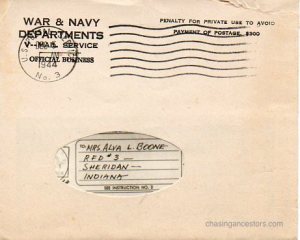
In Mid November, he wrote that he was “making Christmas cards for some of the fellows.” I wonder what kind of drawings he did. November 22, the day before Thanksgiving he sent a V-mail letter. (Victory mail was a way to decrease the amount of space needed to transport mail from soldiers by transferring the letters to microfilm and then reprinting them for delivery.) The reprinted letter is about 4x5inches. In the letter he let his family know what he was thankful for.

boonevmail1boonevmail2

By early December, he had moved again. Mail censors limited what he could tell the folks back home, but he was allowed to mention that he had visited Valognes, Paris & Cherbourg. The next week his APO address had changed to APO 403 which connected him to the US 3rd Army lead by General Patton. At this point he said he was “sleeping in permanent buildings (on the floor), enjoying warm fires, & eating our chow with a hospital unit.”

There was an interesting card in Edwin’s papers:

pattonprayer“Almighty and most merciful Father, we humbly beseech Thee, of Thy great goodness, to restrain these immoderate rains with which we have had to contend. Grant us fair weather for Battle. Graciously hearken to us as soldiers who call upon Thee that armed with Thy power, we may advance from victory to victory, and crush the oppression and wickedness of our enemies, and establish Thy justice among men and nations. Amen.”

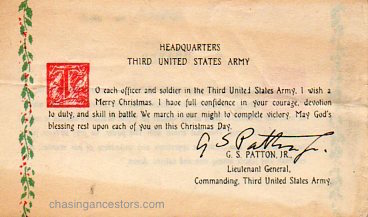
From what I could find this card was issued to all members of the US 3rd Army, reportedly 250,000 cards were printed. Rain had been a significant problem for Patton’s forces throughout the Fall months. On December 8, 1944 he requested the Chaplain to find a prayer for improved weather conditions. By December 20, the weather had improved. On the back side of the Prayer card were Patton’s Christmas wishes for the troops.

pattoncmas


“To each officer and soldier in the Third United States Army, I wish a Merry Christmas. I have full confidence in your courage, devotion to duty and skill in battle. We march in our might to complete victory. May God’s blessing rest upon each of you on this Christmas Day.”

December 16, 1944 was the start of the Ardennes campaign, otherwise known as the “Battle of the Bulge.” US forces worked to push the German army back through Belgium and Luxembourg toward the German lines. The “bulge” was the shape the battle line took initially as the Germans had pushed through the Allied lines creating what newspapers reported as a bulge in the lines. By January 16, 1945, the Allied forces had pushed the “bulge” back and the Germans were forced back to Germany. Heavy casualties were sustained on all sides of the fighting. It was considered one of the most desperate US battles in Europe.

I can’t find much information specifically about the 415th Collecting Company and their role in the European campaign. However, it is pretty obvious that they were assigned to support Patton’s 3rd Army forces during the Battle of the Bulge. Edwin may have been at the hospital base or closer to the front lines, transporting wounded. Regardless, I’m sure he was overwhelmed by what he saw.

His letters during this time tell of moving frequently, sometimes sleeping in buildings & sometimes in “squad tents” holding 16 men. On January 4 he wrote of being promoted to P.F.C. (Private First Class) and receiving the Good Conduct Medal. January 11 he wrote from the “ETO or European Theater of Operations or Somewhere in France.”

With the Battle of the Bulge won, in 1945 the US forces moved on toward the Rhine River & Germany.

Edwin moved on with the Army…

© MJM 2016

Uncle Edwin’s Story, Part 3…Moving with the Army

At the end of April of 1944, Pauline Boone, Edwin’s wife, sent a letter home from Colorado, where Edwin was finishing training as a Dental Technician. She said, “I feel like we are awaiting a sentence of some kind, which can be good or bad. He won’t know where he is going to be sent for a few more days yet, and I can tell you that the suspense is almost unbearable. If I only knew he would be allowed to serve his country here in the United States…but that is the Question!” Edwin had the highest average in his class and had completed his training, so they were waiting to see where the Army would send him next. She also wrote, “I frankly hope Edwin won’t get a furlough right now, unless it is a delayed routing, because that would indicate that he might be going over-seas. So I have hoped that he would be assigned someplace & then get a furlough later on.”

Mid-May, 1944, Edwin wrote that he was on a train headed to California. “We crossed the Divide about 5 o’clock after going through 31 or 32 tunnels!” He said he was in a “troop sleeper” car attached to a regular train. The car held 30 men with 3 tiers of bunks. He lists his new address as ASF-PRD, 1st Bn. Co E-1, Camp Beale, California.

Camp Beale was located about 40 miles north of Sacramento, near Maryville, CA. It was a large camp with training for several divisions. In May of 1944, it opened a German Prisoner of War base camp. Edwin was assigned to ASF-PRD which was the code for Army Service Forces Personnel Replacement Depot. It essentially was a temporary duty station for soldiers waiting new assignments.

Edwin’s letters from Camp Beale tell of a waiting game. He was expecting to work temporarily in the Dental clinic—can’t say that he actually did that. Otherwise, he had KP duty, went on hikes—up to 8 miles at a time, and loafed. He said in June that he started going to a ranch to help “thin out the peach crop, ” for which he got $5/day and his meals. He said that about 150 men from Camp went out each day with 10 to 20 going to each ranch, working for about 9 hours a day. He wrote about this in a letter postmarked June 8, 1944. One of the last sentences was, “It looks like the war is just a little nearer being over. At least we can hope and pray that it is soon.” Of course, on June 6, the US forces had landed on the beaches of Normandy. Perhaps this is what Edwin was referring to.

On June 20, he wrote that he had gone to a nearby Baptist Church on Sunday and was treated to Sunday dinner from one of the families. He then said he went on a 10 1/2 mile hike on Monday, drilled & then had Judo training. He was called off the field in the afternoon to prepare to ship out to Ft. Sam Houston, TX. He traveled by train to Los Angeles and then across country to Texas. He drew a picture of a yucca plant that he saw along the way.

edwinyucca

Edwin stopped in Ft. Sam Houston for a few days, sending only one letter from there. Then he was back in Camp Barkeley, Texas. He was assigned to the 415 Medical Collecting Company. He was expecting to be on KP duty, but said “KP isn’t very hard here for we eat out of mess kits, consequently there will be no dishes to wash.” So I guess they changed things a little since he was first stationed there. Eating out of mess kits was the norm now instead of a punishment for not passing inspection. He also began to wonder what the next move would be. “They keep shipping me around this way, I’ll begin to think there isn’t any place for me in the Army.” Pauline moved out to Texas again in July.

By the end of July, Edwin had moved again. This time he was stationed at Camp Bowie at Brownwood, TX. He was still assigned to the 415 Medical Collecting Company. Camp Bowie was another large training camp. Edwin said the camp could hold 80,000 soldiers. He started painting signs again but didn’t do much else. Pauline followed him to Brownwood. However, with such a small town near the large Army base, Pauline mentioned that prices were “double or triple for everything.”

Edwin didn’t have much news to report home. He spent time in the field practicing carrying litters or riding in the ambulance. He indicated toward the end of August that the unit has been “alerted” and is to prepare to go overseas. Edwin didn’t think he would be going with the group. As he was nearing 38 years old, he was showing his frustration with the system & was hoping that he would get out of the Army. He also indicated he wished he could be home to help his aging parents with the farm.

He explained the workings of a Medical Collecting Company to his folks. “Contrary to what the name makes you think of, it has nothing to do with finance! Casualties are picked up at the stations near the front lines and are carried back to the Collecting station and sent by ambulance back to a “Clearing station” (serving several Coll Co’s), from where the “Clearing” evacuates them on to a field hospital. As I am a litter bearer in this Co. you know that they aren’t going to take me when there are younger men in the Army they can use.” Again he expected to get out of the Army. “Under Army Regulations they cannot change my classification (as a dental lab technician), so eventually they will either find a place for me or let me out of this Army.”

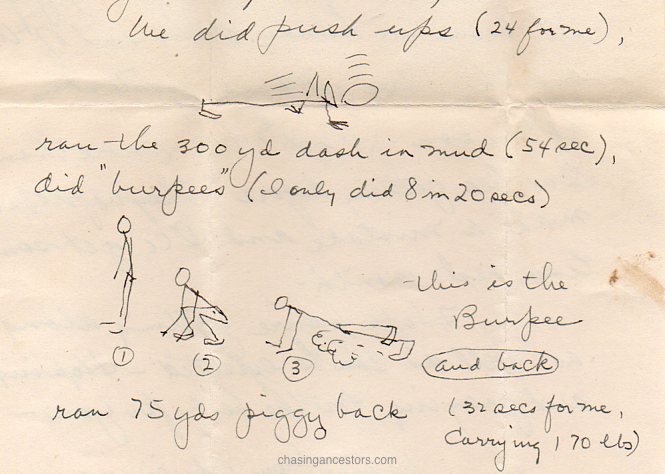
Still at Camp Bowie in September, soon after his 38th birthday, Edwin wrote of his job of “putting the men’s serial numbers in their shoes and helmets.” Two days before this the company had their physical fitness test, so he was glad to be able to sit and work on a task! The fitness test included the following exercises as well as “creeping and crawling in the mud” & a 4 mile forced march which they did in 44 minutes.

edwinexercises

He still talks of the company moving out soon and expects he will transfer to a hospital where he can “begin to do some good for the Army.”

On Sunday, September 24, 1944, Pauline sent a letter home. Edwin had been restricted to Camp for the week before, but he managed to slip out & meet Pauline Tuesday, Wednesday & Thursday evenings. He didn’t show on Friday night or Saturday. Pauline didn’t hear from him. She went to the Camp Sunday morning and was informed that “several hundred men left at 2 o’clock Friday nite and the 415th was among them. They shipped out under concealed orders, destination unknown. Of course, I know he is going to the Port of Embarkation.”

The standard War Department change of address postcard was also sent to his parents.It had an APO New York address instead of a camp name.

So Edwin was on his way to a new duty station with the Army…

© MJM 2016

Uncle Edwin’s Story, Part 2…In the Army

Richard Edwin Boone was called up for service in the US Army July 21, 1943. He was 36 years old. Being a Quaker, he entered as a Conscientious Objector. My Grandmother, Margaret McKinley, gave me a shoe box one day and when I asked what was in it, she said, “It’s Uncle Edwin’s letters from the Army.” So most of my knowledge about his service is from these letters. They were from Edwin to his parents. There were also some letters from his wife, Pauline to his parents. Incidentally, the word “free” was written in place of a stamp on the envelope for each of the letters sent while he was in the U.S.

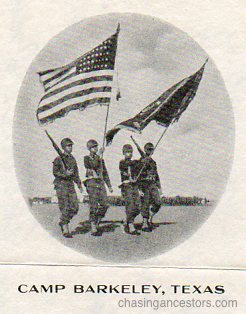
campbarkeleyletterheadEdwin started at the Reception Center at Fort Benjamin Harrison, Indianapolis, IN. Then on September 8, 1943, he sent his first letter from his training station. He settled in Camp Barkeley, near Abeline, TX. His return address is Company A 63rd Medical Training Battalion. Edwin expected he might be there for 21 weeks & since this was a medical training center, he presumed he was now in the Medical Corps. The men he transferred to TX with started calling him “Pop.” He wrote “I don’t know why unless it’s because I’m the eldest.” In later letters, he calls himself “Old Pappy.” He described his barracks as a one story “hut” that held 16 men, had no wallpaper or rugs but did have a “good soft mattress.” He did complain later that he missed a good shade tree. The trees in TX weren’t very tall so he couldn’t “lay in the shade.”

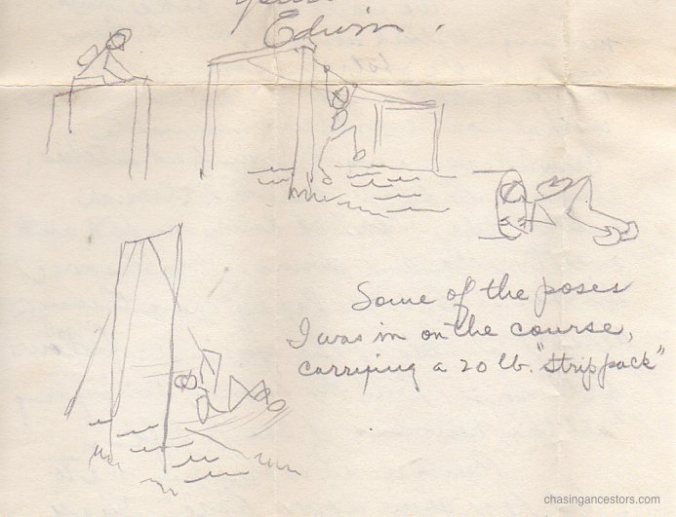
He began training September 21, 1943. He mentioned in a letter on the 26th that he had been painting signs & doing class room work. He said they hiked 5 1/2 miles one day and also did the obstacle course. He was part of the Battalion choir. In October he talked about field exercise in which they all pitched their “pup” tents on the parade ground and displayed their field equipment for inspection. His Division didn’t pass the inspection so they were made to eat from their metal mess kits for a week instead of using the china in the mess hall.edwinobstaclecourse

In November, he ended up in the hospital with an “attack of the good old-fashioned shingles.” Then on November 23, he wrote that his wife, Pauline, had moved down to Abeline. Later that month, Pauline joined him at the camp for Thanksgiving dinner.

December 7, 1943, a War Department postcard was sent out that listed Pvt Richard E. Boone’s new address: Dental Techns Sch. Fitzsimons Gen Hosp, c/o Postmaster Bunell, Colo. His next letter showed he was a part of Company D SMDET (School for Medical Department Enlisted Technicians). So he had moved on to Dental Technical School to train to be a dentist’s assistant. He expected to be in school for 3 months. Pauline moved out to Denver later in December. Edwin is learning how to make false teeth & other dental appliances. He’s in a more relaxed atmosphere, able to go off post at night and for the weekend. So he & Pauline are able to spend time together.

In January he wrote of being on “litter detail—that is the squads of stretcher bearers who are picked out for each evening, theoretically to carry wounded from the hospital trains that come in. As none come in, there’s nothing to do, & all it amounts to is being restricted to camp for the evening.” Pauline got a job in the library. They also found time to do some sight seeing.

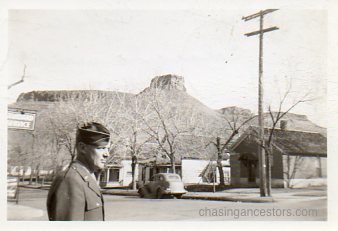
edwingoldenco

Golden, Colorado with Castle Rock in the background

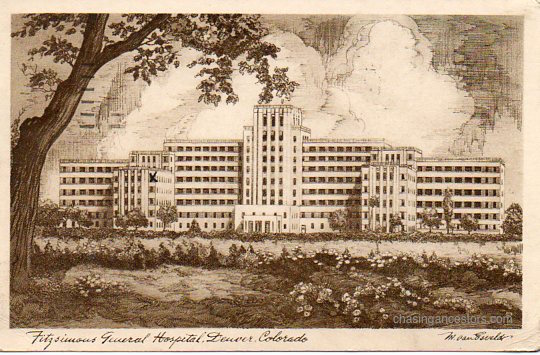
In February, Edwin ended up in the hospital again. This time for hemorrhoids. He had one procedure & was expecting to have surgery. He comments on the fact that his bed has built-in radio earphones on which he has a choice of 3 radio stations. He had surgery for his “piles” mid-February & was back in school a month later.fitzsimonshosppostcard

Pauline sent a postcard home just after Edwin’s surgery. The X toward the left wing of the building marks the area of the hospital where Edwin was. The hospital had 608 beds.

In May, 1944, Edwin was on the train headed to California…

© MJM 2016

Uncle Edwin’s Story

maryedwin

Mary & Edwin Boone

Richard Edwin Boone was born August 28, 1906. He was the son of Alva and “Allie” Erp Boone. He was 15 years younger than his big brother, Chester and 9 years younger than his sister, Mary (my Great Grandmother). He was 11 years old when his niece, Margaret Millikan, my Grandmother, was born. So in essence, Uncle Edwin bridged the gap between the two generations. Edwin grew up on the Boone farm near Sheridan, Indiana.

On April 30, 1920, when he was 13 years old, Edwin placed a want ad in the Sheridan News for a “second hand bicycle, must be in good condition.” I don’t know if he ever got it. In April of 1922, he shows up in the Sheridan News as a member of the “Sheridan Jersey Calf Club.” Also in that newspaper was the announcement that Edwin “won the first prize of $10 offered by Elliott’s drug store for the best painting of the Jonteel bird trade mark.” Jonteel was a line of cosmetics and the trade mark symbol was a stylized colorful bird of paradise. Edwin also worked on the Sheridan High School Newspaper. In November of 1922, he is listed as the associate editor of the Black & White. In 1923, Edwin is a reporter for the paper.

Then in June of 1925, there was an article on page 1 of the Sheridan News about how Edwin “drew the cover page design for the special Outing Edition of the Indianapolis Star.” The special section was the “Vacation and Travel Guide” & Edwin’s illustration included outdoor and travel scenes. The article said that Edwin had “been engaged in drawing and sign painting” since graduating High School in 1924 & “he seems to have exceptional ability & will probably figure in commercial art circles.”

Edwin also did illustrations for the Sheridan News. When I have looked through 1926 and 1927 editions of the paper, I recognize his drawings. He was pretty good.

Grandma showed me a copy of the 1927 Sheridan High School yearbook. The illustrations in the book were also done by Edwin. I think she gave the book to the Sheridan Historical Society.

edwinsign

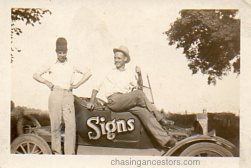
So Edwin found a career as an illustrator and sign painter. He advertised on the jalopy he drove. Grandma had a couple of pictures of him with his vehicle. Edwin is sitting on the car. I’m not sure who the other man is.

edwinpauline1934

Edwin & Pauline Boone 1934

On August 3, 1934, Edwin married Mary Pauline Barker. She was the daughter of Arthur and Jennie Boxley Barker. Edwin & Pauline were both members of Sheridan Friends Meeting. I’m not sure how long they were an item before they got married, but was it a coincidence that the 1927 yearbook he illustrated was Pauline’s Senior yearbook? The caption for this picture is “the bride and groom.” It was taken soon after they got married.

Census records have Edwin, age 22, in 1930, living with his folks in Hamilton County IN. He worked as a sign painter. In 1940, Edwin and Pauline have moved to Indianapolis, living at 2706 Olney St. They owned their home, valued at $2100. They were living at the same place in 1935. Edwin was working as a Decorator for a Contracting Co. and earned $1200 in 1939. The Indianapolis City directory for 1943 has Edwin listed as a painter for CWC. Most likely CWC is Curtiss-Wright Corporation, a propeller manufacturing company.

Then in July of 1943, Uncle Sam called Edwin into the US Army….

© MJM 2016

Autumn Sunday Eve in Indian’

My Grandmother, Margaret (Millikan) McKinley (1917-2007) wrote poetry. I didn’t know about it until she was close to 90 years old. I told her I had found her collection of poems & enjoyed reading them. She said she thought there were plenty of other folks who were more talented. I did put the poems together into a little book that I gave to family members. In all, there were 144 poems. Here is one of them, written October 7, 1935 when Margaret was only 18 years old.

How I love Sunday evenin’ here on the farm
Down in central Indian’
When soft twilight spreads an arm
‘Cross the eastern horizon.

Just to climb to the top of the silo
And view the neighborhood;
Watch the nearby stream a flow
Carryin’ an occasional leaf from the wood.

See the blaze of color in Nature
As Autumn puts on Her gown
Of wonderful hues of azure,
And orange, red, yaller and brown.

chickens

Millikan girls with the chickens

That orchard down yander is shinin’
With fruit that’s got to be picked,
And the old vinegar barrel is a pinin’
To get sum more sweet cider fixed.

Thers popcorn over there to gather;
And “sweet taters” yet to dig;
And fire wood to save frum the weather.
And walnuts to save frum the pig.

There’s Mother a callin’ the chickens
And the neighbors are callin’ thers too;
And the pigeons are gitten’ the pickens
Out there where the hogs are through.

A far off sheep bell is tinklin’;
And a sleepy bird warbles “good-night;”
And the cows are in for the milkin’;
And in a winder shines a light.

A few early stars begin tinklin’ and I reckon
The sun’s way down ‘hind the trees in the west.
A church bell rings a clear sweet beckon.
Don’t you love this time o’ day best?


© MJM 2016