Friends in the Family

Friends—that is the Religious Society of Friends, also known as Quakers, were prevalent in my Father’s ancestry. First, some background on the group: The Friends religion was started by George Fox in England in the 1650’s. The term “Friend” comes from the verse “I have called you friends, for all things that I have heard of my Father I have made known unto you,” John 15:15. The name “Quaker” was used as a nickname because they “trembled (or quaked) in the power of God.” In the late 1600’s, Quakers were settling in the New World. William Penn established the Quaker settlement that would become known as Pennsylvania.

Friends meetings were set up in the community, such that people could get there easily by horse or on foot. They held weekly religious services and early on these were “quiet Meetings” in which people would meet in silence, with members rising to speak as they felt led by God. “Thee” and “Thou” were familiar words in the household. Monthly business meetings were also held, with men and women holding separate meetings. Quakers kept records from these business meetings & on member births, marriages & deaths and those records that have survived through the years offer a wealth of information for the family historian.

When I first started researching the family tree, I knew that some of my ancestors were Quakers. I was surprised to find in my local library a resource that gave information on the Quakers in other states. It was a collection of volumes: William Wade Hinshaw’s Encyclopedia of Quaker Genealogy, originally published in 1936. (It is now available on Ancestry.com) Mr. Hinshaw extracted basic information from meetings in several states, including North Carolina and Pennsylvania. Looking in these books, I found some of the Millikan, Hinshaw, Boon and other Quaker names from Dad’s side of the family. Most of his ancestors came from North Carolina Meetings. But I didn’t quite understand the terminology in the book. Hinshaw had placed a key in the front of the book indicating what abbreviations he used. Some of the abbreviations are: gct=granted certificate to, rocf=received on certificate from, rqct=requested certificate to, dis=disowned & mou=married out of unity. The combination of “dis mou” was seen quite frequently in the records.

So looking at this collection, it was easy to see in the Springfield Monthly Meeting records of Guilford County, NC, that John Boon married Sarah Pierson in 1816; that Sarah was originally listed with her parents, William and Elizabeth; that John & family got a certificate to a meeting in Indiana in 1819. That gave me quite a bit of information to work with. John & Sarah Boon are my 4thG-Grandparents.

The Hinshaw, Barker and Allen ancestors were found in records from Holly Springs Monthly Meeting in Randolph County, NC. There were also notations in some early records that some of the Hinshaws came from County Tyrone and Grange, Ireland.

The Millikans show up in the records of Marlborough Monthly Meeting in Randlolph County, NC. Just a couple of lines had me wondering exactly what they were up to. Clark & Lydia (Hinshaw) Millikan (my GGG Grandparents) were married in 1855, but Lydia was “dis mou,” disowned for marriage out of unity. I didn’t quite understand this because all that I knew about Clark at the time was that he was a “birthright” Quaker. So why was he not listed as a member & why was Lydia disowned?

Just a couple of years ago, on a visit to North Carolina, I found information that may have answered the questions. Clark married Nancy Adams in 1851. She was not a Quaker. She also had a daughter at the time they were married. Clark and Nancy had a daughter together, Nancy Angeline, and Clark’s wife, Nancy died. So, my assumption is that Clark may have been a member of a Meeting in the past, was “dis” for marriage to Nancy. Then Lydia was “dis mou” for marriage to Clark. Clark was received into the Meeting on request in 1864 and Lydia with their 3 daughters in 1865. Then, in 1867, the entire family gct Greenwood Monthly Meeting in Hamilton County, IN. Clark and Lydia stayed in Indiana for the rest of their lives. They remained members of the Society of Friends as well; as did some of their descendants.

So, in all, the Quaker connections in the family have made some of the research easier. Now, many of the actual Meeting records have been digitized into Ancestry.com’s collection. Who knows what other tidbits may be found there.

© MJM 2016

A Connection to Wyatt Earp

When I was in school & had to do a genealogy project, I asked my Grandmother for information on the family. I remember she said we were related to Wyatt Earp & Daniel Boone. This made sense because there are Boone and Earp ancestors on my Dad’s side of the family, however our Earp’s spell their name, Erp. Grandma did not have the information that made the connection to either of the famous men. Part of the fun of genealogy is to find a famous ancestor. As of right now, I still don’t have the definitive connection to Daniel Boone, but I did find the family lines that connected to Wyatt Earp.

One day several years ago, I made a chance discovery at my local library. There is a genealogy wing at the library & even though most of my research is not from this locality, I check the library resources from time to time as there are several items available from other states. I was getting ready to leave the area and passed by the desk & saw the shelf of “New Books.” One of the books was a large volume, The EARP Family in America, by Sharron Studebaker Spencer and Irmalee Earp Williams. It was a pretty in-depth work taking the Earp family back to the earliest Irish immigrant, Thomas Earp, Jr. This book gave the full connection from my direct Erp ancestors to the relatives of Wyatt Earp. Of course, I contacted the author and purchased the book to add to my own reference library.

So Wyatt Berry Stapp Earp (1848-1929) was a famous figure, best known for his exploits with his brothers as law men and gamblers in the “Wild West.” The most recognized incident is the “Gunfight at the O.K. Corral” between Wyatt & his brothers and the Clanton brothers, which took place in Tombstone, Arizona in 1881. He has become a larger-than-life character with stories of his life portrayed in movies and TV shows through the years.

Wyatt was born in Monmouth, Warren County, IL and died in Los Angeles, CA. His parents were Nicholas Porter Earp (1813-1907) & Virginia Ann Cooksey (1821-1893). Going back farther on the paternal side, Nicholas’ father was Walter Earp (1787-1953); Walter’s father was *Philip (ca 1755-ca 1833); then William (ca 1729-ca 1778); then Joshua (ca 1705-ca 1751); then John (ca 1680-1744); then Thomas Earp, Jr (ca 1656-1720).

Going forward from Wyatt Earp’s ancestors to connect to my direct line:

  • Thomas Earp, Jr. (ca 1656-1720)
  • John Earp (ca 1680-1744)
  • Joshua Earp (ca 1705-ca 1751)
  • William Earp (ca 1729-ca 1778)
  • *Josiah Earp (1761-1844)
  • Singleton Erp (ca 1802-ca 1886)
  • Allen Erp (1826-1885), my GGG Grandfather

Wyatt’s great-grandfather, Philip and Allen’s grandfather, Josiah, were brothers. They were both born in Maryland & fought in the Revolutionary War. Both families moved a few times. Philip spent most of his life in North Carolina and Virginia. Josiah finally settled in Pulaski County, KY, which is where his son, Singleton, raised his family.

One question I don’t have a good answer for is why some families retained the spelling “Earp” and some used “Erp.” Singleton Erp’s name is spelled both ways in different census schedules. Allen Erp is listed in the 1860 census as not being able to read or write, perhaps this has something to do with the spelling of the name—using the simplest spelling. Regardless, I’m glad I was able to find the connection to Wyatt Earp so when someone asks if there was anyone famous in the family I can answer quickly. Now all I have to do is find the proof one way or another for the Boone connection.

© MJM 2016

Uncle Fred–US Army Veteran

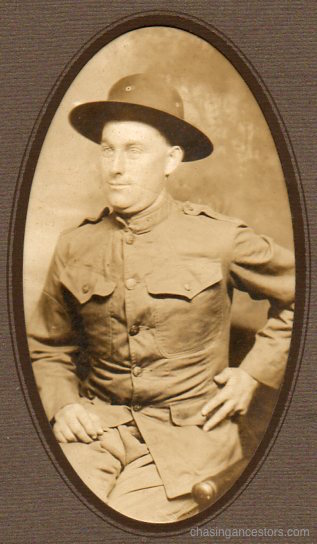
Fred McKinley was born in Morgan County, Indiana, March 21, 1890. He was my Grandfather Loran McKinley’s Uncle. His parents were Jeremiah (1852-1934) and Priscilla (1851-1941) McKinley.fredmckwwi

He was 27 years old & single when he registered for the draft in 1917. His card # is 28. He was living in Clay Twp, Morgan County, Indiana. He worked as a farmer. He was of medium height and medium build, had blue eyes and brown hair.

The Martinsville Democrat newspaper was a source of information regarding the draft. On July 13, 1917 it lists Fred with draft #822 of 1501 registrants from Morgan county. He was not called in the first draft.

Then on April 26, 1918, 58 men were called to Martinsville to the conscription station. Thirty of those men were selected to go to Camp Taylor, Kentucky for training. This is to “fill Morgan county’s quota on the first call of the second draft.” It said that farmers would be given “deferred classification for the present if their cause merits it.”

Even though Fred was a farmer, he did not get the deferred classification & on Friday, May 3, 1918, he is included as part of the group of 33 men who left for training camp the Saturday before “to make themselves ready for actual service on Uncle Sam’s firing line in his great fight to make the world safe for democracy.” It is said that there was a large group of friends and family members at the train station to see the men off.

I got a copy of his service record card from the Indiana State Archives. It states he had the rank of Private in the 159 Depot Brigade, which was essentially the training brigade at Camp Taylor. He was inducted on April 27, 1918 in Morgan County, IN. He was discharged November 1, 1918. He did not go overseas.

The story is that Fred got the flu while in the Army and this is why he was not shipped out. In searching for more information regarding the flu epidemic during the war, I came across a blog post from January 4, 2011 from the Filson Historical Society <filsonhistorical.org>. It mentioned that at Camp Zachary Taylor in Louisville, KY, there was an influenza outbreak in 1918 that killed 824 soldiers and caused 13,000 to be hospitalized. I expect Fred was one of those 13,000.

Fred’s service record card also lists his honorable discharge as S.C.D. When I searched the internet for this code, I found that it is “Service Connected Disability.” His card states that “in view of occupation he was, on date of discharge, reported 10% disabled.” So I guess his experience left him with some kind of permanent disability. I guess I’ll have to do more searching on what exactly his issue was.

Grandpa had a large oval photograph of Uncle Fred that he gave me. It is the same picture as above. It is very cumbersome & the frame is broken, so it sits in a box in my closet instead of hanging on the wall. There were also a few less formal photographs of him in uniform that were given to me by Grandpa.

Once he returned home, Fred spent the rest of his life in the Brooklyn, IN area, continued farming and served as the sexton of the Brooklyn cemetery. He never married. He died at age 81, March 8, 1972 at the Veterans Hospital in Marion, Indiana. Grandpa also had Fred’s burial flag. It is now in my collection as well.

One more thing: On November 15, 1918, the Martinsville Democrat had the front page story of “The end of the war, the world war, the greatest conflict between man and peoples that, we hope, will ever be recorded in this world’s history.” Unfortunately, there were more wars to come. But the end of the “Great War” is commemorated each November 11 as Veteran’s day. Thank you to all who have served.

© MJM 2016

A Lutheran Gal Marries a Catholic Guy

My Maternal Grandparents were John Aloysius Chvarack, (1916-1967) and Lucille Marie Beiersdorf (1920-2011). They were both raised in Sheboygan, Wisconsin.

John was a part of a family of Croatian immigrants. His Father, Steve (1872-1938) came to the US first, then his wife, Mary (1876-1960) and their first 3 children came about 10 years later. Steve was part of the establishment of St. Cyril & Methodius Church in Sheboygan in 1911. John had 2 brothers & 2 sisters and they were raised in the Catholic faith. John was born August 3, 1916 and was baptized at St. Cyril & Methodius August 13, 1916. He attended St. Cyril & Methodius school & graduated from Sheboygan High School in 1934.

Lucille was the only child of Herman (1895-1983) & Amanda (1894-1973) Beiersdorf. Her ancestors were German immigrants. Herman’s parents, August (1858-1903) & Augusta (1868-1955) came to the US in 1889 with 4 of their 10 children. Amanda’s parents, Otto (1869-1954) & Emilie (1867-1940) Steinhaus, came to the US in the mid 1880’s and married in Milwaukee in 1890. Lucille was born in Port Washington, WI on August 23, 1920 & was baptized there on September 5, 1920. The family moved back to Sheboygan & Lucille was raised in Bethlehem Lutheran church. She graduated from Sheboygan High School in 1938.

They attended the same high school but 4 years apart. John’s yearbook caption gives his nickname as “Johnny” and indicates he was on the Commercial Course of study. “It takes tall men to be seen” is the phrase under his name. The caption continues with: “John is quite a shy, tall boy who overcame his shyness when he joined the Glee Club. He seems to have unusual strength, and there are many who admire his skating and swimming abilities.”

Lucille’s caption is shorter: “Louie” is her nickname, her favorite subject is typing, hobby is sewing, and ambition is to be a stenographer.

I interviewed Grandma in 2008 and asked her about Grandpa. She called him “Johnny” but it sounded more like “Junny” when she said it. They met when some friends introduced them and she invited him to a party at her house. She was 14 and he was 18. Lucille’s cousin, Gertrude Beiersdorf was in Johnny’s class so maybe she had a part in introducing them. Grandma said he was so shy that he stayed off to the side and didn’t interact much with the group initially. After he got to know someone, he was more interactive. They started going together after that & were together while Lucille was in high school. They went to dances at the Eagle auditorium & had a group of 4-6 couples that would go out together, get together to play cards or go on picnics.

They got married Wednesday, June 26, 1940 in Sheboygan. Now, I just figured that they got married in the church that Grandma grew up in, Bethlehem Lutheran Church. But when I found the wedding announcement from the Sheboygan Press, I noticed that they got married in the parsonage of the church and not in the church. The announcement said she wore a white net over satin princess style gown. Orange blossoms held her veil in place and her bouquet was of “Euratium lilies, bouvardia and white sweet-peas.” Her attendant, John’s sister, Anna, wore an aqua taffeta gown with “shirred basque waist and empire skirt.” Her bouquet was of American Beauty roses. Lucille’s cousin, Francis Beiersdorf, was the best man.

chvweddinggroup

But I didn’t understand why they got married in the parsonage. I asked Grandma about it. She said it was because she was Lutheran and Grandpa was Catholic. She said his Mother would not attend the wedding and would not permit him to get married in the church. Looking at the pictures, though, seems like she missed out not being able to walk down the aisle of the church in that beautiful dress. Lucille’s parents hosted a supper and reception at their house after the wedding.

John later took classes and joined the Lutheran church. The couple continued on at Bethlehem while they lived in Sheboygan. After John joined the Army and made a career of it, they continued to find Lutheran churches to attend and raised their 2 daughters in the faith.

Johnny died in California in 1967. Lucille had one daughter still at home. My Mother was already married and had a family of her own. Lucille stayed in California for the rest of her life.

© MJM 2016


Boy Soldier

Hanging by a chain on the wall of my Grandmother McKinley’s home was a picture encased in glass with a black background. The picture was difficult to make out because it was so old. It now hangs in my living room. The picture is actually a tintype of a young boy. It took me quite a while to figure out that it is the memorial picture of William Singleton Erp.

William Singleton was born April 9, 1846 in Pulaski County, Kentucky. His parents were Allen Erp and Sarah (Alexander) Erp. He carried the names of his Grandfathers: William Alexander and Singleton Erp. He moved to Indiana with his parents when he was about a year old.

Grandma said he was known as “Uncle Sing.”

There is a commemorative marker in Spencer Cemetery, Hamilton County, IN leaning against his parents’ grave marker that states: “Wm. S. son of Allen & Sarah Erp belonged to the 40th Ind. Co. E. He lies buried at Nashville Tenn. Age. 15Y 11M & 28D”

So, he was a soldier during the Civil War? What happened to this 15 year-old boy? Grandma said the story was that a group of Southern women entered a train with a basket of cookies for the soldiers, over half the soldiers died, including Wm. S. Erp. Grandma requested that I find his grave in Nashville.

I found a Roll of Honor book in my local library: Roll of Honor: Names of Soldiers Who Died in Defense of the American Union Interred in the National Cemeteries, Vol XXII-XXIII, Washington, Government Printing Office, 1869, p. 76, that listed his death date as April 2, 1862 & that Wm. S. was buried at the National Cemetery at Nashville, TN. I had no idea there was a National Cemetery in Nashville. One day I went to Nashville, stopped by the cemetery and found his grave marker. I couldn’t stay long because a storm was coming up. I had enough time to find the marker and take a picture for Grandma.

wserpheadstonetn

But I wasn’t satisfied there. Was the story really true? Was he poisoned? I found a book in the Clinton Co. IN, library: Muster Roll of Co. E. 40th Regiment Indiana Infantry, by Helen E. Grove, 1990. This gave his rank as Private, Age: 15, Height: 5’4”, Eyes: Brown, Hair: Dark, Complexion: Dark, born in Pulaski Co., KY, occupation: Farmer. He was enrolled Oct. 16, 1861 at Hillsboro, IN. His Residence was Hillsboro, Clinton Co., IN. It states he died in April 1863 (off by 1 year) in a hospital at Nashville, TN of Lung Fever (pneumonia). So I guess the story of poison wasn’t true.

William Singleton spent 6 months in the Union Army. According to the National Park Service information about the 40th Indiana Infantry, the unit was mustered in December 30, 1861. Went to Bardstown, KY until February 1862. Then marched to Bowling Green, KY & on to Nashville, TN from Feb. 10 to March 13, 1862. Then they started for Savannah, TN March 29 & on to the Battle of Shiloh April 6, just after Wm. S. died. Who knows how long he was ill before he died. I expect he got sick during the march to Nashville. I wonder how his parents were notified. And did his Father, Allen, know where Wm. S. was buried when he came through Nashville while he was in the Union Army?

Also in Grandma’s collection of pictures,was this picture of the boy soldier:

wserparmy

The photographer who took the picture was located in Frankfort, IN. So the picture was probably taken soon after he enlisted.

Then I wonder how a boy was allowed to join up. But in doing research on the 40th Indiana, I found through the National Park Service website that some of Wm. S.’s relatives were in the same Regiment. John T. Alexander is listed as a soldier. I don’t have much on him, except he may be Wm. S.’s Great Uncle. Another Great Uncle, Galen Alexander, age 30, died in January 1862 in Louisville, KY after contracting a fever. So illness was an issue for the soldiers. Hard to imagine what the conditions were like. The Regiment lost more soldiers (206) to disease than to wounds (143).

Finally, in a small photo album full of tintypes, many not labeled, I found another copy of the picture that is in the black frame:

wserp

I like this one better than the one of him in uniform. But he looks so young!
Rest in peace “Uncle Sing.”

© MJM 2016


The Growth of the Farm

“Old Clark Millikan had a farm…ee—i—ee—i—o!…”

Clark Millikan settled on the farm southeast of Sheridan, Hamilton County, Indiana in the late 1860s. He “traded” his land in North Carolina with a relative for his first 80 acres in Indiana. (There’s more to that story & I’ll get into it sometime in the future.) He had 1 son and 5 daughters living on the farm until the early 1880s.

The Agriculture Schedule of the US Census shows how he improved that farm in the 10 years from 1870 to 1880. We went to the Indiana State Archives a few years ago to check the microfilm of the Agricultural Schedules for several Indiana ancestors. (The schedules for some of the states are available on Ancestry.com, but not for Indiana)

Here is the information from the 1870 Census schedule:

Clark is listed on line #6 on page 3 of the schedule for Adams Township of Hamilton County, IN.

  • He had 25 acres of improved land, 55 acres of wood-land.
  • The value of the farm was $2400, farm implements/machinery $40
  • He had 2 horses, 2 milch cows, 4 other cattle, 7 sheep, 17 swine. Value of livestock: $298
  • Produced 112 bushels Winter Wheat, 200 bushels Indian Corn, 30 bushels Oats
  • Produced 12 lbs Wool, 2 bushels Peas & Beans, 25 bushels Irish Potatoes
  • Had $7 worth of produce from Market Garden
  • Produced 100 lbs Butter, 1 ton Hay, 25 lbs Maple Sugar, 70 gal Molasses
  • Had $128 from Forest products, $300 value of animals slaughtered or sold for slaughter
  • Total estimated value of all farm production: $480

The 1880 Census schedule gives the following information:

Clark is on line #10 on page 29 of the schedule for Adams Township of Hamilton County, IN. (*The enumerator’s handwriting makes it difficult to discern “3” from “9” so I’m making my best guess at times.)

  • He owns the farm with 68 acres of tilled land, 2 acres permanent meadows, orchards, pastures
  • 62 acres of wood-land, 28 acres of other “unimproved” land
  • Value of the farm was $4000, farm implements/machinery $100, livestock $490
  • Cost of building & repairing fences in 1879: $6
  • Amount paid for wages and board of farm labor in 1879: $50, with 19 weeks of hired labor
  • Grasslands: mown 3* acres, not mown 7 acres, 5 tons Hay, 9 bushels Grass seed
  • He had 5 horses, 3* milch cows, 6 other cattle, 1 calf dropped
  • Produced 250 lbs butter
  • He had 44 swine and 96 barn-yard poultry, producing 150 dozen eggs
  • Had 3 acres Buckwheat, producing 35 bushels
  • Had 35* acres Indian corn, producing 1300* bushels
  • Had 3* acres of Oats, producing 125 bushels
  • Had 14 acres of Wheat, producing 400 bushels
  • Had 1/2 acre of Sorgum, producing 40 gallons Molasses
  • Had 2 1/2 acres of Irish Potatoes, producing 150 bushels
  • Had 2 acres of Apple orchard, with 90* bearing trees, producing 50 bushels, sold $10 worth
  • Total estimated value of all farm production in 1879: $982

So he had 80 acres in 1870, by 1880, he had doubled that to 160 acres. The original 80 acres was in Twp 19N, Range 3E, the NW corner of the NW Quarter of Section 9. He added 17 acres just north of this property, in the southern part of Section 4, bordered on the North by the rail road line. I assume the remainder of the 180 acres is in Section 9, but I don’t have the land records to prove it. I guess I’ll have to take another road trip to Indiana sometime to find the records.

As for Livestock: He got rid of the sheep and increased the amount of swine significantly. The 1880 census included poultry # and that seemed like quite a few. However, the egg production was low in that other farms listed near him had the same amount of poultry or less and had significantly more eggs produced.

He increased his crop production in 1880, with so much more land. I guess that’s why he had to hire farm labor. Not to mention the fact that he was almost 60 years old!

So all in all, it seems like Clark was making a pretty good living on the farm, but obviously he had to work hard to manage all of that.

© MJM 2016

Clark Millikan’s 100th Birthday Party

The “oldest man in Hamilton County” celebrated his 100th birthday at his home on April 12, 1924. Below is the leaflet given to guests at the celebration. Pretty handsome old guy!

The poem on the back of the card gives a synopsis of his life.

There was an article in the Sheridan News April 18, 1924 that gave details of the celebration. It indicated that there was a dinner for 60 relatives. Some relatives came from North Carolina, Montana and Illinois. There were also 400 people who stopped by to celebrate with “Uncle Clark.” He reportedly shook hands with all of those visitors.

There was “an enormous three-tier birthday cake containing 45 eggs & 15 cups of sugar” made by his daughter, Alice Cox and granddaughter, Carrie Cox Bell. The cake had 100 candles. It didn’t say if he blew all of those out in one breath!

There were flowers and gifts given to Clark. He received “90 letters of congratulations” during the week. One of the largest flower arrangements was of 3 dozen carnations from the Indiana Condensed Milk Company of Sheridan. Clark indicated he appreciated the flowers while alive, something he couldn’t do when dead.

Also a part of the celebration was a “room of relics” from the Millikan family. These included many hand-woven items. A quilt was made from scraps woven by both of Clark’s wives and quilted with home-spun thread. A hammer that was 150 years old was on display. There were also items of clothing, including 3 vests “made of hand-woven cloth and hand stitched.” The black satin vest worn by Clark on his wedding day in 1855, when he married Lydia Hinshaw, was also displayed. This vest is still in the possession of a family member. I saw it a few years ago & it was in pretty good condition. I was surprised at how small it seemed.

One other thing that happened on this special day was that Clark listened to the radio for the first time in his life. Hard to imagine!

The News article stated that “this celebration will probably never be paralleled in this locality.” I wonder if it ever was? And “Uncle Clark survived the day with splendid endurance.” I bet he slept for a few days after! And “several kodak pictures were taken.” Here is one of them:

clarkbday

This is Clark in front of his house with the cake and several of the flower arrangements. I expect the large arrangement in front is the one from the Indiana Condensed Milk Co. Looks like he was having a good time!

© MJM 2016


The Oldest Man in the County

When Clark Millikan died in February, 1926, at age 101, he was the oldest man in Hamilton County, IN. He was a little over 2 months shy of his 102nd birthday.

He was the patriarch of the Millikan family in Indiana. He was born in Randolph County, NC on April 12, 1824. His parents were Samuel Millikan (1789-1871) and Sally Clark (1800-1869).

He was married to Nancy Adams in 1851 and they had a daughter, Nancy Angeline (1852-1926). Nancy died soon after Angeline was born. Angeline never married & lived with her father all of her life.

Then in 1855, he married Lydia Hinshaw (1833-1917), who was the daughter of Trustum (1801-1869) and Martha (1799-1871) Hinshaw. Lydia’s parents were from two branches of the proliferative Hinshaw family originally from Ireland.

Clark came to Indiana in 1864 (there’s a story there, to be told later) and his wife and family came up from North Carolina in 1865.

Clark and Lydia had 7 children:

  • Lewis Elwood (1855-1949) my Great-Great Grandfather
  • Unnamed infant born in Nov and died in Dec 1857
  • Florence Ellen (1860-1923)
  • Lunda Martitia (1862-1947)
  • Alice Martha (1864-1926)
  • Anna Florence (1869-1945)
  • Lucetta J. (1875-1878), was 2 years old when she died.

He worked as a farmer, with a thriving dairy farm in Hamilton County, southeast of Sheridan. He started with 80 acres and added 17 more.

So what factors in his life helped to get him to such a ripe old age? I assume he worked hard on the farm and that itself would seem to run a person down. But maybe that just kept him going.

Here’s a picture of him chopping wood at the age of 95!

img143

Then there are news clippings from his 99th year that say that he “set out 500 sweet potato plants alone and harvested the fall crop without assistance.” (Wabash Plain Dealer, Dec 13, 1923)

His obituary from the Sheridan News (Feb 5, 1926) also states that Clark “had a wholesome philosophy of life and did great good during his long life.”

So maybe it was a combination of hard work and “good living” that got Clark to the milestone of being “the Oldest Man in the County.”

© MJM 2016

Chickamauga Battlefield

Recently, my folks made a visit to Chickamauga Battlefield National Military Park in North Georgia. Relating to my early blog posts about our ancestor, Allen Erp, they followed the 86th Indiana Infantry markers at this battlefield. One of the places they visited was the Snodgrass Cabin, which was used as a field hospital. So, if Allen was still working as an ambulance driver, he would have frequently been close to this cabin.

In general, after spending time at Murfreesboro, TN, Allen and the 86th moved on to Chickamauga as part of the Army of the Cumberland. The battle occurred September 19 & 20, 1863. The Union Army was defeated at this battle and withdrew back to Chattanooga to then find victory at Lookout Mountain & Missionary Ridge in November 1863. There were about 62,000 Union soldiers and 65,000 Conferderate soldiers involved in the Chickamauga battle. The approximate number of casualties (killed, wounded, missing/captured) was 16,170 on the Union side and 18,454 on the Confederate. Hard to imagine all of that in only 2 days.

The book mentioned in the early blog: The 86th Regiment, Indiana Volunteer Infantry. A Narrative of It”s Services in the Civil War of 1861-1865. James A Barnes et al. Crawfordsville, Ind. 1895 (available on Google Books) gives a very detailed story of the Chickamauga battle. The book was published at the same time the Military Park was dedicated. The author ends the chapter on this battle with the following:

“Thus has been given the part that this, the Eighty-sixth Indiana, bore in one of the severest battles of modern warfare, in many respects the severest. The members of the regiment who yet survive may glory in the part they bore on that deadly field. The children of all of the members of the regiment, of the members living and of those who are dead, will never have cause for feelings other than of honest pride that they whose names they bear, were with those who fought at Chickamauga. They joy of to-day comes to the survivors in that the war in which they participated has passed, and Peace shall ever reign within this land. He who shall visit Chickamauga in the future may read in enduring bronse and firmest granite the deeds of valor of the men of the North; and the sons of the South, may see the pride and glory of the Nation in that now all cause for strife has passed, and that only deeds of bravery are remembered where once ran the red tide of battle.

“The roar of the battle on the field of Chickamauga is hushed and in its stead from the leafy bowers and beside the quiet stream is to rise for all future time the anthem of peace. The men who died on this field did not shed their blood in vain. The cause for which they of the Union army fought was triumphant, and Chickamauga was the beginning of the end of the years of strife.” (p. 209-210)

So one of these days I hope to visit the battlefield myself and walk in the steps of my ancestor from the Indiana 86th.

©MJM 2016

Remembering with Granny Boone, Part 2

As mentioned in the previous post, my Grandmother, Margaret Millikan, kept some notes of conversations with her Grandmother, Sarah Alzada Erp Boone, “Allie” or “Granny Boone.” Allie’s mother was Sarah Alexander Erp. Here are more of those memories.

Sarah Erp washed on a big rock by the stream. Water was heated in a big iron kettle over an open fire. A paddle was used to beat dirt out of clothes on a big flat rock. One of the sons made a paddle & bored holes in it as a gift to his mother to help with the washing. A big board with grooves cut in it made a scrub board. Clothes were spread on grass, bushes and fence to dry. They would “wash clothes on Saturday night for Sunday School.”

All clothes, dresses, overalls, men’s clothes were cut and sewed by hand. As mentioned before, Sarah wove cloth on her loom. Clothes were not plentiful. There were two outfits for each with “one on & one extra.” Allie had a little white dress with “saw teeth” (rickrack?) around the neck and sleeves and she was afraid it would cut her head! She remembered a little pink bonnet and a black and white dress. Her first high boots had red tops or “uppers” and copper toes. Their stockings were knit from wool they had spun. The wool came from sheep they helped to shear. Natural dyes made “butternut” pants and “hickory” shirts. Sarah Erp also wove “coverlets.” She sewed for neighbors too.

A baby would be placed in a horse collar on the floor with a pail of water with a rag in it in front of the baby to teach it to sit up. What child could resist playing in water!

Christmas was “slim.” They would shoot guns, had gun powder “fireworks” and used big boards to make “spring boards” to make noise.

There were few toys. Allie was seven or eight years old when she had a rag doll, “Dinah,” with shoe-button eyes.

Allie must have gone to school when 4 years old. It was a log house with no desks. Seats were split logs around the room and heat came from a long box stove. Spelling and ciphering were about all they did. They were called to a long bench in front to read in concert. There were “spelling schools” and “singing schools!”

There were no musical instruments in church.

Allie told of a trip to visit “Uncle Henry” (possibly an Alexander relative) who lived right on the Wabash River in a two room house or cabin. He could sit in front of his house and fish in the river. He built a 6 or 8 foot rock-lined pool where he kept fish to sell. Steam boats came up the river at night and the boat lights scared Allie. Uncle Henry had a big watermelon patch, would thump a big one, drop and burst it and “the kids ate out of it by the fist-fulls.” She told about dividers in a door made of dried corn stalks cut into different lengths & strung on twine.

Granny talked of “love apples;” tomatoes planted in the yard like flowers. They were afraid to eat the fruit. (Maybe she was talking about passion fruit.)

When she was 20 years old, Allie married 28 year old Alva Lorenzo Boon, November 28, 1889 in Clinton County, Indiana. (The “e” shows up at the end of Boon after their marriage.) They lived in the Dillard community of Clinton County, Indiana; then moved East of Sheridan, Hamilton County, Indiana around 1908. They stayed on this farm until just before Alva’s death in 1945. They are buried in Spencer Cemetery, Sheridan, Hamilton County, Indiana.

Allie and Alva had 6 children:

  • Nora Mabel, born in1891 and died less than one year later in 1892
  • Chester Emmett (1892-1954)
  • Rachel Gertrude (1896 or 1898-1969)
  • Mary Geneva (1897-1992) my Great Grandmother!
  • Chauncey, born in 1902 and lived 7 days
  • Richard Edwin (1906-1980)

Mary Geneva Boone reminisced with her daughter, Margaret: She told of few toys. Jimson weed blossoms were dipped in suds and used as bubble pipes. Balls were not from stores but “we raveled Papa’s heavy work socks and wrapped the string around a wad of cloth to make balls.” The only dolls were corn cob dolls.

The school house was just South of the house at Dillard and a store was South on the West side of the road. The church was North in the N.W. corner of the cross roads.

Granny (Allie) & Chester sold Larkin goods. (soap products & household goods. The company offered premiums that could be redeemed for other items.) He got a guitar through sales for Larkin. Granny Boone’s bookcase desk was a Larkin premium.

©MJM 2016