Gone Fishing

I went fishing today at a little pond not too far from my house. Caught a few small bluegill and a nice big catfish. The pond is “catch and release” so no taking anything home. 

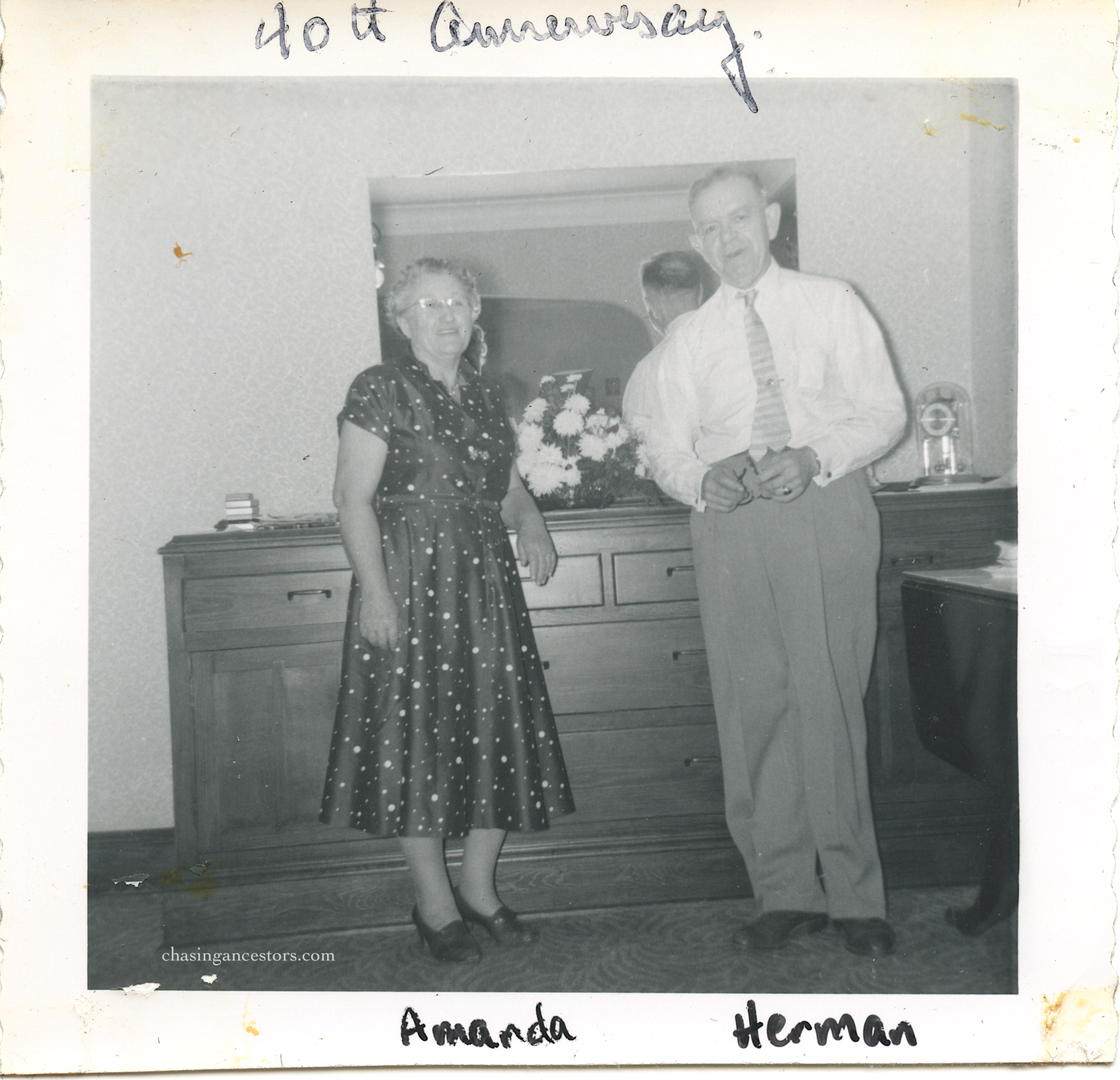
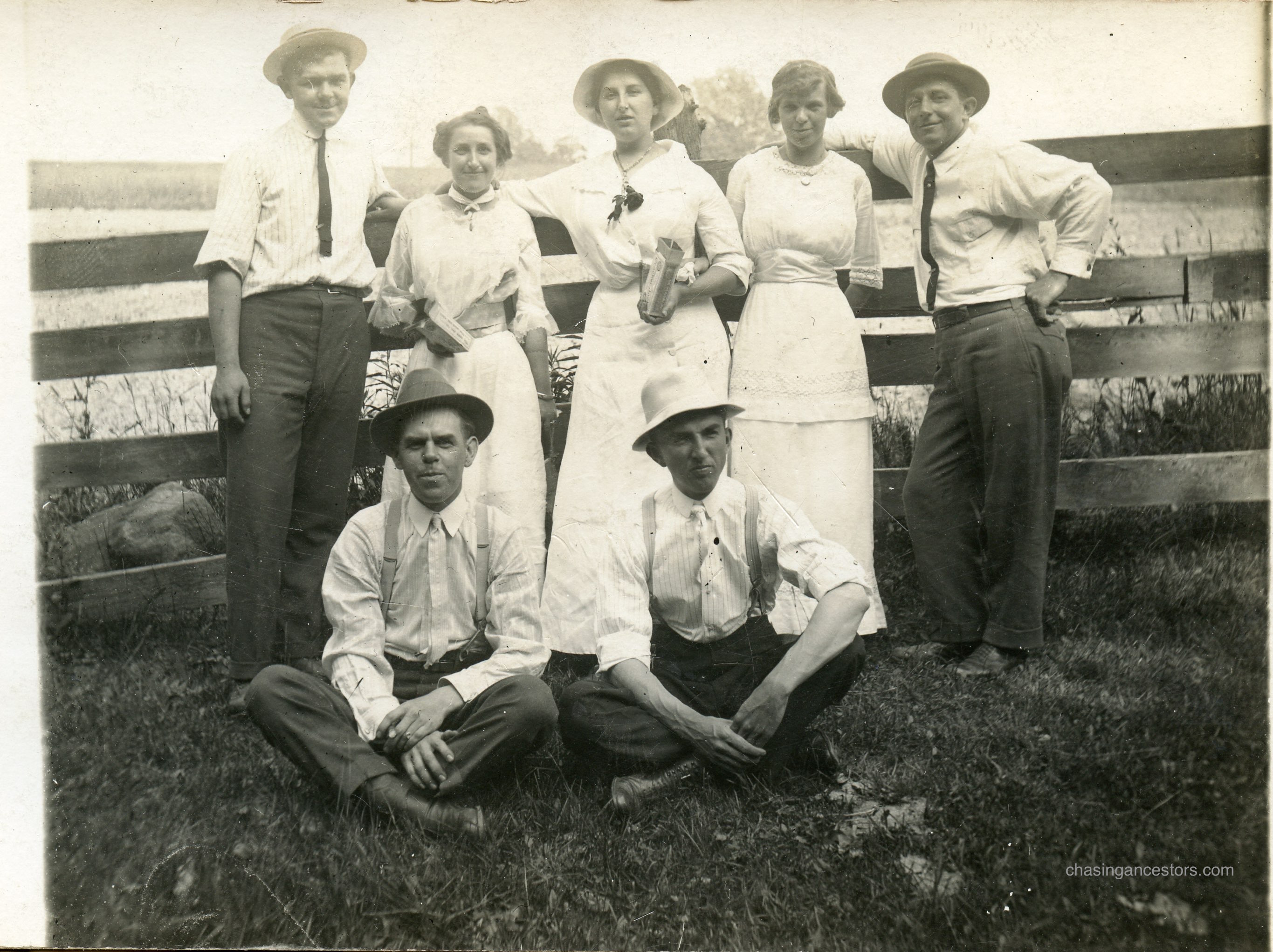
But I got to thinking about a picture in my collection of my Great Grandfather, Herman Beiersdorf (1895-1983).

Herman is the one in the center who seems to be dressed a little too formally to go fishing. The picture was taken sometime after he was married in 1916 as he is wearing a wedding ring. 
I don’t know who the other two men are, but I wonder if the one on the right is his brother, August C. (1884-1974).

Herman is holding basic fishing gear—bamboo poles. No reels or bobbers. Just a pole, line and hook. I wonder what they used for bait? I expect they fished in the Sheboygan river. Looks like they managed to catch a good “mess of fish.” And I bet that was dinner for the day. 

I wouldn’t be surprised to learn that they went fishing frequently. I hope they had fun. 

©MJM 2025

The Choir

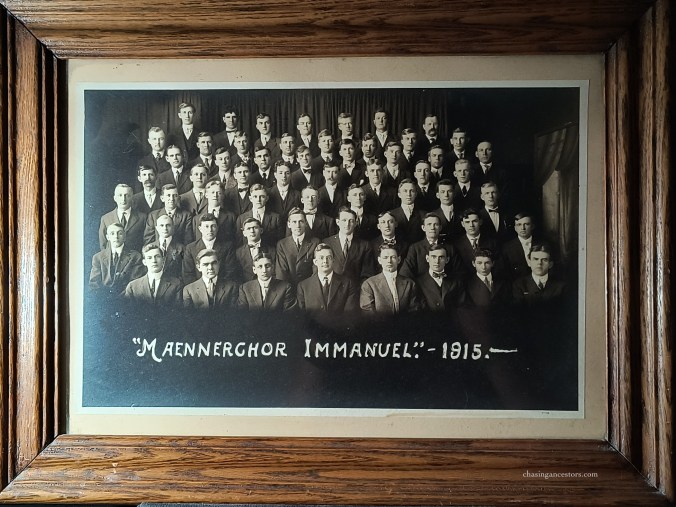
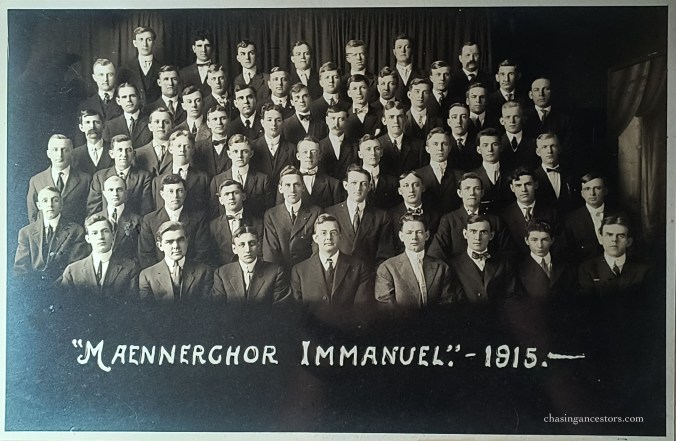
One of the treasures I have from my Maternal side of the family is a group photograph labeled “Maennerchor Immanuel—1915.” This photo hangs in my living room. I always wondered what the story was behind it.

One thing I did know was that my Great Grandfather, Herman Beiersdorf (1895-1983) was in the photo. Looking closer, I also found his older brothers, Fred (1882-1963) and August (1884-1974) in the group. Herman is on the bottom row, 2nd from left. August is on the same row, far right. Fred is on the fifth row, far left.

But what was the group that the three brothers were a part of? I recognized the name “Immanuel” as the church the Beiersdorf family attended in Sheboygan, WI. The word “Maennerchor” translated to “men’s choir.” So the brothers were part of the Immanuel Lutheran Church men’s choir. 

I wanted more information about the choir, and I was hoping to find a list of all of the men in the picture, so I contacted Immanuel Lutheran Church in Sheboygan, WI. I was put in touch with a woman who keeps the archives for the church and she sent me a wealth of information about the Maennerchor. 

From the church’s 25th anniversary booklet (translated from German): “This choral society was founded on November 27, 1911. The purpose of the men’s choir is to cultivate spiritual and secular singing and to promote close cooperation within the community.” In essence, it was a men’s club focused on singing and fellowship. Choir rehearsals were held at 8 p.m. in order for members to have “time to work in their gardens.” They had to pay an entrance fee of $1.00 and monthly dues of 15¢. Fifty men were part of the original choir. The choir sang during the church services and community events. They joined an association of male choirs of Lutheran churches in Wisconsin and participated in many Saengerfests or “singing festivals” through this organization. During the flu epidemic in 1918, choir members sang at funerals, giving solace to families who had lost loved ones during that terrible time. Another reference from the church indicated that the Men’s choir would join with the Mixed choir and the church band for a special Christmas concert for the children of the Immanuel Lutheran school & would give special gift bags to the children. 

I also received the full list of members in the photograph:

Seventh Row: Emil Klewin, Herman Erdmann, Herman Bendler, William Guether, Erwin Nack, Emil Marquardt, Ernst Oberheu

Sixth Row: Hugo Kaems, Paul Mahnke, Charles Grimmer, Elmer Doege, Arthur Kaems, William Schild, Herman Wesener, Robert Perl

Fifth Row: Fred Beiersdorf, August Lutze, Fred Schoening, Nels Nelson, Otto Marquardt, Louis Falk, Frank Becker, Barney Schneidewind

Fourth Row: Albert Falk, William Daehnert, Ernst Leikip, Fred Schoen, William Steffen, Sr., Herman Kohls, Herman Daehnert, Edgar Reinholz

Third Row: Gustave Littman, Charles Pantel, Albert Nack, Carl Bendler, Oswald Wolfgram, Charles Lutze, Otto Daehnert, Richard Klatt, William Busse

Second Row: Hugo Overbeck, George Gauger, Henry Zinkann, Erich Gauger, Theodore Burger, E.W. Fremder, Director, Oscar Uttech, Carl Vorphal, John Stengel, Adolph Littman

First Row (Bottom): Alfred Kowert, Herman Beiersdorf, William Zamzow, Rev. Theo. Laetsch, Sr., William Kolbe, Valentine Drews, Emil Erdman, August Beiersdorf

This confirmed that I was correct in the identification of the Beiersdorf brothers in the photo. But I also saw some other familiar family names on the list. William Kolbe could be a cousin to the Beiersdorfs—son of Herman & Minnie Juergen Kolb. And perhaps there is a typo in the list—4th row, Herman Kolbs—is this actually Herman Kolbe? If so, this would be the brother of William. Brothers Carl Bendler and Herman Bendler were brothers-in-law of August Beiersdorf—brothers of Helen Bendler Beiersdorf (1888-1962). 

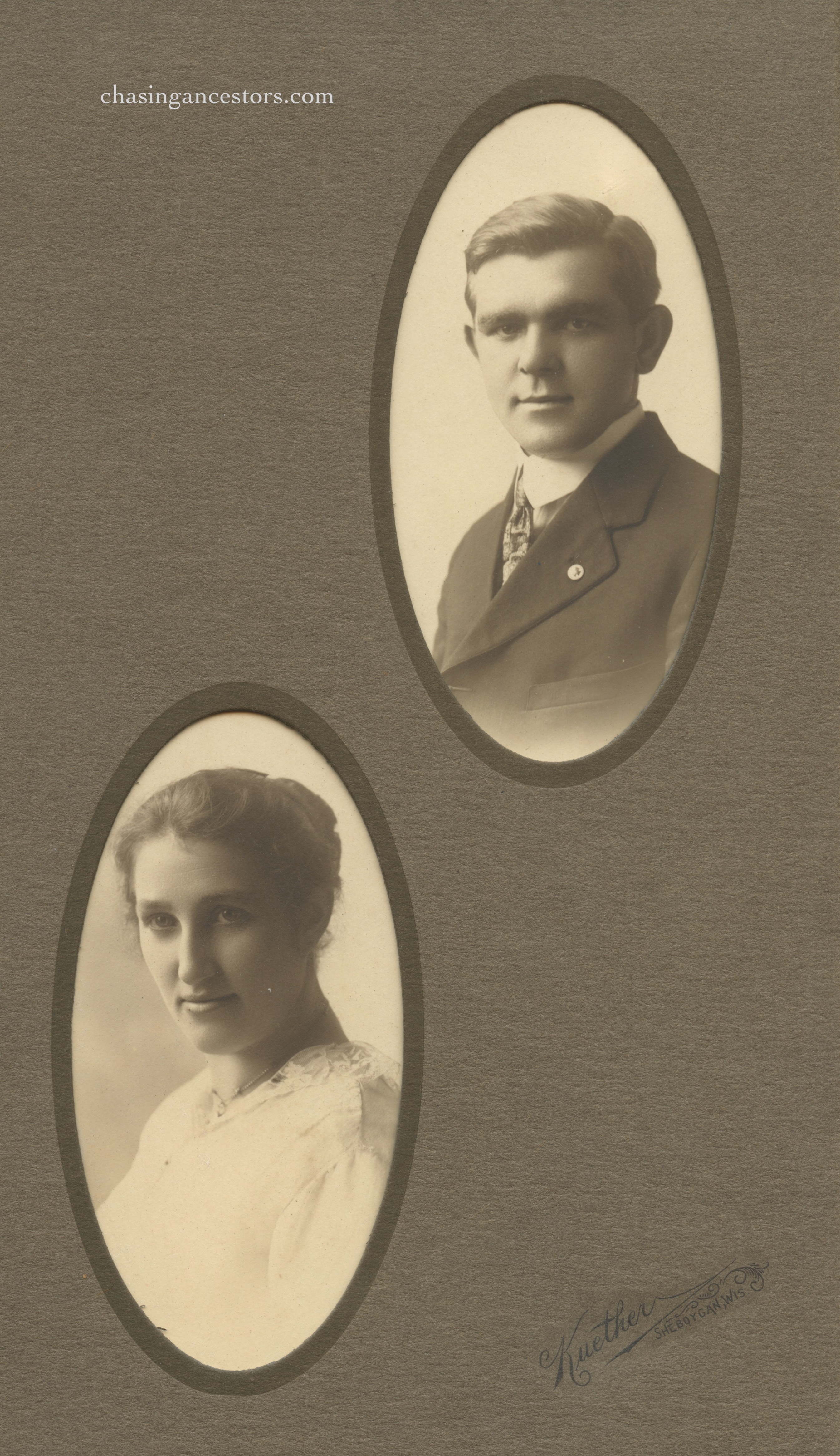
Regarding the Beiersdorf brothers tenure in the choir: Herman sang Second Tenor and was in the choir from 1913 to 1917. He married Amanda Steinhaus (1894-1973) in 1916 and started attending her family church, Bethlehem Lutheran after that. Fred sang First Bass and was in the choir from 1915 to 1923. August sang Second Bass and was a part of the choir from 1915 to 1926. 

Of course I still wanted to find out more about the choir. As I usually do when I’m looking for a story, I went to Newspapers.com and searched for any information about the choir, particularly in the Sheboygan Press. I found an article from April 9, 1915 announcing a concert on April 11 with the Philharmonic Orchestra. 

Then in November, there was another announcement for a concert with the Philharmonic Orchestra to be held November 21 at the “new” Bethlehem (Lutheran) Church hall. The announcement included the exact same photograph of the choir that I had! The group was to sing two numbers with the orchestra and there would also be “several amusing selections, such as solos trios & dialogues.” On Saturday, November 20, there was a notice that the concert had sold out so they would repeat the program again on Monday the 22nd. I guess the choir was a hit.

There were several more articles and announcements in the Sheboygan Press about choir programs through the years. There were also mentions of the choir participating in “Saengerfests.” The official translation of Saengerfest is “singer festival.” In essence, choirs would come together for a day of singing, with competitions and parades & picnics.

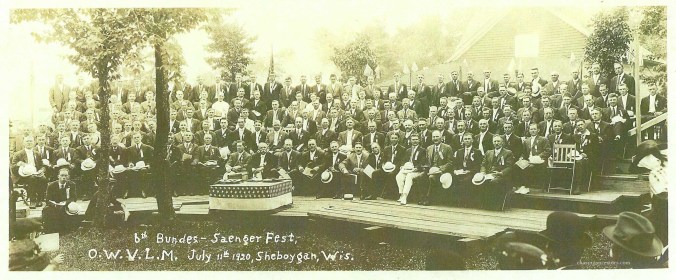
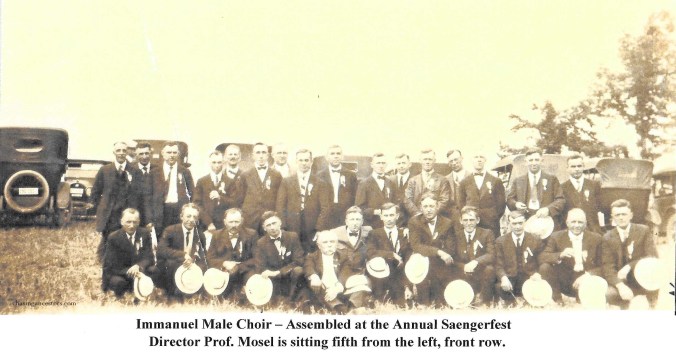
I had also received from the Immanual Lutheran Church archives two pictures referencing the July 11, 1920 Saengerfest of the O.W.V.L.M. (Ost-Wisconsin Verband Lutherische Maennerchore) or Eastern Wisconsin Association of Lutheran Men’s Choirs. The festival was held at Sheboygan, WI.

According to an article in the Sheboygan Press on July 6, 1920, a chartered special excursion train would bring “500 singers & guests from Two Rivers, Maintowoc and Newton” on the morning of the festival. The choirs and bands from Sheboygan would meet the train at the depot. There would then be a parade from the depot to the Immanual hall on S Seventeenth Street and Illinois Avenue. The mass choir of over 200 voices would rehearse before marching to the Lake Front Shooting park for the festival. A stage was constructed just for this event. They expected “several thousand people” to attend and were prepared to serve meals to everyone.

The program for the festival was also published in German in the article from July 6. The first part would start at 10:30a.m. with a worship service with community singing, Scripture reading, a selection by the mass choir, a sermon given by Pastor Theo Laetsch, a special collection for missions, and prayer and blessing. The second part of the festival would start at 2:00p.m. with a singer’s march, a welcoming speech from Sheboygan’s mayor, Herman Albrecht, and songs by the different choirs as well as the mass choir. The last musical number was to be a medley of “The Best-Loved Southern Melodies” which seemed out of place with all of the German music listed in the program. 

Being a part of the Association of Men’s choirs gave the choir the opportunity to sing at many  venues and events.The choir continued to participate in several more Saengerfests through the years. The Immanuel Choir is said to have manned the “Beer stand” at the festivals—this was their means of raising money. 

An article in the Sheboygan Press from November 23, 1946 announced the 35th anniversary celebration for the choir. At that time the choir consisted of 16 men with two members of the original choir still singing, Albert Nack & Louis Falk. The choir would sing at both the German and English worship services on November 24. The 16 men in the choir would be joined by 10 former members for that day. 

Due to declining membership, the choir was disbanded on November 9, 1982. The organization had served the congregation and community well for 71 years. From what I gather, the choir was more than just a “church choir,” it was an organization that celebrated good music performances & good fellowship for the men involved. 

©2025 MJM

1930’s Snow Days

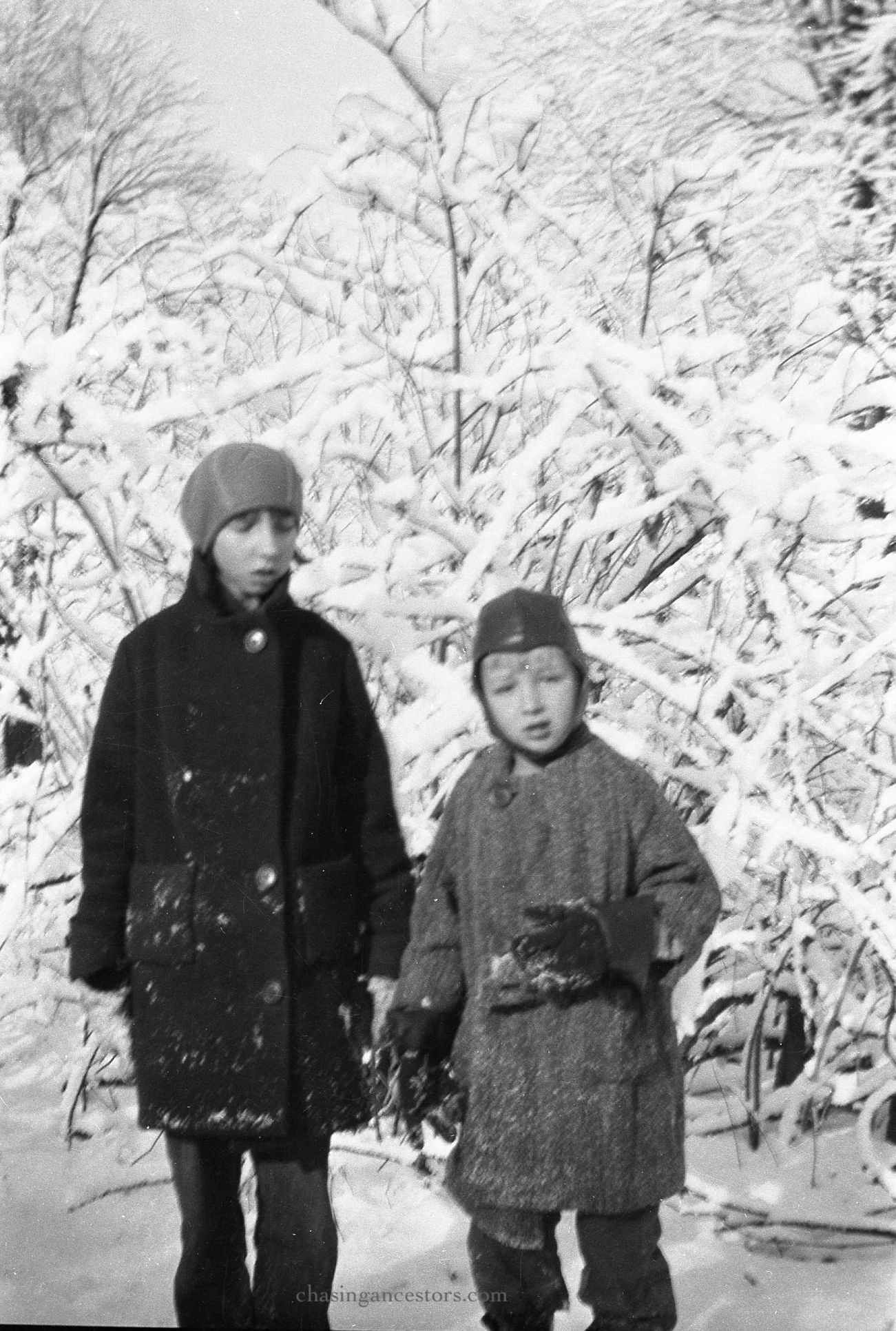
With the recent winter storms affecting the country, I got to thinking about some pictures taken of my ancestors after snow storms. I think these pictures date to sometime in the 1930’s.

First, pictures of the relatives from Indiana:

Millikan166nBetAClark copy

This is sister and brother, Betty Lou (1921-1990) and Arza Clark (1925-1975) Millikan, probably taken on or near their farm in Sheridan, IN. Looks like they may have enjoyed playing in the snow.

Then their older siblings, Miriam Frances (1918-2018) and Margaret Pauline (1917-2007) Millikan checked out the mound of snow left by the plows. Margaret was my paternal Grandmother.

Millikan101nFranMargsnow copy

Finally, a picture from Wisconsin:

LucilleSnow1 copy

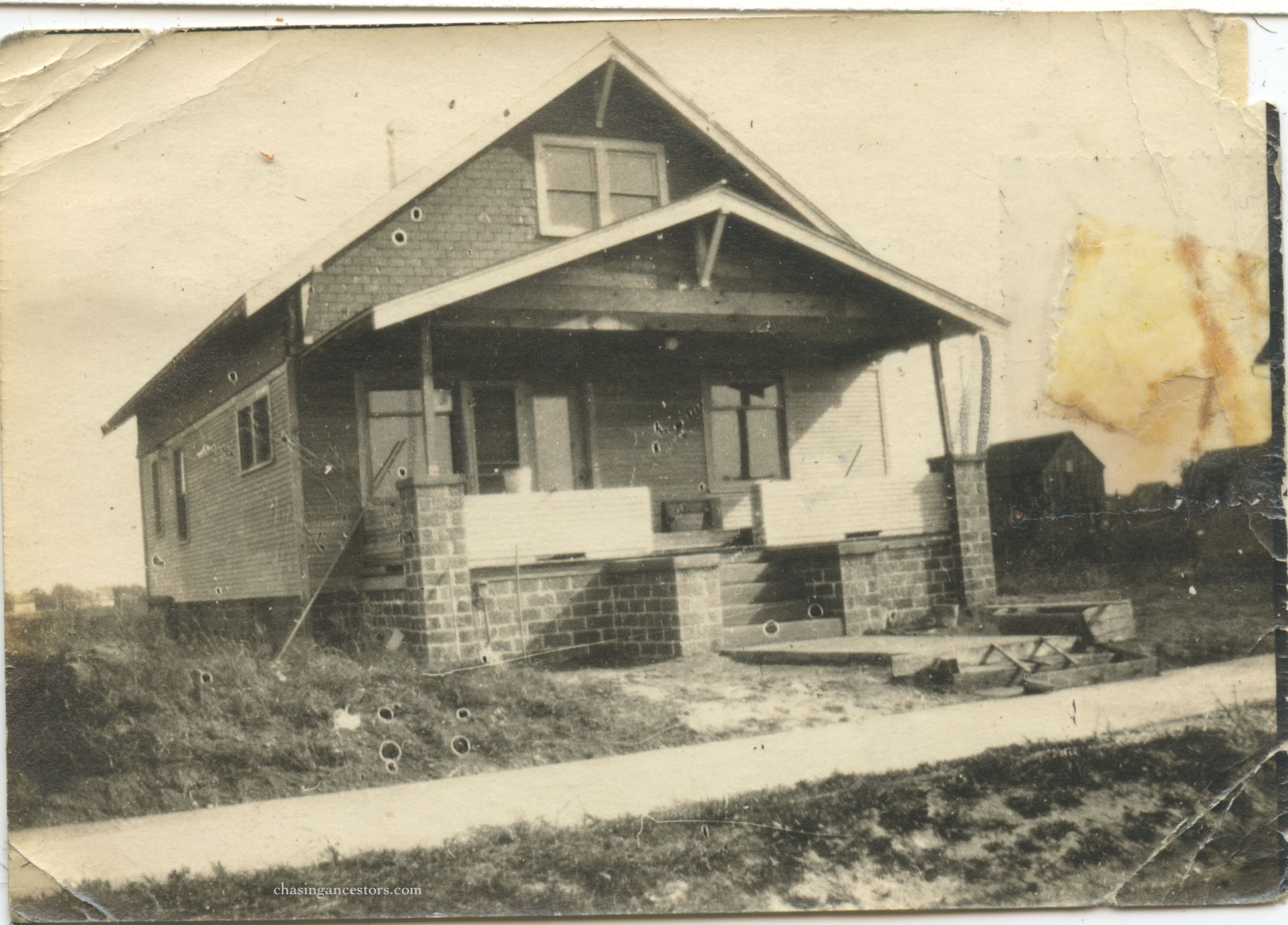
This is my maternal Grandmother, Lucille Beiersdorf (1920-2011) pictured in front of her home at 2211 South 14thStreet, Sheboygan, WI. Looks like the plows did a good job of piling up the snow!

So I guess taking pictures in the snow seems to have been just as popular in the past as it is now. Glad to have these memories to share.

Happy New Year!

© MJM 2022

Turtle Soup

I was going through and scanning the many piles of photographs from my maternal side of the family and came across this picture:

1300groupmenturtlehunt copy

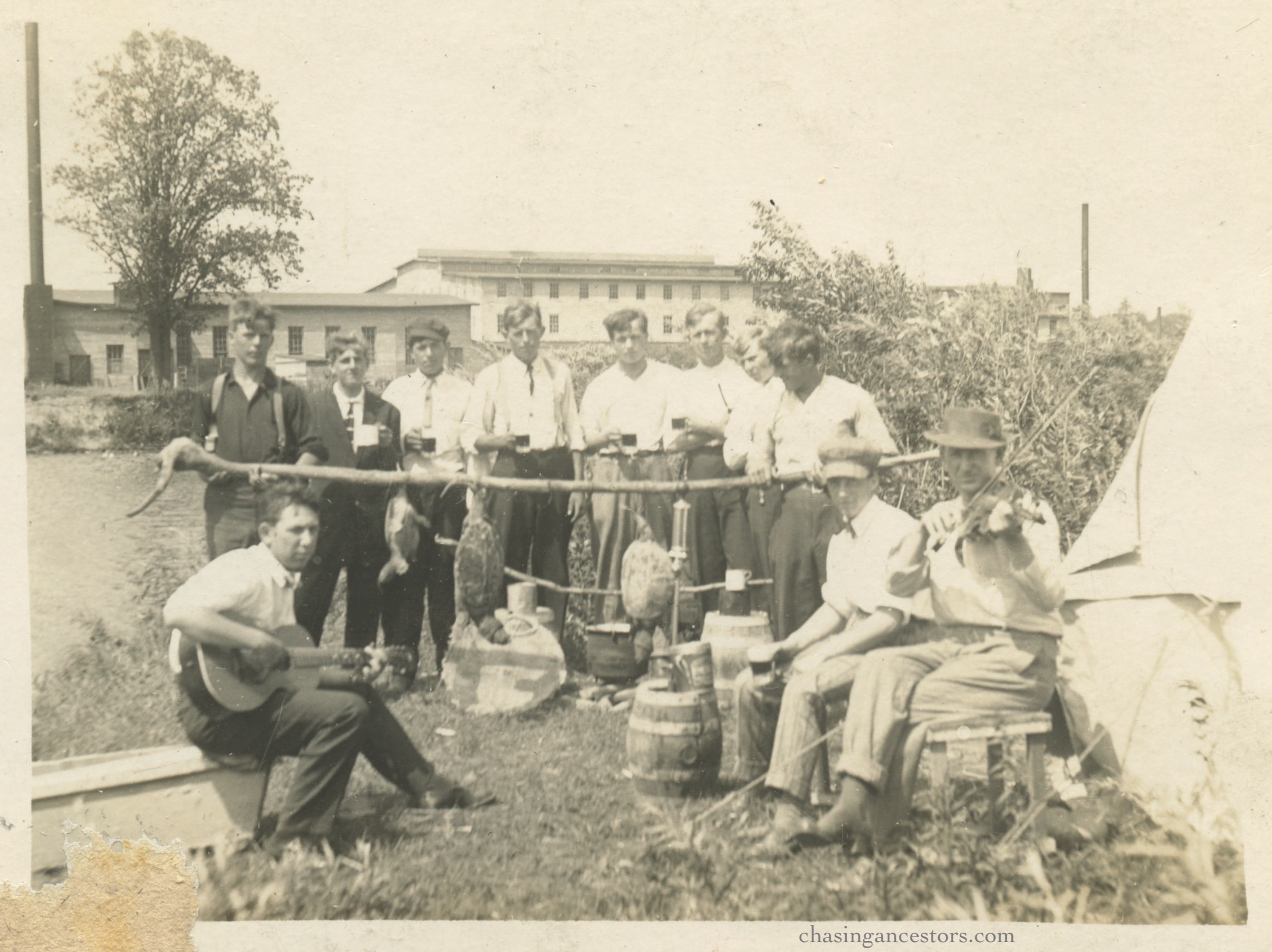
At first I couldn’t quite figure out what was going on in the scene. Taking a closer look, I see that the men are standing at the bank of a river and the one on the left with the guitar is sitting on a boat. Looks like there is a tent on the right side of the frame. Then, looking even closer, I noticed that there were three turtles hanging from the cross bar.

turtlecloseup

And there is what looks like a cooking pot sitting on logs behind the turtle on the right.

So what is this all about? Did people really catch turtles? Were they going to make turtle soup?

First, to set the location. Most of my maternal ancestors lived in Sheboygan, WI. The Sheboygan River runs through the city. I figured I would try to find out if there were any newspaper articles about catching turtles in Sheboygan.

Using Newspapers.com, I found that indeed, people did catch turtles in the Sheboygan River. There were a few references in the Sheboygan Press. A notice from July 9, 1909 stated that turtle season was now open & some large turtles had been caught “up stream.” It stated that “young men enjoy fishing” for the turtles & “Mr. Kempf has purchased 4 large ones which he will serve to his trade on Saturday night.” The next year, on April 22, 1910, there was an advertisement from Kempf’s that said a “Big Turtle Caught. Come and have the first Turtle soup of the Season at Kempf’s.” Another article in 1910 tells of some “turtle fishers” catching a 37 pound turtle in the Sheboygan river. In November 1921, instead of fishing, they were shooting mud turtles off the branches of trees.

There was another article in November of 1947 telling of a man who caught turtles and sold them to customers in New York. He said that snapping turtles would eat the fish in the streams and clearing out the turtles from the streams would improve the trout fishing. Instead of fishing for turtles, he would wade into the shallows and when a turtle was disturbed, he would “clamp a booted foot down on the turtle’s back, hook the prongs of his steel rod under the snapper’s back and lift it up to see which end is which.” Once the hunter determines which is the tail end, he grabs the turtle by the hind leg or tail to pick it up to put in the sack. He seemed to have a lucrative business, selling thousands of pounds of turtles a year.

The Milwaukee Public Library Digital Collection Historic Recipe File includes a recipe for Turtle Soup that was published in the Milwaukee Journal on April 4, 1964. The ingredients for this version of Turtle Soup were peas, carrots, celery, onion, barley, tomato pulp, egg dumplings. The seasoning for the soup included garlic, parsley, bayleaf, salt, pepper and sherry. Cooked turtle meat was added to these ingredients to make the soup. The recipe also includes quite detailed instructions for preparing & cooking turtle. Snapping turtles were the preferred variety over mud turtles which were considered too small. Preparing the turtle seemed like a labor-intensive process.

beerkegcloseup

So, back to the picture. It doesn’t look like these young men had been wading in the water to make their catch. My guess is they used the boat and baited hook and line to catch the snapping turtles.

Looks like they were having a good day of it. Also noted in the picture, almost every one of them is holding a glass of beer. The beer keg is in the foreground of the picture. So I expect they were celebrating a good catch and looking forward to a good meal & a good time with their buddies.

Unfortunately, there was no information with the picture so I cannot identify any of the young men. If they are related to me, they are either of the Chvarack, Beiersdorf or Steinhaus lines. Maybe someday I’ll be able to figure out who they are.

I hope they enjoyed their turtle soup.

©MJM 2022


A Christmas Tradition

In 2008 I sat down and interviewed my maternal Grandmother, Lucille Beiersdorf Chvarack Ash (1920-2011). We talked for over two hours. I asked her what she remembered about all of her relatives—grandparents, aunts, uncles, cousins, her husband, John Chvarack (1916-1967) & his family. Since I hadn’t known any of the folks we talked about, I learned a lot that day. At the end of the interview, she turned the tables and interviewed me. We had a good talk.

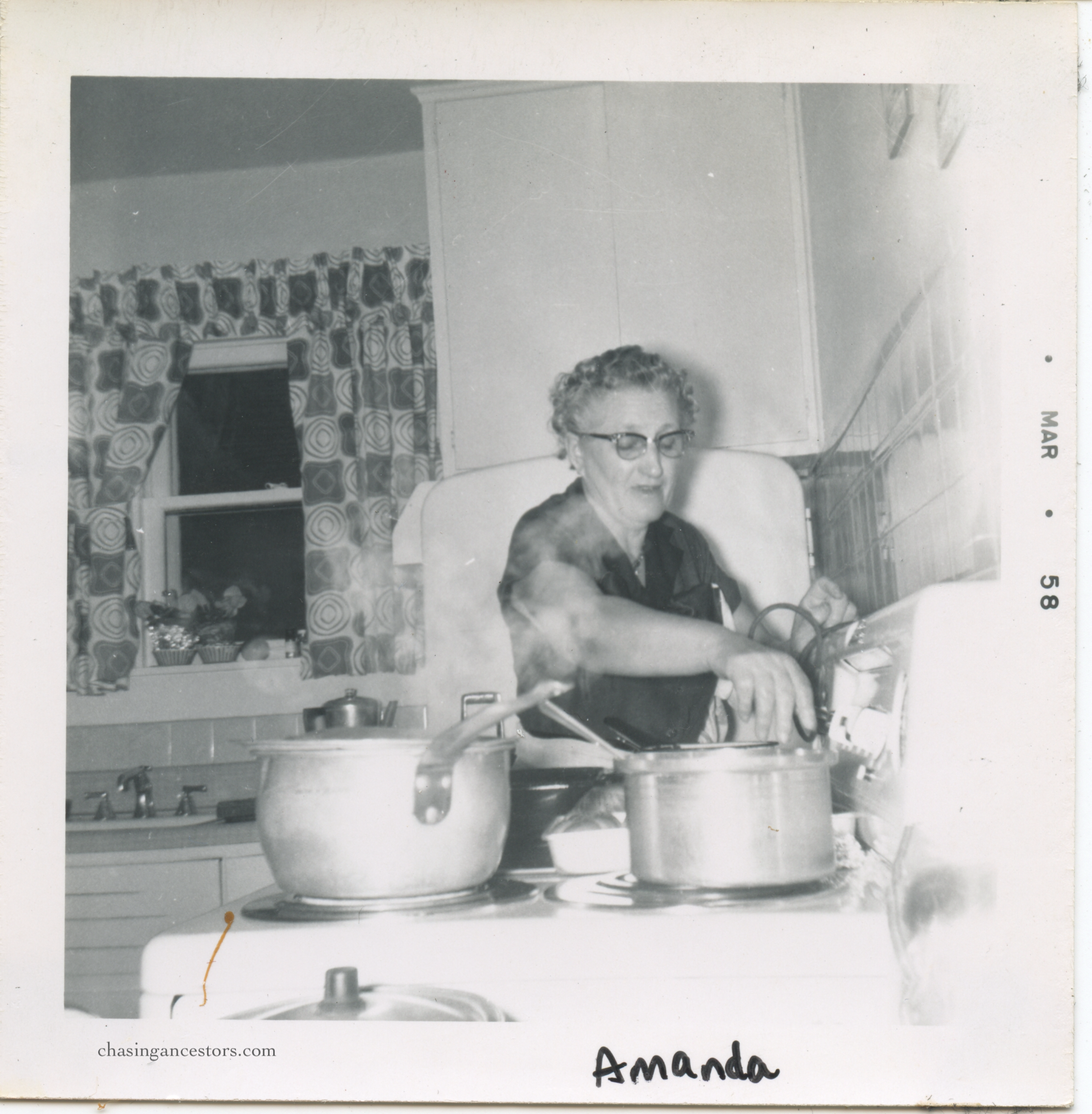
Lucille grew up in Sheboygan, Wisconsin. She was the only child of Herman (1895-1983) and Amanda (1894-1973) Steinhaus Beiersdorf. Both of her parents had several siblings who resided in Sheboygan. One of the stories Grandma told me was of the family’s Christmas Eve tradition.

Our entertainment was different than now & like on 13th Street—Christmas and so. We’d start at my Grandma’s, we went to church, came from church—we’d start at my Grandma Steinhaus’ & they would have some candy or little things, not big gifts, but little things, have a Christmas tree & we’d sit around. Then we’d go over there about a block to Ray and Olga’s & their 2 children & we would sit there for about a half hour or so & then we’d go over to my Aunt Ella & Uncle Walter’s & we would do something there–see their Christmas things & they had a piano so they would play a little bit once in a while & from there we went up about a block to visit another aunt and uncle, Martha & Gustav & that was Janet Steinhaus & Don & Kenneth & there we would do the same & we had one more aunt & Uncle Paul & that would be at the last stop–then they would come over to our house–from 13th street over so that was about, oh, maybe 8 blocks or so–they would come over there & then we would all have something– & have–oh coffee & drinks–I think the men had drinks, or had one drink–we would get coffee and then have some refreshments & Mother would always have cookies & cake & that was on Christmas Eve.

Essentially, the Christmas Eve tradition was to attend church services & then visit the homes of each Steinhaus family member in the immediate area “on 13th Street.” 

First, a look at the Steinhaus family:

  • Otto Steinhaus (1869-1954) married Emilie Binder (1867-1940). Their children were:
  • Walter (1891-1962)
  • *Ella (1892-1953) married Walter Axel (1893-1945)
  • *Martha (1893-1934) married Gustav Becker
  • *Amanda (1894-1973) married Herman Beiersdorf (1895-1983)
  • William (1896-1963)
  • Clara (1897-1974) married Rudolph Voigt (1897-1968)
  • *Paul H. (1900-1972) 
  • *Olga (1907-1981) married Ray Steinbruecker (1906-1980)
  • Edwin (1909-1955)

Unfortunately, I don’t think I have any pictures of these gatherings. I do have a picture of some of the Steinhaus siblings mentioned in Grandma’s interview:

Steinhaus family
  • Left to Right, Back Row: Walter Axel, Gust Becker, Herman Beiersdorf, Rudy Voigt, Emilie Steinhaus.
  • Left to Right, seated: Ella Axel, Amanda Beiersdorf, Clara Voigt, Martha Becker & Kenneth
  • Left to Right, children in front: Edwin Steinhaus, Allen Steinhaus, Olga Steinhaus. 

The picture was probably taken in late 1917 or 1918.

Now, to follow the path of the Christmas Eve gathering. Through US Census records and Sheboygan City Directories from the 1930’s, I was able to figure out the addresses of all of the homes mentioned. Each family owned their home. I wonder, if like my Great-grandparents, some were the original owners?

Bethlehem Lutheran Church

1 They started at church. This was Bethlehem Lutheran Church (1121 Georgia Avenue). It was the home church for most of the Steinhaus family. Newspaper articles in the 1930s indicate that there was usually a service at 7pm on Christmas Eve. This was the service that included the Christmas program from the Bethlehem Lutheran School that was attached to the church. While Lucille did not attend this school, I think some of her cousins did. So perhaps through the years, the family would start with watching some of their children in the program. 

2 From the church, they would all head to “Grandma Steinhaus’” home. This would be the home of Otto and Emilie Steinhaus (1437 South 13th St.) In 1930, their youngest son, Edwin, age 21 was still living with them. There they would have “some candy or little things, not big gifts, but little things…”

3 Next, they would go to “Aunt Olga & Ray’s”–Olga & Ray Steinbruecker (1524 South 13th St.). They would stay for about half an hour. 

4 Then on to the next aunt & uncle: Ella and Walter Axel (1617 South 13th St.) Grandma said that they had a piano, so I bet there would be some good music and singing at their place. 

5 Next was the home of Gustav and Martha Becker (1708 South 13th St.). 

6 Then to Paul and Anna Steinhaus’ place (1847 South 13th St.).

7 Finally, they would reach the last stop, Herman & Amanda Beiersdorf’s home (2211 South 14th St.) Refreshments would be served, and after visiting for a while, everyone would return to their own homes. According to Lucille, this migration would take until about midnight, then she and her parents would open their presents. 

All in all, the trip from the church to South 14th St. was about a mile. Sounds like the families would gather every year for the same routine. I wonder if each family had it’s own specialty when it came to refreshments? I also bet they all enjoyed the festivities and decorations at each house. Eventually, more children were added to the families & I’m sure the cousins would compare Christmas wish lists and try to figure out the presents under the trees. Then the grandchildren would come along as the routine continued. With all of them living in such close proximity, it is a sure bet that the families were interacting frequently. My Great-grandparents lived in the house on South 14th St. until Amanda’s death in 1973. I think many of the siblings stayed in their homes most of their lives. So the tradition ended with the passing of the elders. 

I asked my Grandmother if they then slept most of Christmas, since they had such a big night on Christmas Eve. Her response was “No, we’d get up on Christmas & we’d go to church & then for dinner we would go to Grandma Beiersdorf’s…” They would visit with the Beiersdorf siblings at the home of Augusta Beiersdorf (1868-1955). But at least everyone would come to one location, instead of traveling from house to house. As Grandma said, “the house would be full.”

One more thing I forgot to mention. Wisconsin weather in the Winter can be quite harsh. These two pictures of Lucille show some of the snowfall they had. I expect the transit from house to house might have been a little treacherous at times. 

So in this year when it is recommended not to visit family due to the pandemic, I thought it nice to remember another time when Christmas family traditions meant visiting house to house to enjoy each other’s company and the togetherness of family. 

Merry Christmas!

© MJM 2020

100 Years Ago Today…

… a baby girl was born!

That baby girl was my Grandmother, Lucille Marie Beiersdorf. She was born to Herman Beiersdorf (1895-1983) and Amanda (Steinhaus) Beiersdorf (1894-1973) in Port Washington, Wisconsin. Herman was working in Port Washington as a foreman when Lucille was born. However, they soon returned to Sheboygan, Wisconsin, where she would grow up. 

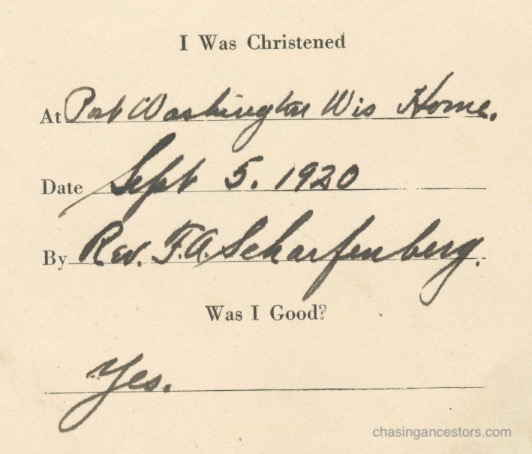
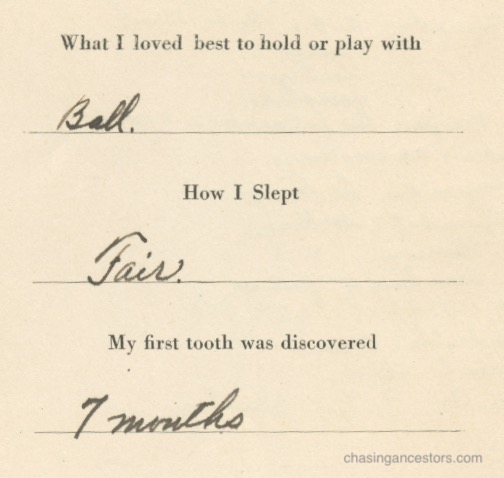
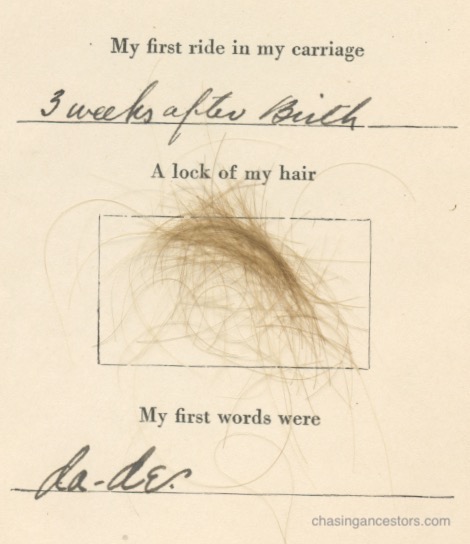
I have Lucille’s Baby Book, titled “All About Me” and it gives the vital information regarding her birth and routine during her first year:

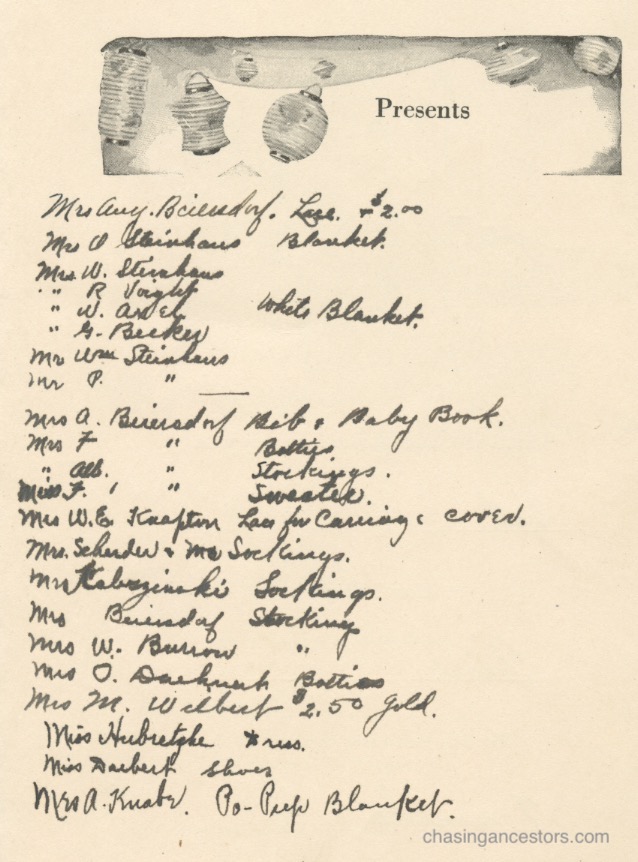
Most of the people who gave her gifts were relatives. Looks like she got several pairs of booties and stockings.

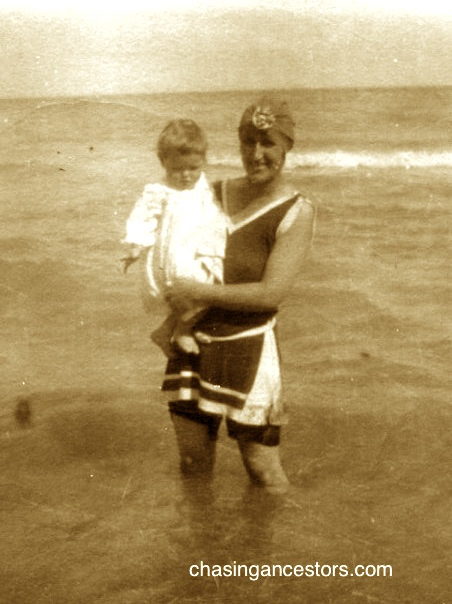
She took early outings to the shore with her parents.

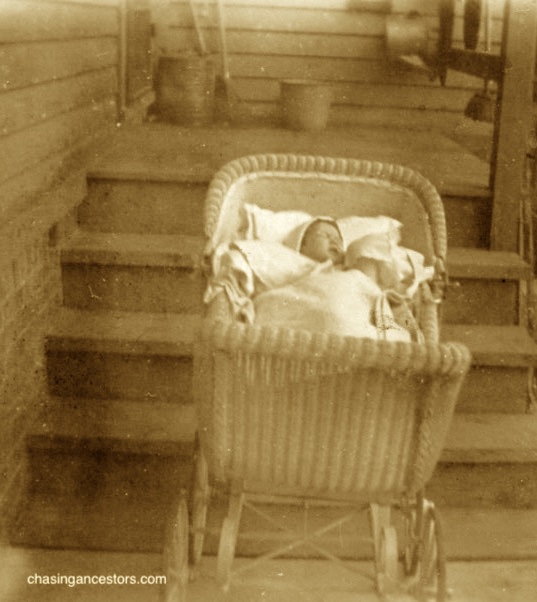
She had her own little dolly and baby carriage to play with as a toddler.

So what happened to this baby? She was an only child and grew up in Sheboygan with her parents. Both the Beiersdorf and Steinhaus families lived in Sheboygan, so she had many cousins to hang out with. She travelled twice to Germany with her husband, John Chvarack (1916-1967) and 2 daughters while John was in the US Army. She ended up in Salinas, California after returning to the USA in the 1960s and when John died, she stayed in California. She celebrated her 90thbirthday with 3 parties in 2010. She died in 2011, having lived a full life. I expect there may be more stories to tell about Lucille.

© MJM 2020

Veterans of the Great War

The 11th Hour of the 11th Month, 1918. The time when all fighting would cease in France after the Armistice had been signed that morning. The end to the Great War. That was 100 years ago.

So I figured I would dig through my family history information and honor those ancestors who served during that war.

I already mentioned Fred McKinley (1890-1972), Brooklyn, IN; my Dad’s Great-Uncle on his Paternal side. He served in the US Army from April 27, 1918 to November 1, 1918.

Fred’s cousin, Frank B. Crider (1896-1978), Morgan County, IN. Served in the US Army from July 22, 1918 to January 16, 1919.

Then there was Chester Emmett Boone (1892-1954), Connersville, IN; my Dad’s Great-Uncle on his Maternal side. He served with the US Army 309th Supply Company, Quartermaster Corps, Private, #778964. He departed from Newport News, VA June 6 1918. He left Brest, France June 29, 1919. Arrived July 8, 1919 at Hoboken, NJ, listed as a Private 1st Class.

Chester’s cousin, William Hobart Boone (1896-1991), also served in the US Army. The only information I have about his service is that he served in 1918.

On Mom’s side of the family—they were first generation citizens at the time of the War. I wonder how they felt heading off to Europe to fight against what might have been their own relatives.

First, the brother of my Great Grandmother, Amanda Steinhaus Beiersdorf (1894-1973):

William Steinhaus (1896-1963) from Sheboygan, WI. Served as a Private in the US Army M D, Private, #2822606. Departed from Brooklyn, NY to Europe Sept 17, 1918 with Ambulance Company 342-311. Listed on roster of sick or wounded in Hospital in Bordeaux France 11/16/18 w/ Left Inguinal Hernia.

William’s father, Otto Steinhaus (1869-1954) had two cousins who also served:

Paul Richard Steinhaus (1892-1964), Sheboygan, WI, US Army, Private, #2822617. Departed from New York, NY to Europe Sept 9, 1918 with the 86th Div, 171st Infantry Brigade, Company D, 342nd Infantry. He left Brest, France on June 12, 1919. Arrived in Hoboken, NJ June 20, 1919. He is listed as part of the US Army Machine Gun Company, 55th Infantry.

Herbert August Steinhaus (1895-1957), Plymouth, WI, served with the US Army Field Remount Squadron #318, #2831867. He departed from Newport News, VA on Aug 14, 1918, listed as Acting Corporal. He left Brest, France on June 23, 1919. Arrived Boston, MA July 5, 1919, listed as a Private 1st Class.

Who would have thought when these men came home from their service, that their sons would once again take up arms in another war in Europe.

So, remembering just a few named veterans from my family tree who served during the Great War 100 years ago. I also thank the other veterans who served our country in other times of war and conflict

© MJM 2018

Mother & Daughter Silhouettes

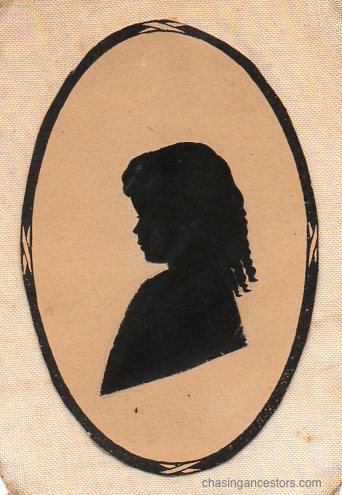
For Mother’s Day I figured I would share two silhouettes that are part of my collection. They came from my Grandmother, Lucille (Beiersdorf) Chvarack Ash (1920-2011).

Silhouettes used to be quite popular before photography became affordable. After that they were more of a novelty.

First, we have my Grandmother, Lucille’s silhouette. Don’t know when it was done, but I guess she was a few years old.

LBeiersdorfSilhouette

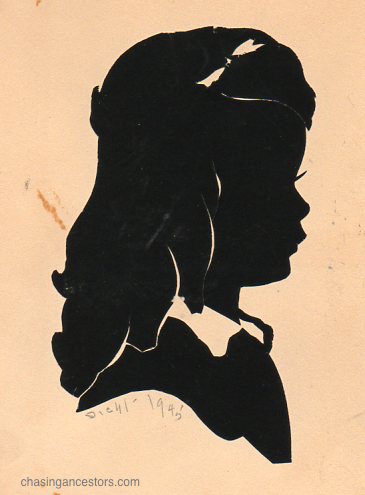
Next, the silhouette of her daughter, my Mother. It was done in 1945. She was a few years old then. So I guess the two were done about 20 years apart.

JChvarackSilhouette

Mom’s has a few more details cut into it. But I notice both girls had quite curly hair. Can’t say I inherited that trait.

Happy Mother’s Day!

© MJM 2017

Enjoying a Beautiful Day

This is one of my favorite pictures in my collection:

BeiersdorfGroup

Back Row: Herman Beiersdorf, Amanda (Steinhaus) Beiersdorf, Helen (Bendler) Beiersdorf, Marie (Beiersdorf) Knapton, Eldon Knapton
Front Row: August Beiersdorf, Fred Beiersdorf

These folks are all relatives on my Maternal side of the family. They lived in Sheboygan, WI. The outdoor scene shows water in the background, possibly the Sheboygan River, since there is land visible on the other side.

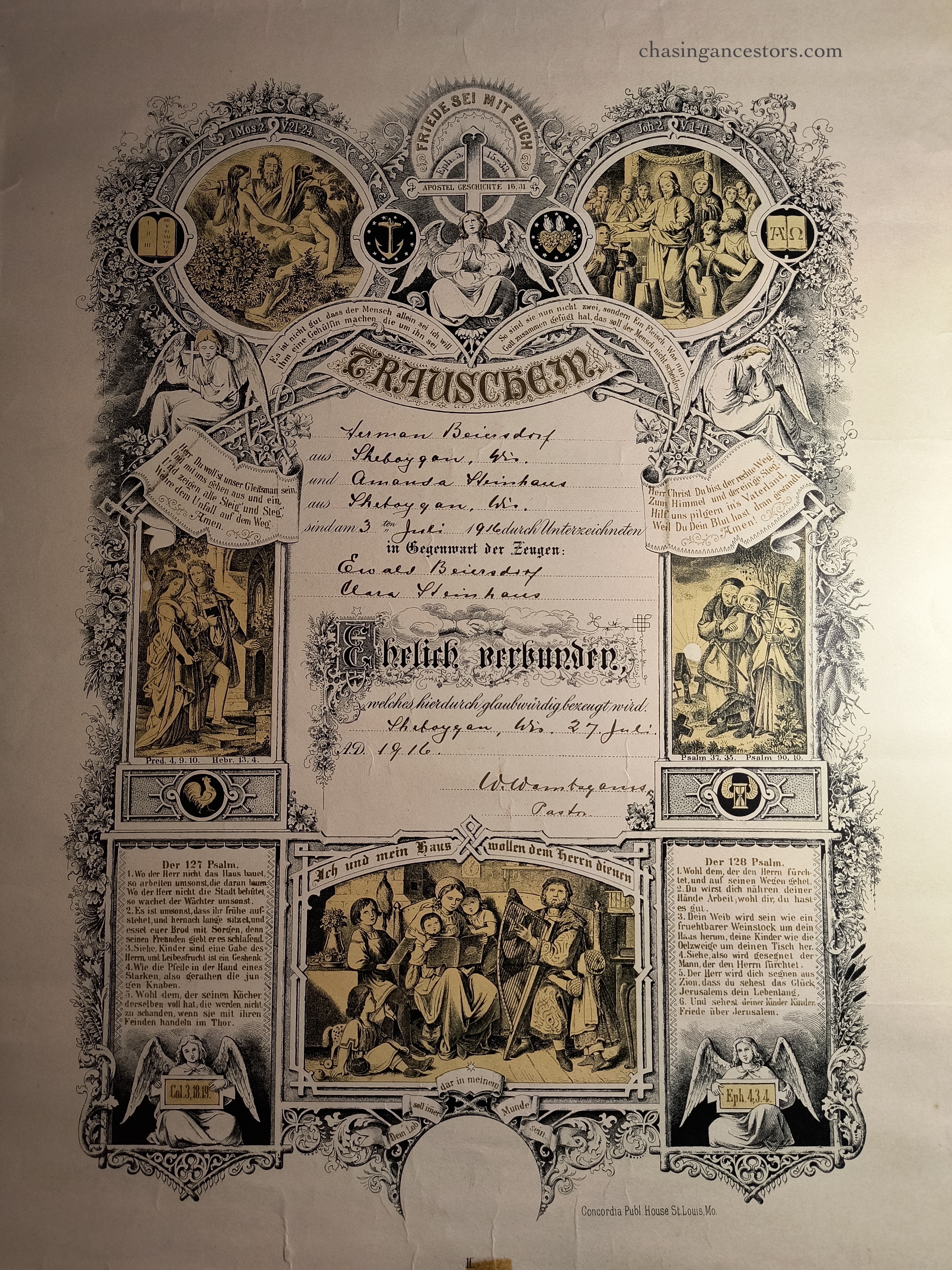
Herman & Amanda were my Great Grandparents. They were married in 1916. August and Helen were married in 1915. Eldon and Marie were married in 1914. Missing from the picture is Fred’s wife, Mary (Duchow). Perhaps she was taking the picture. Looks like all of them are having a good time.

A couple of other things to note in the photo:

crackerjack


Amanda and Helen are holding boxes.

Closer inspection shows that they are holding Cracker Jack boxes. The popular molasses coated popcorn & peanut candy first came out in 1896. This box design is seen in advertisements from around 1918, before the logo included “Sailor Jack” & his dog, “Bingo.”


Also, Amanda is wearing a bracelet.

bracelet


I’m pretty sure that it is a bracelet that I now have. It is a gold-color bracelet with a nice floral design.

bracelet2

bracelet3


On the inner rim are her initials and the date, 1913. This would have been the date of her high school graduation.

What a cool connection to the picture!

So, that’s about it, a nice photo of a group of siblings and their spouses enjoying a day outdoors. I wonder what they did that day. Did they have a picnic? Or did they get together after some event? Maybe for a walk after Sunday dinner? Who knows. But does it really matter? I’m just glad they posed for the picture so that day could be remembered.

© MJM 2017

Mystery Solved!…or is it?

Some of the first information I received from my Maternal Grandmother about her family included August and Augusta Beiersdorf’s family notes. I remember commenting to my Grandmother that the first 3 children in the family were born before August and Augusta got married. I was told that August had been married before, his first wife died and he married Augusta, who was her sister. But I didn’t have all of the pieces of the puzzle, so I couldn’t really put truth to this story.

First, August Beiersdorf (1858-1903) was married to ??? and they had Fred (1882-1963), August C. (1884-1974) and William G. (1887-1942).

Then, August married Augusta (1868-1955) in 1887. They had Gustav (1888-1890), Marie (1890-1973), Albert G. (1892-1977), Herman (1895-1983), Otto (1896 stillborn), Ewald (1898-1971) & Frieda (1900-1974). As mentioned in a previous post, August, Augusta & the older children moved from Germany to Sheboygan, WI in 1889.

So, how do I find out who August’s first wife was? And if she really was Augusta’s sister?

First, I found August’s obituary when I took a trip to Sheboygan. He died in 1903. The obit. was in a German newspaper. Roughly translated, it confirmed that he came from Germany in 1889 and that his wife Auguste’s maiden name was Juergen. It made no mention of a previous wife.

Next, I found Augusta’s obituary in the Sheboygan Press. She died in 1955. Her obit. listed 2 surviving sisters: Mrs. Herman Kolbe & Mrs. Carl Kuehl living in Sheboygan. It also states 2 sisters and a brother died before she did. But it did not indicate her maiden name.

Then, using Newspapers.com I was able to find the obituaries for Mrs. Herman Kolbe & Mrs. Carl Kuehl.

Minnie Kolbe died in 1957. Her obit. indicates her maiden name was Jurgen. It lists one sister, Mrs. Christina Kuehl surviving her, 4 sisters and a brother preceding her in death.

I didn’t find Christine Kuehl, but I did find Ernestine Kuehl’s obituary. Her obit. from the Sheboygan Press in 1961 gives a little more information: Her parents were Gottfried and Christine Juergen & she was preceded in death by a brother & 5 sisters. So, with the last 2 obits, we gained another sister if I count correctly—Augusta, Minnie, and 3 other sisters. (where Augusta’s obit only listed 4 sisters, 2 living and 2 dead) I still don’t know the names of the brother or other sisters. But I did have the names of the parents.

Looking for Christine or Gottfried Juergen’s obits, I was unsuccessful finding Gottfried’s. Christine’s gave me another name: her son-in-law Christ Duckow. Christina died in 1913.

Then on to the search for Christ Duckow (or Duchow): his wife was Louise and she died in 1938. Her obit from the Sheboygan Press, stated she was the daughter of Gottfried Juergen. Her sisters are listed as Mrs. Minnie Kolbe, Mrs. Augusta Beiersdorf, Mrs. Marie Schrader & Mrs. Ernstine Kuehl. Her brother’s name was William Juergen. Now there are 2 more names in the family, Marie and William.

Marie Schrader died in 1954. Her obit. gives the same parents, Gottfried & Christina Jurgen; 3 surviving sisters, Augusta, Ernestina and Minnie; a sister (Louise) and brother (William) preceding her in death.

Next, William Juergen’s obituary from the Sheboygan Press in 1947: confirms the names of the parents and sisters. So no new information.

From all of those obits I have the following information: Gottfried and Christina Juergen were the parents of Louise (1859-1938), Minnie (1864-1957), Augusta (1868-1955), Ernestine (1871-1961), Marie (1874-1954) & William (1874-1947). The family members all settled in the Sheboygan area. However, none of the obits give mention of any other children of Gottfried & Christina.

So I figured I would look at US Census records next. Gottfried and Christina show up on the 1900 Census in Sheboygan, right next to Christ & Louise Duchow and their family.

1900censusclipJuergen

This Census has a line related to how many children a woman had and how many were still living. Christine is listed as having 9 children with 6 living.

Then in the 1910 Census, Christine is living with the Duchow family and is listed as having 9 children with 7 living.

1910censusclipJuergen

Still a little confusing, but it appears that Christina Juergen gave birth to 9 children which is 3 more than I knew about. Could one of them be August Beiersdorf’s first wife?

One last piece of information. When I met with the granddaughter of August, Gertrude Schwalbe, she gave me a copy of a torn and taped together piece of paper. It was the baptismal record of her father, August C.

AugustCBeiersdorfBaptism

Written in German script, it was a little hard to decipher the first time I looked at it. Now, it makes a little more sense. It seems to me that it starts with the statement that Carl August Beyersdorf was the legitimate son of Carl August Beyersdorf and Regina Christina Beyersdorf, born Jurgen.

So without digging into additional German databases, I’m pretty much convinced that Regina Jurgen, August’s first wife, could very well have been the sister of Augusta Juergen, August’s second wife. She would then be one of the 9 children that Christina Juergen gave birth to. Maybe someday I’ll look at more of the German records and confirm the suspicion.

So that mystery is considered solved in my book for now. Or is it…

My Great-Grandfather, Herman Beiersdorf’s Birth Certificate lists his Mother’s maiden name as “Auguste Radloff.” I guess I’ll have to keep digging to get the full story…

©MJM 2017