Several years ago my uncle, Leroy McKinley (1941-2023), gifted me with a box of Bibles. Among the many small personal Bibles were two large Bibles. One was the Erp family Bible & the other was what appeared to be the Lectern or Pulpit Bible from a church. I can’t remember where he said he got this Bible.
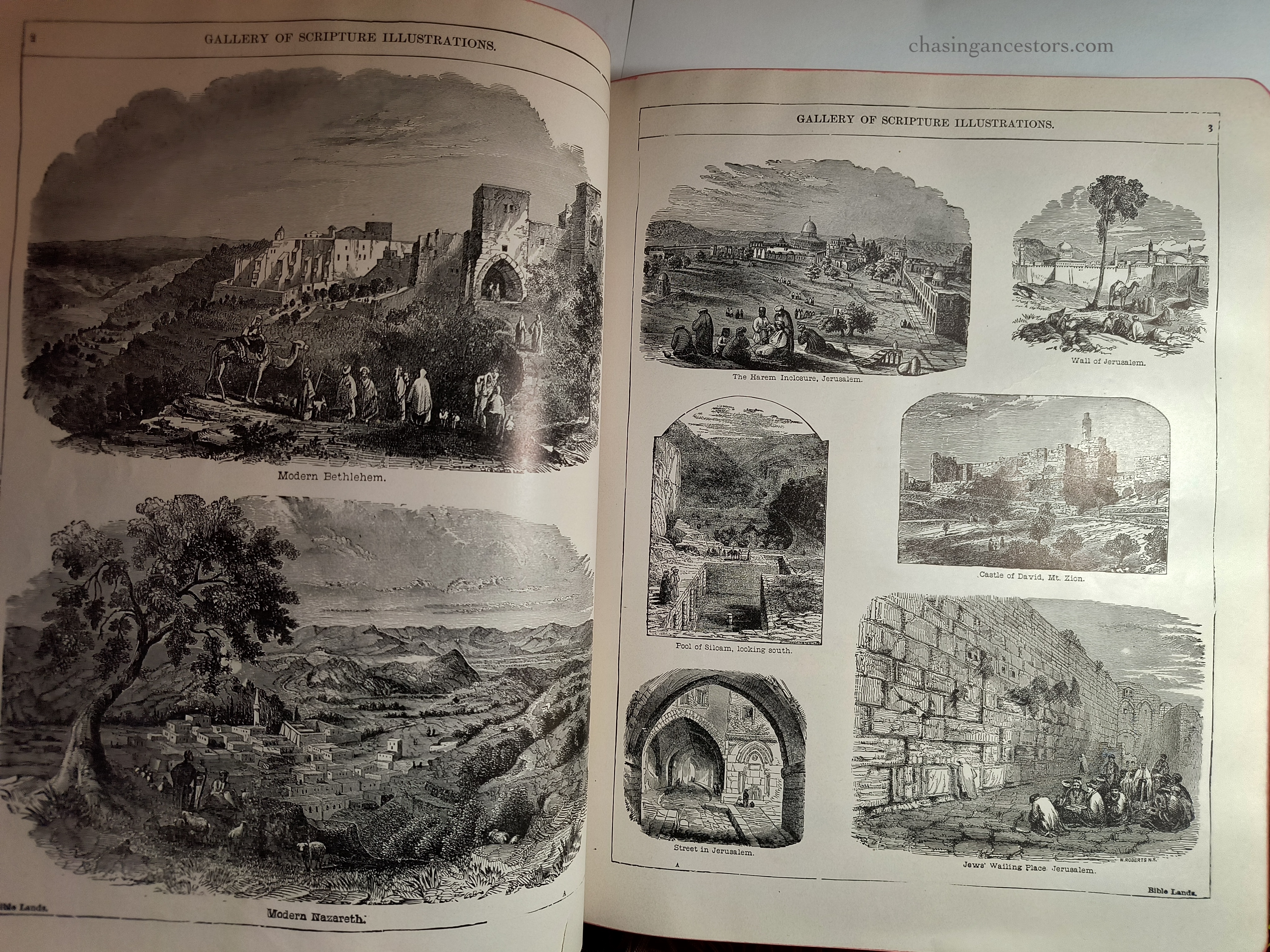
The Bible is a large black leather-bound book with reference pages and illustrations. There is no printing date that I could find.


It even contained the bookmark that would have matched the altar paraments.
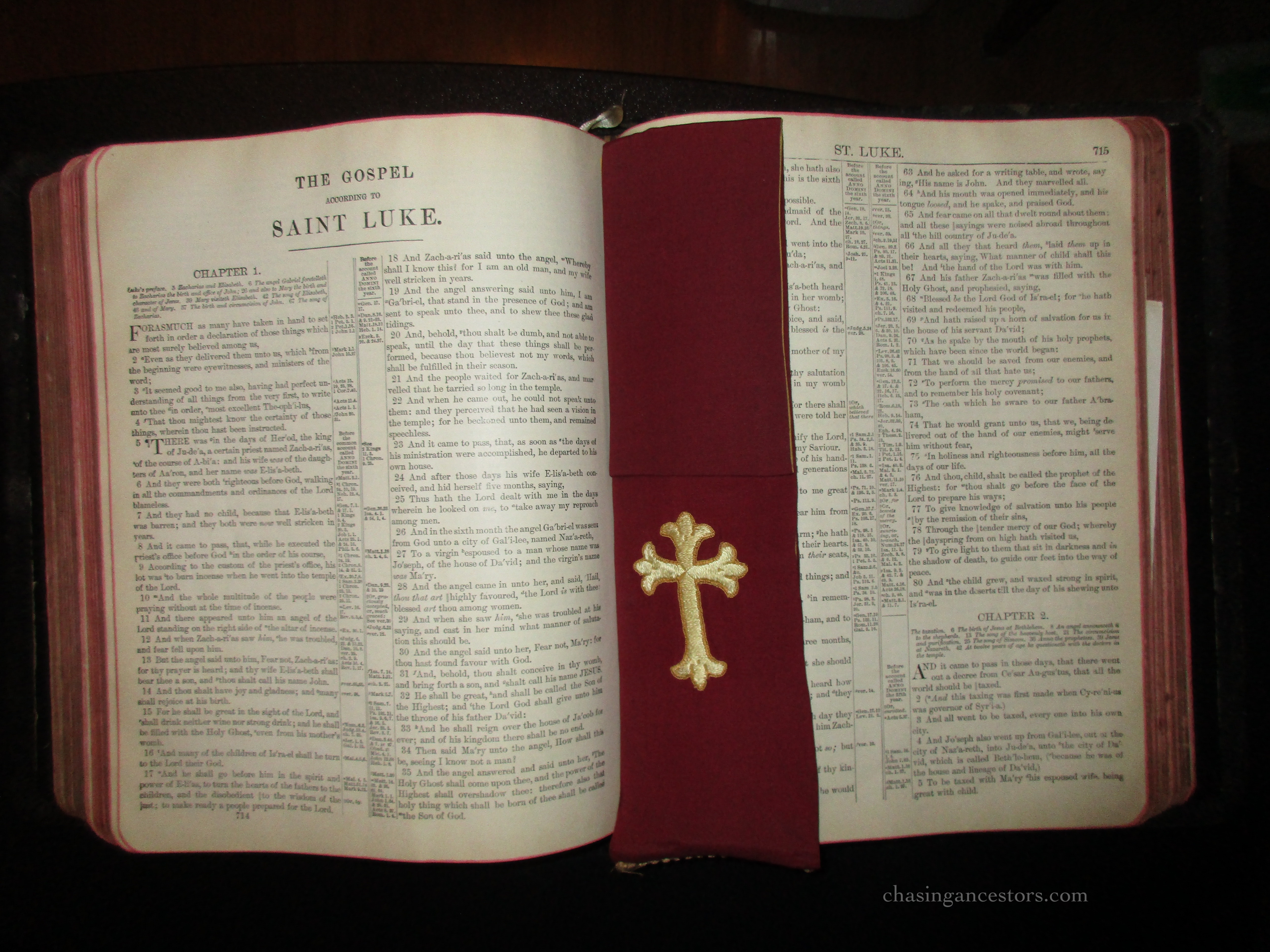
But what first intrigued me about this Bible was the inscription in the front:
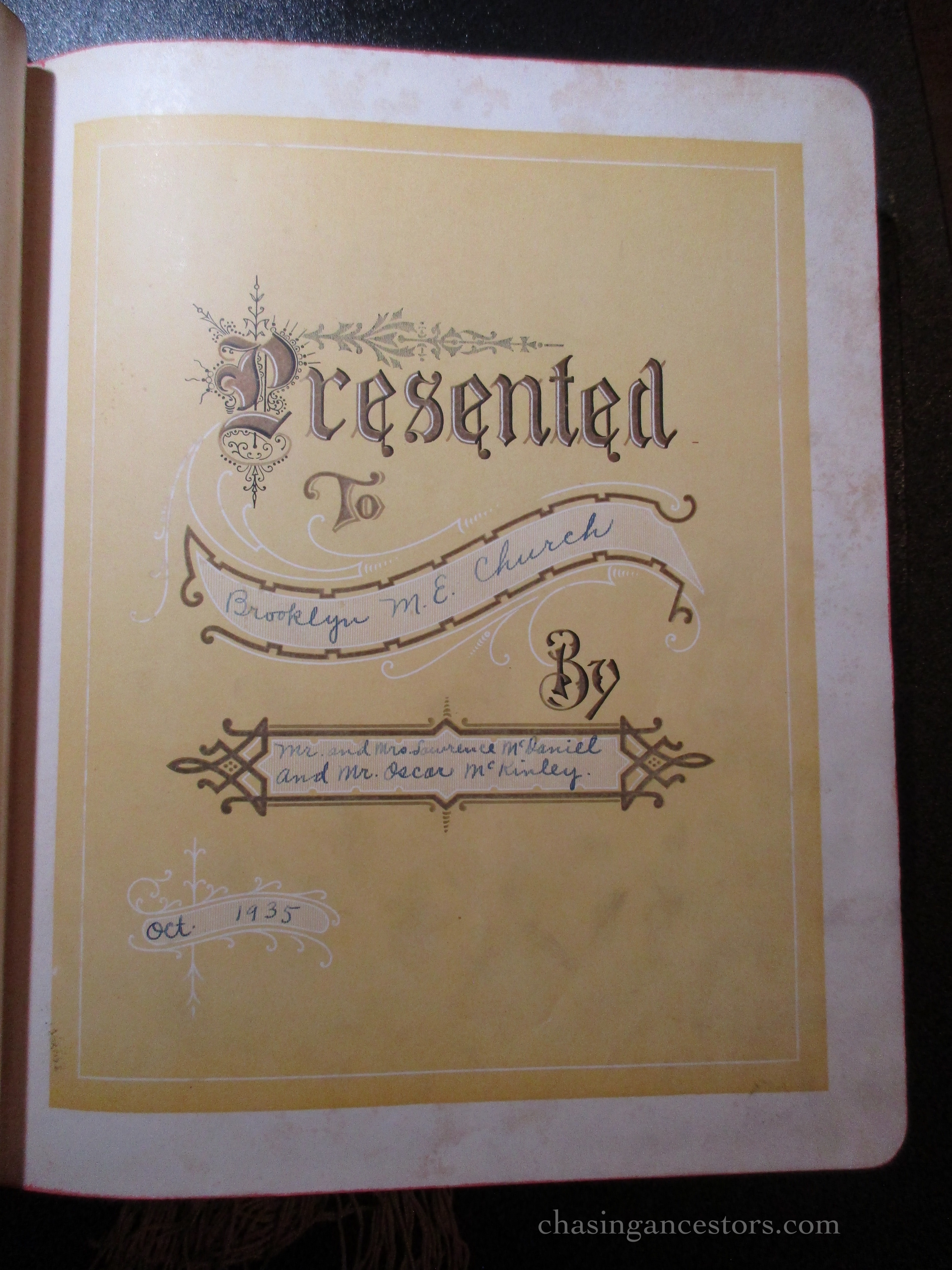
The Bible was presented to Brooklyn M.E. Church by Mr. and Mrs. Lawrence McDaniel and Mr. Oscar McKinley in Oct. of 1935. Oscar McKinley (1887-1969) was my Great Grandfather.
Brooklyn Methodist Episcopal Church was located in Brooklyn, Indiana, a small town in Morgan County. Brooklyn was where my Great Grandfather lived and where my Grandfather, Loran McKinley, Sr. (1916-2003) grew up.
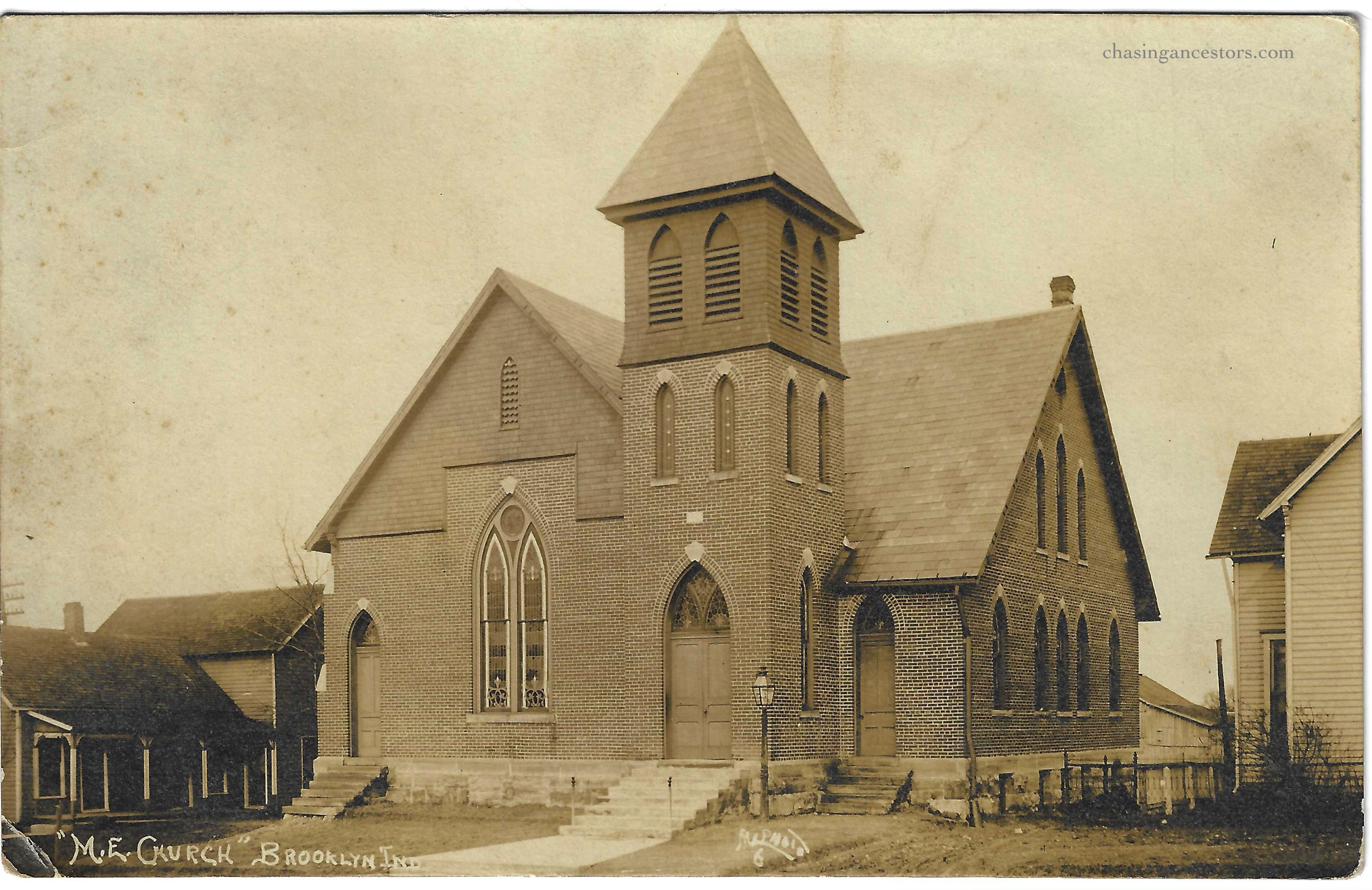
This undated postcard picture of the church was in the collection of photographs I received from my Grandfather.
The other fun thing about this Bible is the additional pages that listed the members of the church at the time the Bible was presented.


“Members of the Brooklyn, Ind. M.E. Church at the time this Bible was presented—October, 1935.”
Trustees: J.B. Abrell, Lawrence McDaniel, Oscar McKinley, R.C. Minton, Dr. John S. Spoor, Samuel Swope, H.C. Zenor
Members:
Abrell, J.B, Bertha, Forrest; Bradford, Georgia; Caldwell, Lee, Rilla, Ruby; Copeland, Mrs.
Clara, Lee, Martha; Clark, Minnie.
Clay, Mary, Viola, Ethel, Emma; Dillender, Fred; Edson, Nina, Roger, Robert; Forrester, Sarah, Andrew, Bennie, Ida, William, Mrs. Wm, Richard, Katherine; Fleenor, Maxine, Rex; Gilbert, Laura, Earl, Bill; Griggs, Loren; Hensley, William, Fannie.
Hornaday, Chas, Catherine; Holdaway, Mary E; Jones, Senith, Wallace, Mrs. Mabel; Kincaid, Otis; Matthews, Annie; Morgan, Avis; Morrison, Thelma, Mrs. Harvey; Minton, Carl R., Rose; Moulton, Roy, Mrs. Roy; Monical, F.S., Mrs. F.S.; McNeff, Clyde, Julia, Dorothy, Robert, Leslie. McDaniel, Lawrence, Eva, Sadie; McKinley, Oscar, Loren [Loran]; Plummer, Lillie, Jane; Powell, LeOtis, Beverly, Opal Theresa; Passmore, Josaphine; Riggs, Chester (Eugene, next page); Ritzler, Amelia, Charles; Richardson, Mrs. Dora; Rathrock, Hattie; Simpson, Edith; Rike, Effie; Rike, Mrs.; Rooker, Bernice; Rinker, George, Jr.; Rinker, Geo. W., Eliza, Ida Ann.
Rinker, Eli; Rober, Martha; Riggs, Eugene; Rymerson, Bessie; Swope, Samuel, Mrs. Celia, Clarence; Sanders, Martha; Self, Maude, Harry; Spoor, Dr. John S., Iola; Soots, Frank, Dolly, William; Stafford, Violena; Shelly, T.Z., Mrs. T.Z.; Smith, Mary, S.R., Armina, Betty Lou. Swarens, Rev. A.L. Pastor 1934-1936, Mrs. Mae; Throckmorton, Mrs. Perry; Wall, Hallie; Woodard, Pruah; Williams, Geo, Ida, Garnet; Waltz, Maude, Mary, Roy; Welty, Rose; Wiley, Rosemary, Kathleene, Rose; Young, Mrs. Gerald; Walker, Carl; Wratten, Lottie Mae; Zenor, Harry C., Mrs. Nellie.
I looked at the 1930 and 1940 US Census records on Ancestry.com and found that most of the members of the church lived in the town of Brooklyn. I also learned that some were the only family members listed on the roll, a husband or wife was not listed. I saw that not many children were listed, but I’m not surprised as children were probably not considered members until they reached teen or pre-teen age.
From the census information, I found that the church members had a variety of occupations. There were two telegraph operators for the Penn R.R. Co.; a station agent for the Interurban R.R.; a barber; a few bookkeepers for various industries; several teachers, both male and female, and a school principal and a superintendent. The Postmaster of Brooklyn was a member of the church as was a postal clerk. There were two attorneys, one of which was also a furniture buyer. One member owned and operated a filling station while another owned a garage. Of course there was a Dry Goods store owner. The two main industries in Brooklyn, the Brooklyn Brick Company and the Indiana Drain Tile Company were well represented in the membership w/ laborers as well as the superintendent for the Brick Company and the Secretary/Treasurer for the Tile Company.
I also found a few family connections on the membership roll. First, as mentioned already, my Great Grandfather, Oscar McKinley (1887-1969) was listed along with my Grandfather, Loran (1916-2003) who was 19 yrs old in 1935. Then there were the Caldwells. Lee Caldwell died in 1936 and his widow, Rilla (1894-1982) married Oscar McKinley on January 31, 1941. Oscar had been divorced from his first wife, Gertrude (Portis) McKinley (1888-1967) for several years by then. Another church member, Carl Minton (1867-1936) was an attorney and was a first cousin to Gertrude (Portis) McKinley, my Great Grandmother.
I searched newspapers from the area through Newspapers.com and found more surprising connections to my family. Violena “Lena” Stafford (1878-1968) was married to Benjamin Franklin Stafford (1874-1946) who was a half first cousin once removed to my Grandfather, Loran McKinley. Lena was the sister of another church member, Hallie Wall. Also, Mrs Laura Gilbert (1856-1946) was a 2nd cousin once removed from my Grandfather, Loran. She was the daughter of Noah J. Major who wrote “The Pioneers of Morgan County, Memoirs of Noah J. Major.”
There were other family groups who were part of the membership of the Brooklyn M.E. church. Georgia Bradford was a sister-in-law to Lawrence McDaniel. Maxine and Rex Fleenor were the grandchildren of Senith Jones. Catherine Hornaday was Maude Self’s sister. Mary Smith was the mother of Mrs. Roy (Ethel) Moulton. Hattie Rothrock was the mother of Edith Simpson. Eugene Riggs was the grandson of Charles Hornaday. Mrs. Perry Throckmorton was the mother of Rilla Caldwell. She was also the sister-in-law to Dolly Soots. Rosemary Wiley was the daughter of Jane Plummer. I expect these families celebrated many milestones and mourned losses with each other at the Brooklyn M.E. Church.
So what about the church? Why was the Bible in my possession and not still in the church? What is the history of this church and what happened to it? I searched Newspapers.com and a few other sources to find the answers. There were several articles in the Martinsville, IN Reporter-Times newspaper that chronicled the church’s history.
From what I could find, the Brooklyn Methodist Episcopal Church congregation was established in 1821 and first met in a shed on someone’s land. The first brick structure may have been erected in 1869 & was replaced by the present building in 1895. The stained glass windows were donated by prominent citizens who were members of the church. There were modifications made to the building through the years as noted in later photographs.
In 1908 they ordered 75 hymnals and organized a Sunday-school orchestra. In 1914, the congregation raised $500 for repairs to the church. There was a Ladies Aid society that had regular meetings and sold food and desserts at local fairs. One meeting in November, 1932 had the ladies “tacking two comforts” that they presented to a family who had lost their home to a fire.
In January of 1934, the church was the location of the funeral of Jap Miller, the “mayor of Brooklyn.” Mr. Miller was made famous by James Whitcomb Reilly in his poem, “Jap Miller down at Martinsville.” He also operated a store in Brooklyn.
The church was used for school graduation ceremonies in the 1930’s, both for the Clay township high school and the 8th grade graduates. It also hosted exhibits for the 4-H clubs and Home Economics clubs. In 1943, there was a sewing and cooking exhibit and home canning demonstration.
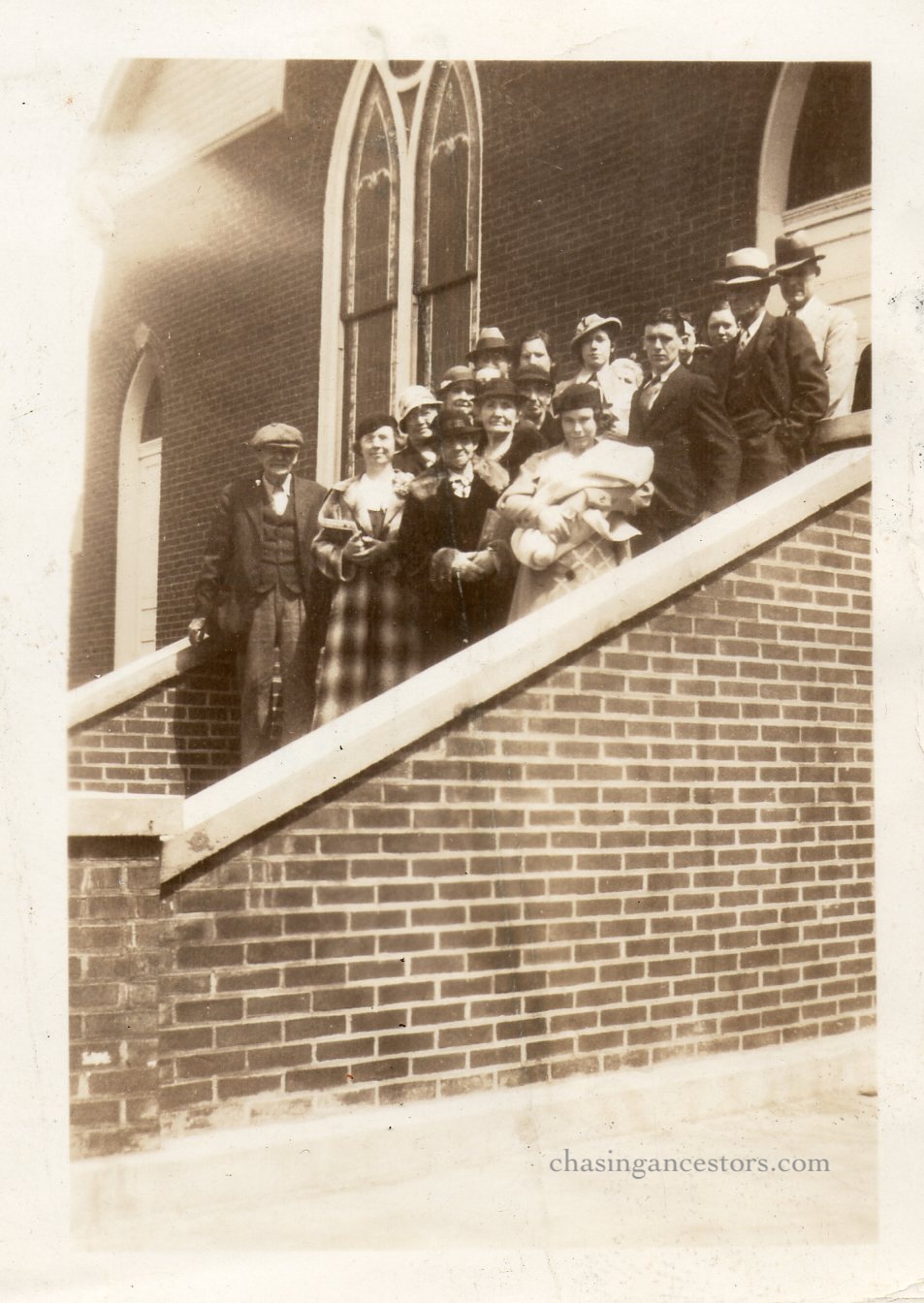
This undated photo was also in my Grandfather’s collection. I wonder if it commemorated the baby’s baptism. There was no identification given for any of the people in the picture, although I think my Great Grandfather, Oscar McKinley is the man at the top of the stairs in the light colored suit. This picture also shows how the stairs were modified from the earlier picture.
There was a special service held in August of 1940 to dedicate new memorial hymnals. Many were donated either in memory of or in honor of someone dear to them by the members of the congregation listed on the 1935 roll.
In the 1940’s they shared services with Monrovia Methodist Church in Monrovia, IN. The newspaper would indicate whether morning or evening services were at Monrovia. The attendance in March of 1942 was 72.
The first WWII casualty from Brooklyn was 20 year old Charles Arnold, Jr, who died in Italy. His memorial service was held in the church on January 16, 1944.
In September of 1945, the church had a special homecoming service and picnic to celebrate the 50th Anniversary of the morning worship period. So I guess the Bible may have been presented in 1935 in honor of the 40th Anniversary.
The church held ice cream socials and taffy pulls and spelling bees as well as other activities through the years. Revivals were also held at the church.
On May 25, 1969, the church closed as it could not meet the obligations to the denomination. Many children attended the church at that time and the assessment for financial obligation was determined by the number of people on the rolls. According to an article in The Martinsville Reporter- Times from June 2, 1969, and an article in The Martinsville Democrat June 6, 1969, the Sunday school attendance outnumbered the regular worship attendance by 2 to 3 times. Worship attendance was averaging around 30 people, while the rolls listed 142 names. The church was assessed $14.83 for each person on the roll & $33 for each $100 paid to the pastor. The church was reported to be financially solvent at that time, but not able to keep up the obligation to the Methodist Conference. Options to merge with other congregations were turned down for various reasons; as well as the possibility of staying open only as a Sunday school congregation. Apparently no deed could be found for the church, so the Conference was not able to claim the property.
The article from the Democrat mentioned a lady, Mrs. Frank Soots, age 83, who had been a member of the church since her childhood and who was present when the church doors closed. She was actually Dolly Throckmorton Soots & she was listed with her husband on the church roll from 1935.
The church building was used by other denominations & religious groups through the succeeding years. It is now listed on a Realtor site for sale as a commercial site. The address is 9 N Church St. Several photographs are posted of the interior and exterior of the building.

I took this picture a week ago on a recent trip through the area. The building is a bit run down, the stained glass windows are long gone & the yard is overgrown. It is just a building. The people who passed through its doors from generation to generation to gather as community to worship their Lord are the real legacy of Brooklyn M.E. Church.
©MJM 2024




 George died in 1916. In the 1920 US Census, Mariah shows up with Oscar and Gertrude McKinley and their boys, Myron and Loran in Brooklyn, IN. No street name is listed in this census.
 So, in 1996, after I got started in researching the Family History, Grandpa (Loran McKinley) took me on a road trip to show me where he grew up in Brooklyn, IN. He drove up High street and pointed out the house he had lived in.
 The house didn’t look very different from the old pictures & was still standing strong after about 80 years! I’ve been past it a few more times during the years, just to make sure it is still there. Pretty cool!
 Chasing Ancestors