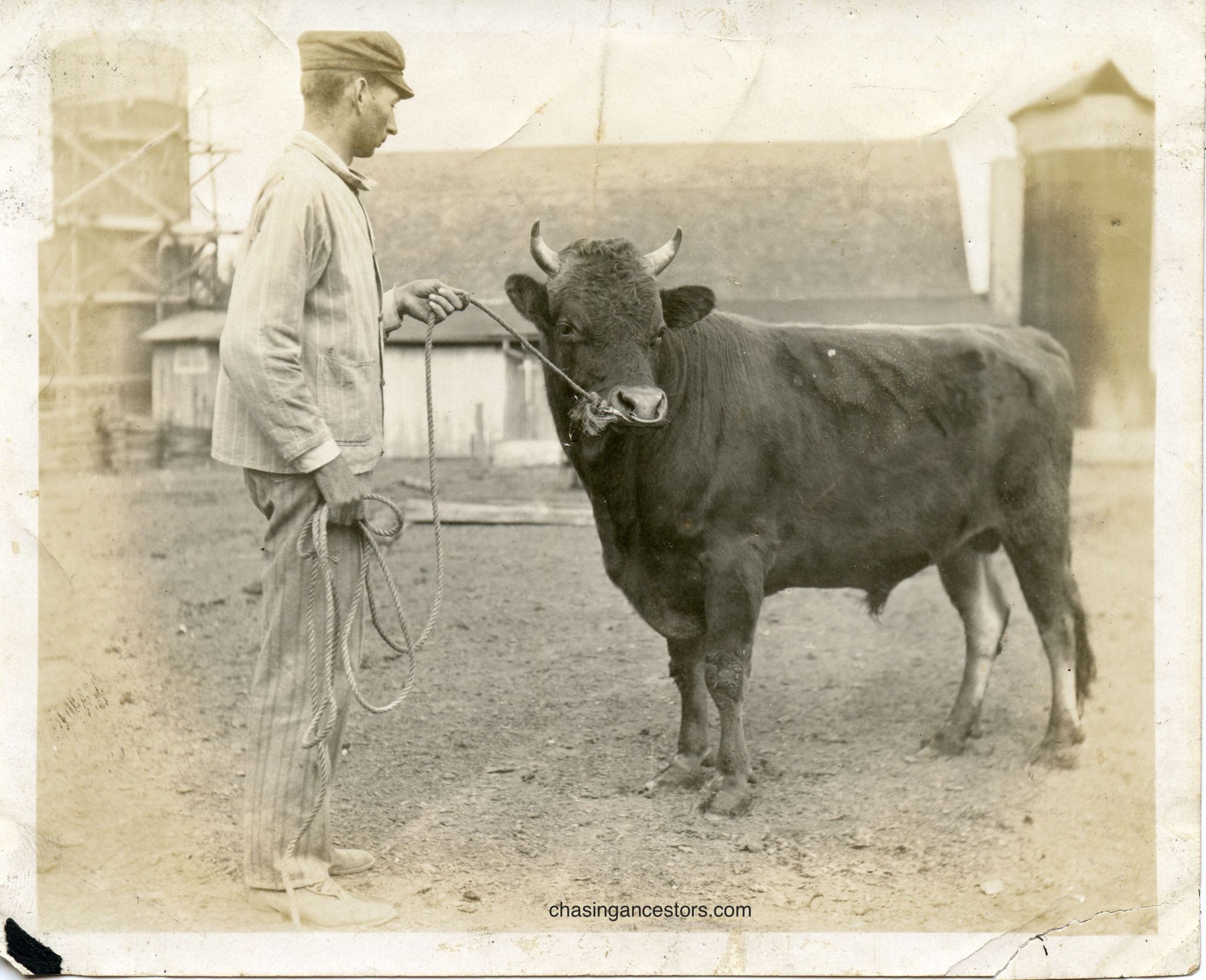
An Unfinished Story

I was looking through some of my old genealogy files, trying to organize things & I opened the file of old letters. This letter seemed simple enough and I wanted to find out more about the author, and while I did find some records to fill in his story, I didn’t find enough to complete it. 

The letter: To Arza Millikan (1883-1964), my paternal Great Grandfather. From Wm. C. Millikan. It was postmarked from Newport, R.I. on Nov 20, 1909. And the first page gives more information as to the origin: Fort Adams, R.I. The salutation is “Dear Cousin.”

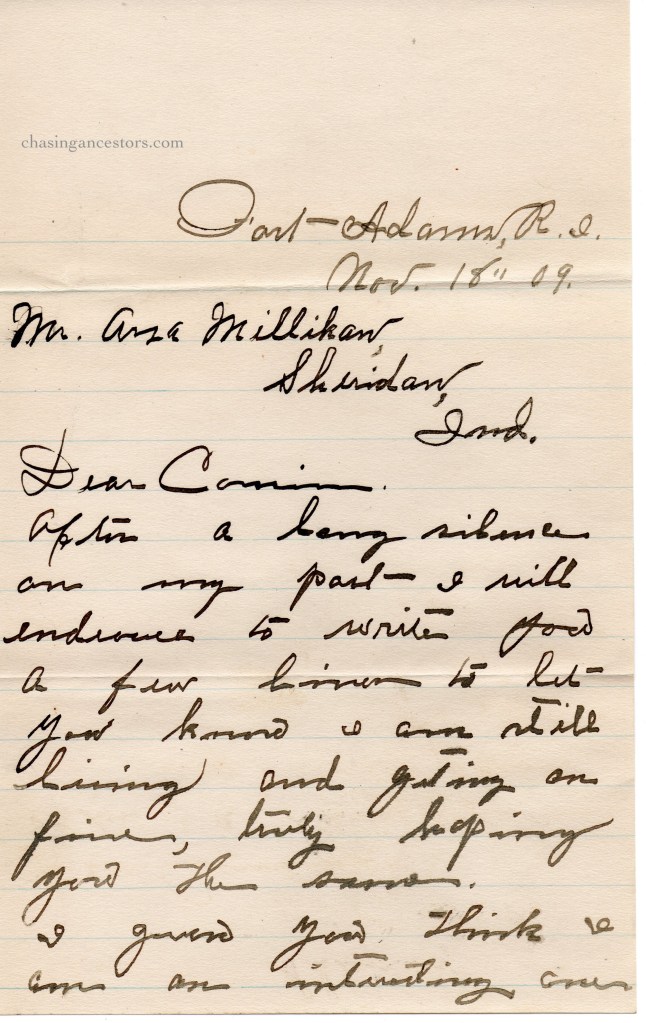
The transcription is:

Port Adams, R.I.; Nov. 18” 09.; Mr. Arza Millikan, Sheridan, Ind. 
Dear Cousin.
After a long silence on my part I will endeaver to write you a few lines to let you know I am still living and geting on fine, truly hoping you the same. I guess you think I am an interesting one
(2) to correspond with, don’t you?
Well I must admit I am very careless about writing sometimes I fail to write home for weeks at the time and they will wonder what has become of me, You see after a fellow has been away from home so long as I have he gets negligent and fails to write to his own people.
Well I would like to be out in the good
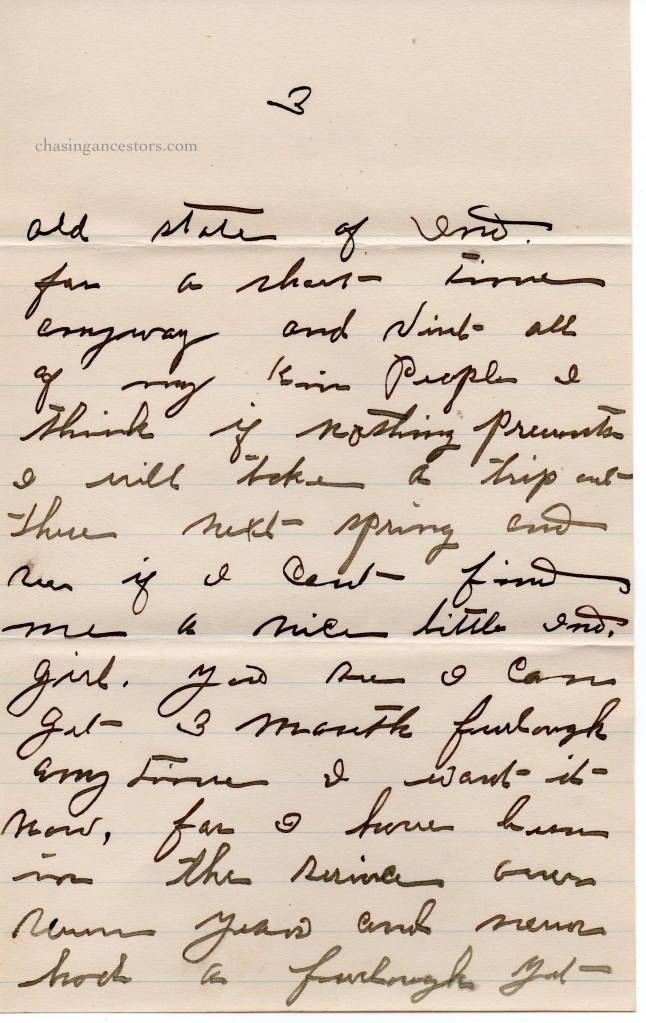
(3) old state of Ind. for a short time anyway and visit all of my kin people I think if nothing prevents I will take a trip out there next spring and see if I can’t find me a nice little Ind. girl. You see I can get 3 month furlough any time I want it now for I have been in the service over seven years and never had a furlough yet
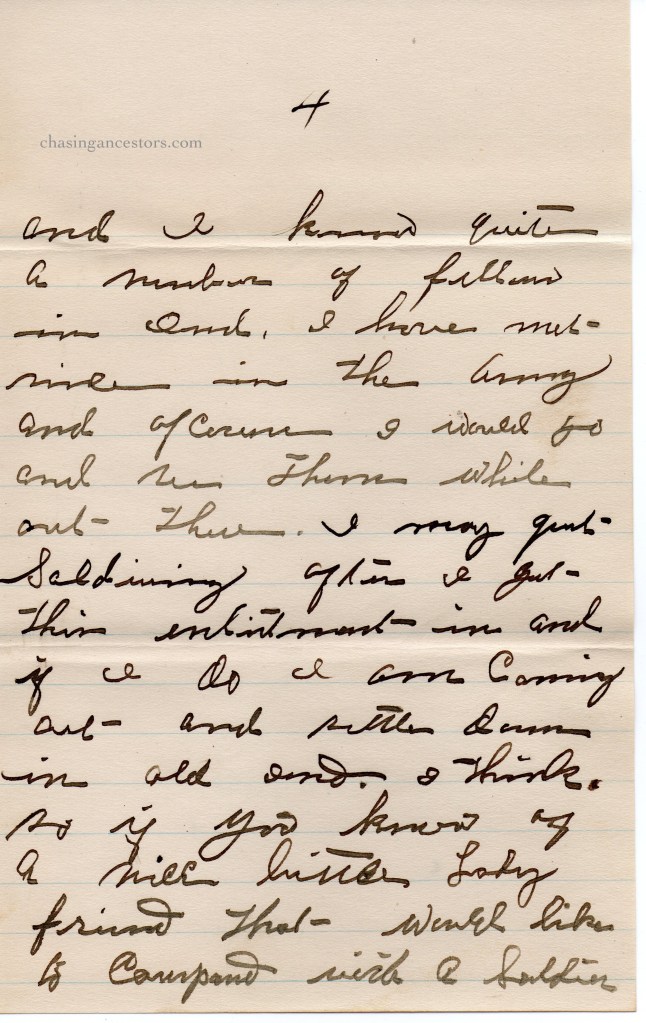
(4) and I know quite a number of fellows in Ind. I have met since in the Army and of course I would go and see them while out there. I may quit Soldiering after I get this enlistment in and if I do I am coming out and settle down in old Ind. I think. So if you know of a nice little Lady friend that would like to correspond with a soldier
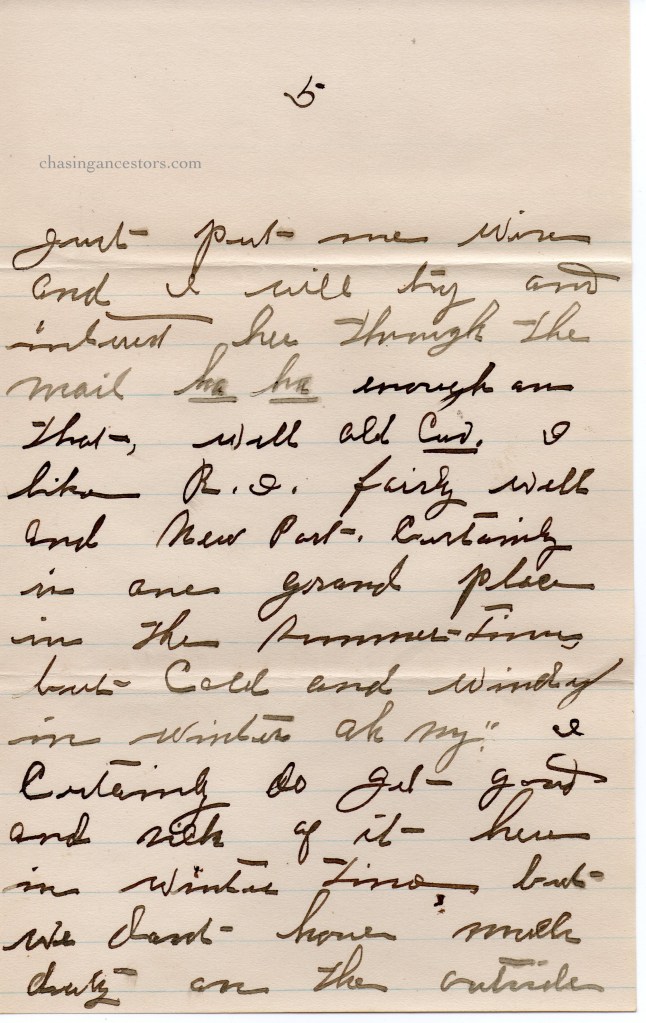
(5) just put me wise and I will try and interest her through the mail ha ha enough on that, well old Cus. I like R.I. fairly well and New Port certainly is one good place in the summer-time but cold and windy in winter oh my. I certainly do get good and sick of it here in winter but we don’t have much duty on the outside
(6) in winter time you see we have indoor instructions here in the cold weather we do guard duty of course but we only go on guard about once every three weeks and then only lasts 24 hrs at the time 2 hours on duty and 4 off so we certainly have an easy time and more fun in the summertime than a little.
I think there is more girls in the state of R.I.
(7) than any state I was ever in in all my life. Say Cus when are you going back to New Mexico to live and how do you like that part of the country write and tell me all about yourself and don’t forget to get me a lady friend to correspond with in Ind.
So give all my best regards and tell the Riggs family hello for me.
Your cousin Wm. C. Millikan

So, of course the question is, “Who is Wm. C. Millikan?” Clues in the letter indicate he is a “cousin” of Arza’s. He has been in the military for 7 years. He is familiar with Indiana, where Arza lives & would like to visit again. He is looking for a girl—so he is single. He mentions the Riggs family. There were Riggs who show up on the same page as Arza in the 1900 and 1910 census records for Hamilton County, Indiana. I assume this is who he mentioned in the letter.  

First, perhaps his military service records would give more information as to who he was. I was able to find through Ancestry.com some “US Army Register of Enlistment” files from 1798-1914. These files had a William C Millikan listed for several years:

In 1902 he was listed as enlisting on October 8, in Tampa Florida by Lt. Smith for 3 yrs. He was born in Randolph Co, NC; age 26 & 2 months; occupation Farmer; eyes Blue; hair light brown; complexion fair; height 6ft 1 1/2 inches. This connects w/ 7 years in the military as the postmark on the envelope was 1909. 

Looking at the clues from this register, William was born in Randolph County, NC in roughly 1876. I went back to my genealogy files for Millikan’s from Randolph County, NC—there were a lot of them. One that fit the date of birth was William C. Millikan, son of Thomas Franklin Millikan (1846-1924). This William was the grandson of John Kelly Millikan (1826-1908) who was the brother of Clark Millikan (1824-1926), the grandfather of Arza Millikan (1883-1964), to whom the letter was written. William and Arza would have been 2nd cousins. One assumption is that William may have visited Indiana to work on Clark Millikan’s farm for a season. There were other relatives who did this. 

I don’t have good sources for William C Millikan. Records from other researchers indicate he was born in 1876. He shows up as a 3-year-old in his father’s household in the 1880 US census in Randleman Township, Randolph County, NC.

The 1900 US Census has him listed with his brother, Joseph. They are still in North Carolina, Randleman town of Randleman Township, Randolph County. He is listed as a 23-year-old farmer. His birth date was listed as July 1876. So this seems to coincide with the other records regarding age.

But this is about where the family record ends. I found an obituary for Thomas Millikan,  father of William C. He died in 1924 and the obituary stated that only one of his children, Joseph, was still living. W.C. is in the list of deceased children. The obituary of another brother, Samuel Bentley, who died in 1915, also indicated that all other siblings except Joe had passed away. Other siblings of William had passed away before this letter was written. I have not been able to find an obituary for William. But right now the indication is that he died before 1915. 

So, now that I have some idea of who William might have been, I figured I would look a little more at his military records. As I mentioned, I found records of enlistment on Ancestry.com. The first record from 1902 stated that he was in the “CA” or Coast Artillery, Company 107-117. (The Coast Artillery Corps was a US Army corp established in 1901 to defend the coastlines using heavy artillery.) Continuing on with the enlistment records, William re-enlisted in 1905 and again in 1908. 

Fold3.com had additional records for William’s military service. The “US, Returns from Regular Army Coast Artillery Corps Companies, 1901-1916” records essentially gave a status report of William’s service through the years. 

The first record for Company 117, Coast Artillery for February 1903 has William joining on Feb 3, ’03. He was a private. He was a Sergeant on the report from May 1905 and on Detached service at Ft. Monroe, VA. The report from October 1905 showed that he was discharged on October 7 and reenlisted on October 8 at Fort Fremont, SC. His character was “excellent.” He transferred to the 127th Company at Ft Fremont, SC on June 8, 1907.

In 1908, William was listed as a Private again and was discharged from the 127th Company, Coast Artillery Corps at Ft. Fremont on October 7 with final statement given of his service being “honest & faithful” and his character “very good.” He reenlisted with rank of Private to the 117th Company Coast Artillery Corps at Fort Slocum, NY on October 16th. 

He was on detached service to Ft. Wetherill, RI in January 1909. Then in 1910, he is at Fort Adams, RI which is just across the harbor from Ft. Wetherill. As a side note, most of the forts mentioned are no longer military installations, but several have been preserved as state parks. 

He shows up again in the US Census in 1910 in Newport city, Newport County, RI, Ft Adams. This entry has him listed along with the other soldiers at Ft. Adams. He is reported as being 30 years old.

The last Coastal Artillery return reports that I can find reference his desertion July 8, 1910 from Ft. Adams. The next report indicates that he was “apprehended at Newport, RI and returned to Military Control at Fort Adams RI Aug 6, ’10.” The final “Return of the 117th Company of the Coast Artillery Corps, for the month of September 1910”:

William is listed as being sentenced by a General Court Martial on September 25, 1910 to be Dishonorably Discharged. His services was “not honest and faithful.” So I wonder what happened to William during his time in the Coast Artillery that he went from being a Sergeant with faithful service to a Private, dishonorably discharged for desertion and service that wasn’t honest & faithful. 

This seemed to end what I could find about William. Then I took one more look on Familysearch.org & used their “full-text” search tool. I found some general index cards for Adjutant General communications. There was an index card for his reenlistment in 1908. Then there were cards regarding his desertion July 10 and apprehension August 9, 1910. The last card was from January 24, 1911 regarding clemency. William was listed as a “Mil. Convict, Ft. Adams, R.I.” I then looked at the National Archives to see if the Adjutant General Communication files were listed there but did not find files for 1911. 

So this is the end of the trail on “cousin” William C. Millikan. I haven’t been able to locate any more records for him. My assumptions for his identity may be correct or not. Maybe someday I’ll be able to find another record that completes this unfinished story.

MJM © 2025

Did You Hear the Story?…

A little over a year ago, one of my Father’s cousins was passing through this area and stopped in to show us a box of old books that had belonged to our ancestors. He said his family members didn’t want the books and would be happy to give them to me. He is related through Arza Clark Millikan (1925-1975) who was the brother of my Grandmother, Margaret Millikan McKinley (1917-2007).

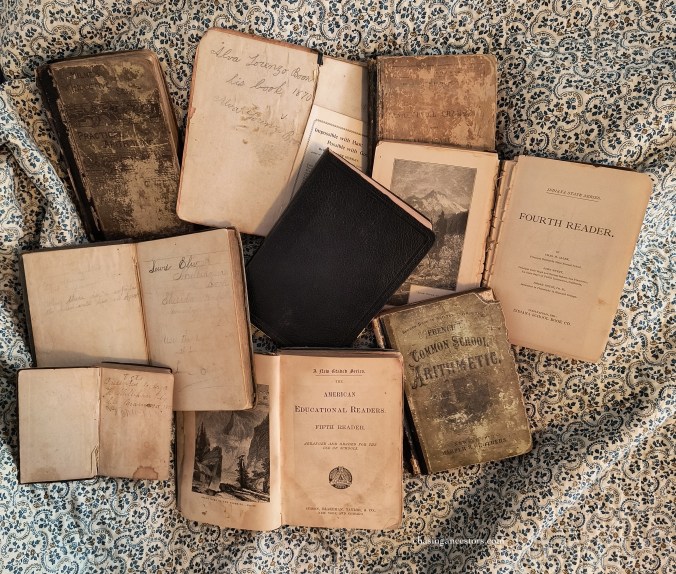
The box contained several early school books that belonged to my Great Grandfathers Alva Boone (1861-1945) & Arza Millikan (1883-1964); as well as my Great Great Grandfather Lewis Elwood Millikan (1855-1949).

In the Forth Grade Reader, there was a fragile 3-page report on the robin, written by Arza. The first paragraph is shown here:

Another item that was in the box with the books was the following program announcing the commencement of the Washington Township, Hamilton County, IN school district. Arza was listed in the program as one of the graduates. He would have been 14, so this was an 8th grade graduation. I don’t know that he went further in school as I have not found a high school graduation record for him.

While we visited, Dad’s cousin would often say “Did you hear the story?…” and start with a question about the family. We had a good visit and talked through many of the family stories. 

He asked “Did you hear the story that we had the old family Bible?” I said I hadn’t & I didn’t know of a family Bible other than the ones I had in my possession. Then reaching the final book in the box, there it was, the old Millikan family Bible! The cover was falling off and many pages were loose.

The title page indicated that the Bible was published in 1849. I wonder if when it was brand new it was given to our ancestor, Clark Millikan (1824-1926) when he married his first wife in 1851? It would have come with the family in the wagon on the trip from North Carolina to Indiana after the Civil War. 

The records pages were lying loose in the front of the Bible. Usually I find them in the center section, between the Testaments. Thankfully they were in pretty good condition and the writing was legible. The handwriting is a pretty close match to Clark Millikan’s.

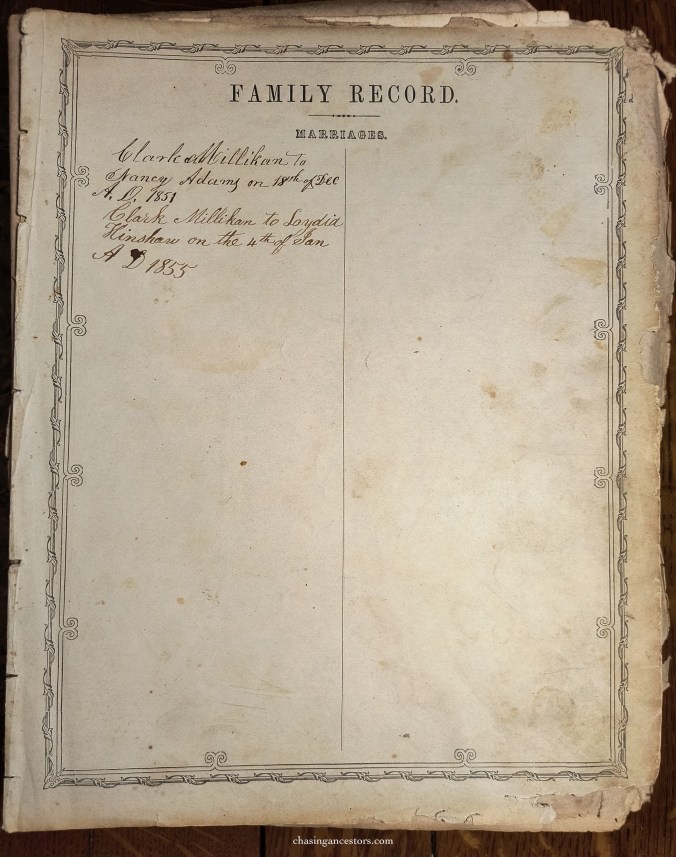
First the Marriage record page with two entries:  “Clark Millikan to Nancy Adams on 18th of Dec A.D. 1851. Clark Millikan to Lydia Hinshaw on the 4th of Jan A.D. 1855.”

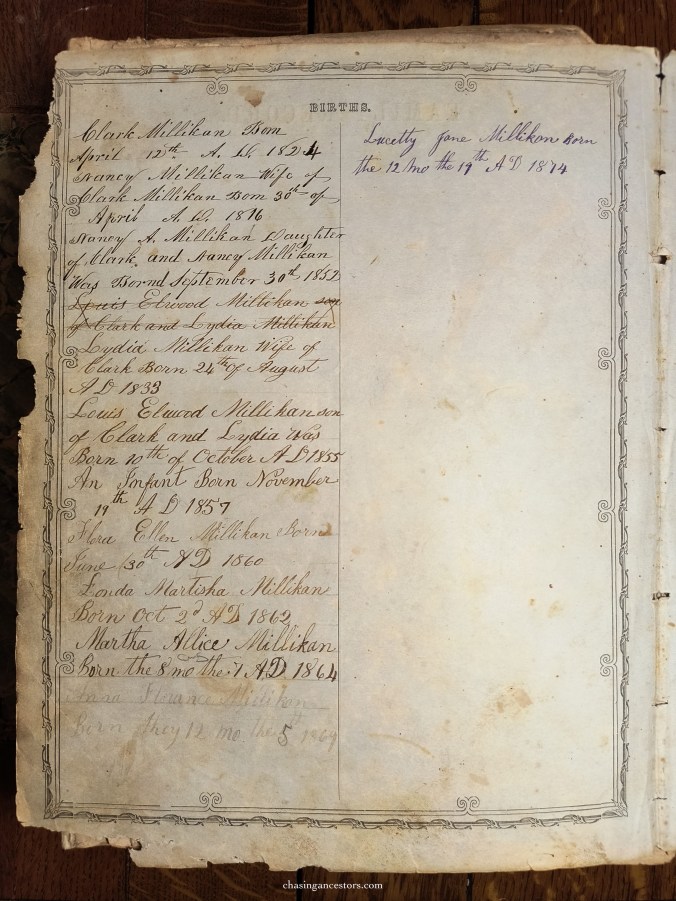
Next, the record of Births:

Clark Millikan Born April 12th A.D. 1824. Nancy Millikan Wife of Clark Millikan Born 30th of April A.D. 1816. Nancy A. Millikan Daughter of Clark and Nancy Millikan Was Bornd September 30th, 1852. Lydia Millikan Wife of Clark Born 24th of August AD 1833. Louis Elwood Millikan son of Clark and Lydia was Born 10th of October AD 1855. An Infant Born November 19th AD 1857. Flora Ellen Millikan Born June 30th AD 1860. Londa Martisha Millikan Born Oct 2d AD 1862. Martha Alice Millikan Born the 8 mo the 7 A.D. 1864. Anna Florance Millikan Born they 12 mo. the 5th 1869. Lucetty Jane Millikan Born the 12 mo the 19th A.D. 1874.

A couple of comments on the Births entries—The entries from Clark to Nancy A seem to have been written at the same time. The ink color changes a bit for the next entries. And there is even an entry written in pencil. I wonder if Clark intended to mark Louis’ birth, but realized his mother, Lydia hadn’t been recorded so crossed out the entry to put Lydia first. Also, all other records I have seen have Louis spelled “Lewis.” I have always thought as well that “Londa” was actually “Lunda” Martisha.

Finally, the Death Record:

Nancy Millikan Wife of Clark Millikan Departed this life October 11th A.D. 1852. An Infant Departed this life December 8th A.D. 1857. Lucetty Jane Millikan daughter of Clark & Lydia Departed this life they 8 mo the 30th 1878.” There were no other entries.

Completing the entries for deaths:  Lydia died Sept. 18, 1917. Flora Ellen died June 2, 1923. Clark died Feb. 1, 1926. Martha Alice died March 13, 1926. Nancy Angeline died April 17, 1926. Anna Florance died Feb. 21, 1945. Londa Martisha died Dec. 14, 1947. Louis Elwood died March 16, 1949.

So there really was a family Bible & Arza Clark’s family did have it. I wouldn’t have known it existed unless that cousin had come by with a box of books. The Bible went back home with him to give to one of his family members.

©MJM 2025

Dear Cousin Mattie…

As I have mentioned before, my Grandmother, Margaret Millikan McKinley (1917-2007), kept many family papers and photographs. Some of what she saved were letters from various family members. I wonder why some letters were saved and many more were discarded. But I am grateful for those letters that give a glimpse of family life & maybe even a little more insight into family relationships. Here is one such letter:

HJL1890en copy

The envelope indicates this letter was sent to Martha E. Millikan, Sheridan, Ind. (Hamilton Co.)

It was sent from Moffits Mills, NC with the postmark of Oct 1, ’90.

Note the 2¢ stamp! Things have really changed!

MarthaEMillikancrop copy

Martha E. Millikan was Martha Ellen (Barker) Millikan. She was born May 25, 1858 in Randolph County, North Carolina. She moved to Hamilton County, Indiana in 1866, with her parents, Elihu Barker (1822-1910) and Hannah Jane (Allen) Barker (1825-1899); and siblings, Amelia Ann (1855-1890), John Gurney (1860-1942) & William Capres (1865-1880). She married Lewis Elwood Millikan (1855-1949) in 1882. Lewis and Martha or “Elwood” and “Mattie” as they were commonly known, were my Great-Great Grandparents. Mattie died Feb. 27, 1932.

As for the letter in the envelope, the handwriting is beautiful! I’ve heard that cursive isn’t taught much anymore in school, so I wonder if young people can even read this. 

On the top right of the first page, it says “Kemps Mills, NC” while the postmark said “Moffit’s Mills, NC.” I found only one map online that shows the location of these two places. The map is dated to 1873 and hand-drawn by J.W. Bean & can be found in the digital archive of the University of North Carolina.(https://dc.lib.unc.edu/cdm/ref/collection/ncmaps/id/223) Essentially these communities were centered around family-owned grist mills on Richland Creek about 10 miles southeast of Asheboro, NC. My guess is that the Post Office was at Moffit’s Mill at the time the letter was written. 

The transcribed letter:

Kemp’s Mills, N.C.

9 mo. 29th 1890 

Dear Cousin Mattie:–

Thy interesting letter of 8 mo. was duly received. Were truly glad to hear from so many of our relations. We are in usual health:–all able to help in the common cares of life. Our relations are mostly well so far as we know except Simeon Barker, we hear is quite sick. I was at Uncle Seth’s in last month:–They seemed lively enough considering their age & were able to get out to Quarterly Meeting at Marlboro. Suppose you have heard of their son, Benjamin’s death.

It was brother Jno’s right arm that was taken off. There was a tumor on it near the shoulder which was thought to have been caused by a severe bump he received from the plow handle while 

[pg 2] plowing several years ago. During the past year or so, the tumor increased so rapidly in size, and hurt so much, that it became evident something had to be done more than outward appliances, so he went to what is said to be the best Surgical Hospital in Phila. to have it removed. When they commensed the operation all the doctors agreed that in order to save his life the arm would have to be severed, which they did by unjointing at the shoulder. In thirty days he was able to leave the Hospital. Has got well and enjoys good health but has not been home:–Writes that he hopes to visit us sometime at least. He is employed by Rhoads & Co. 229 Market St. Phila. to keep books and help clerk in a Rubber & Belting store. Has learned to write tolerably well with his left hand, also can operate the typewriter. We miss him much but are 

[pg 3] glad to know he is doing well where he can enjoy life perhaps better than here considering his condition.

The Teacher’s Institute at Asheboro commences today but I am not expecting to teach this winter so have not gone, much as I enjoy attending. Brother Jno. and I both attended last fall. We have an abundance of rain. Wheat was very light last year and if the rain continues, it will be difficult to get any sowed soon. People here have good corn. No peaches the past summer worth relating and only a moderate apple crop. Late ones are rotting; we have been canning and preserving some of ours. Cotton fields are looking white and ready to pick; have ours partly picked out. There is a fine crop of persimmons beginning to ripen but we make little use of them except that the pigs eat them.

How is Cousin Amelia and family? 

[pg 4] I believe thee did not write anything in thy last letter about them. I would be pleased to visit thee and others but do not know that I can do so soon. Mother often talks of writing to relations in Ind. Aunt H. Hockett in particular, knowing her lonely condition but can not see and write so well as when younger. 

Aunt Catharine Barker was here not long ago on a visit; seems and looks real cheerful but cannot hear very well.

Gideon and Asenath Cox staied with us two nights. I believe they honestly think Texas the place to live. Thee may let thy father’s folks read this if they wish to hear about brother’s arm.

It is nearly bedtime so no more at present. Write soon. Thy cousin, H.J. Littler

Jno’s address is 229 Market St. as I have written, but he says so many letters come to the store that he prefers having letters directed to his lodgings which is at 480 N. 5th St. Phila. Penn. I think he would be pleased to hear from any of you. H.J.L.

The letter was written by Mattie’s cousin, H.J. Littler on September 29, 1890. It was written in response to Mattie’s letter a month earlier. Note the use of “Thee” & “Thy” which were commonly used by Quakers in speaking to their close relatives. 

H.J. Littler turns out to be Hannah Jane Littler (1863-1945). Her Mother was Tamar (Barker) Littler (1827-1919) who was the sister of Mattie’s father Elihu Barker. Hannah was a teacher, which may explain her beautiful handwriting. 

Hannah mentions several family members in her letter, many of them Barker cousins. I had some notes regarding this family, but had to verify some information so I used Ancestry.com, Findagrave.com and Newspapers.com to clarify the details of the relationships. 

Enoch Barker was the patriarch of this family. He was born in 1776 in Guilford Co, NC & he married Elizabeth Davis November 23, 1800 in the Holly Spring meeting house in Randolph County, NC. Elizabeth was born in 1782 in Chatham Co, NC. She died in 1834 and Enoch died in 1848. From what I know, they were both lifelong residents of North Carolina. They lived and raised their family in the community near the Holly Spring Friends (Quaker) meeting house. Their children were: Sarah (1801-1846), Daniel (1803-1892), Nicholas (1805-1886), John (1807-1890), Isaac (1810-1820), Seth (1812-1894), Mary (1815-?), Hannah (1818-1899), Elihu (1822-1910), and Tamar (1827-1919). 

Starting at the beginning of the letter, Hannah mentions Simeon Barker, who was probably her cousin. He was born in 1835 to Nicholas Barker (1805-1886) and Catharine Cox (1806-1896). I expect this Catharine was the “Aunt Catharine Barker” mentioned later in the letter. She would have been 84 years old when she visited Hannah. 

She then mentions “Uncle Seth” and his son, Benjamin. Uncle Seth Barker (1812-1894) was married to Margaret Cox (1812-1891). Seth and Margaret would have been in their late 70’s at the time Hannah wrote this letter. The “Quarterly Meeting” was a regional meeting of Quakers held at the Marlboro Meeting House in Sophia, NC. Their son, Benjamin, was born in 1850 and died June 6, 1890. He was 40 years old and left a wife, Esther and family.

Hannah’s brother, John Oxley (“Jno” is an abbreviation for John), was having a rough time with the surgical amputation of his right arm at the shoulder. He spent 30 days in the hospital. But as Hannah wrote, it seems he had recovered well after the surgery and was adjusting to his disability and was working as a clerk & bookkeeper. John Littler was born July 2, 1859. He is listed in the 1880 census as being a student at the Westtown boarding school in Westchester, PA. The school was founded by Philadelphia Quakers. This explains how he ended up in the Philadelphia area. He died September 8, 1891.

Hannah then mentions the status of farming in the region. Sounds like they were having a good year for some crops while others were hampered by the weather. 

Hannah asks about “Cousin Amelia.” This would be Mattie’s sister, Amelia Ann Barker. She was born in Randolph County, NC September 24, 1855. She married Simeon Fesmire (1852-1925) in 1889 but as Simeon’s obituary stated, “she only lived 11 months” after they were married. She died November 29, 1890, only 2 months after Hannah’s letter was written. 

Then there is “Aunt H. Hockett” who lived in Indiana. Hannah Barker Hockett (1818-1899) was married to Mahlon Hockett (1808-1885) in Holly Spring MH in 1858. He was a widower with 4 children. From what I can tell, they had no additional children. They moved to Rush County, IN sometime before the 1880 US Census was taken. He died there in 1885. According to my Grandmother’s notes, Hannah later lived with her brother, Elihu near Sheridan in Hamilton County, IN, not far from where Mattie and Elwood lived.  

At the end of the letter, Hannah mentions Gideon and Asenath Cox, from Texas. Asenath was Hannah’s cousin, daughter of Daniel Barker (1803-1892). She was born in 1829 and married Gideon Cox (1822-1892) in 1858. She was his second wife. They moved to Estacado, TX in 1881, following his son, Paris Cox who had a vision of establishing a Quaker community there. Gideon & Asenath would have been in their 60’s when they visited the folks back home. Gideon died in Texas & Asenath died in Whittier, California, where she had been living with their son, Manley. One more family relationship: Gideon’s half-brother, Thomas was the husband of Sarah Barker Cox (1801-1846), Hannah’s aunt. The Cox and Barker families had many branches and intermarried through many generations so these relationships are somewhat difficult to decipher. 

So again, I wonder why this letter was kept through the years, but I’m glad it was. It shows how over 130 years ago the family was able to stay connected while living so far apart from each other. 

© MJM 2024

1930’s Snow Days

With the recent winter storms affecting the country, I got to thinking about some pictures taken of my ancestors after snow storms. I think these pictures date to sometime in the 1930’s.

First, pictures of the relatives from Indiana:

Millikan166nBetAClark copy

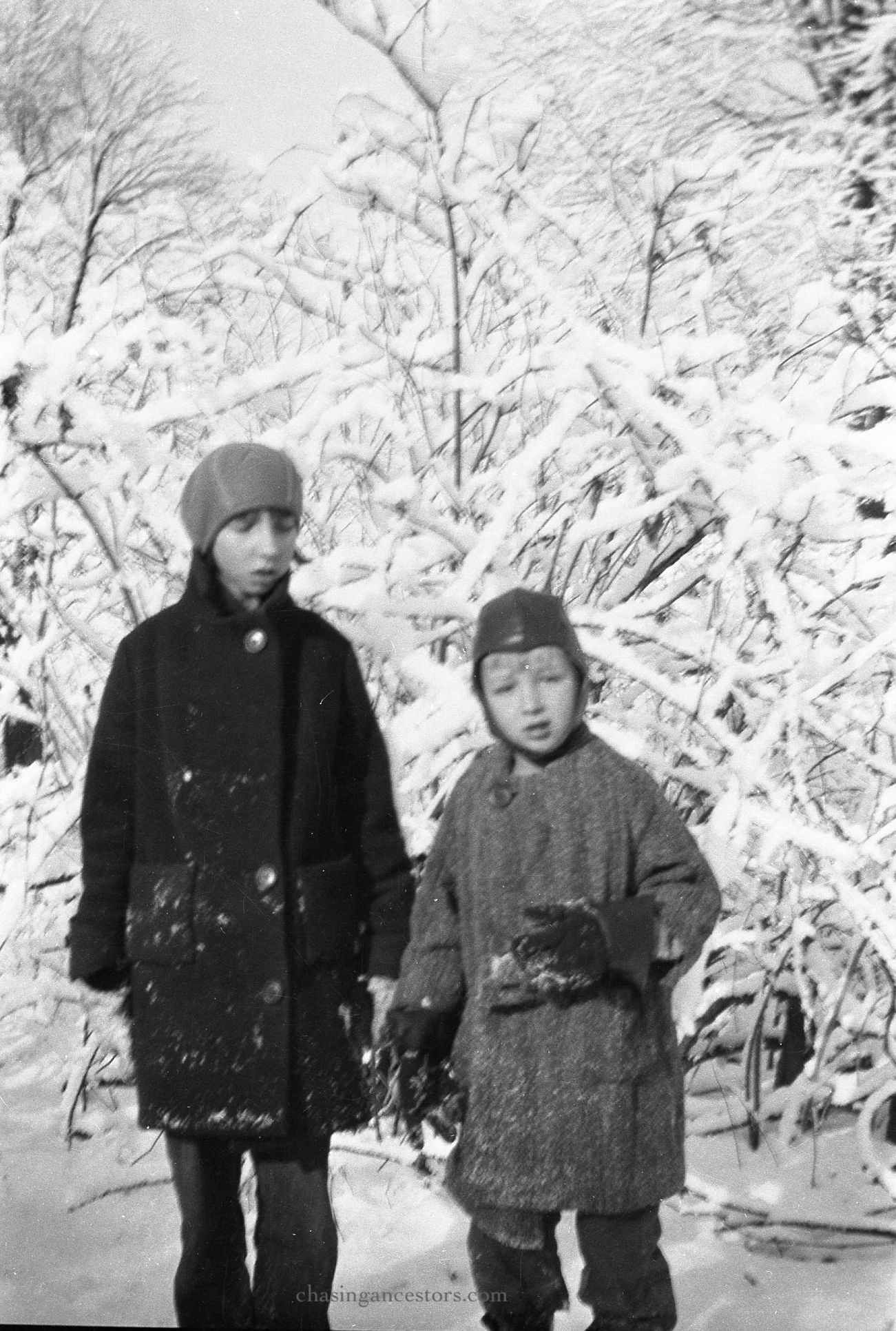
This is sister and brother, Betty Lou (1921-1990) and Arza Clark (1925-1975) Millikan, probably taken on or near their farm in Sheridan, IN. Looks like they may have enjoyed playing in the snow.

Then their older siblings, Miriam Frances (1918-2018) and Margaret Pauline (1917-2007) Millikan checked out the mound of snow left by the plows. Margaret was my paternal Grandmother.

Millikan101nFranMargsnow copy

Finally, a picture from Wisconsin:

LucilleSnow1 copy

This is my maternal Grandmother, Lucille Beiersdorf (1920-2011) pictured in front of her home at 2211 South 14thStreet, Sheboygan, WI. Looks like the plows did a good job of piling up the snow!

So I guess taking pictures in the snow seems to have been just as popular in the past as it is now. Glad to have these memories to share.

Happy New Year!

© MJM 2022

A Village

Recently I was trying to add information to some collateral branches of my paternal family tree. Specifically, I was looking at my Great Grandfather, Arza Millikan’s (1883-1964) cousins. His father, Lewis Elwood Millikan (1855-1949) had four sisters who had children. His sister Flora Ellen (1860-1923) married Leroy Michaels (1851-1918). They had 5 children, their third son being Edgar Ernest Michaels (1889-1913). There is some question as to the last name “Michaels” or “Michael” or even “Mikels.”

I searched Ancestry.com for information in Edgar Ernest & found that some records were under his middle name, Ernest. He shows up as a 10-year old on the 1900 US Census with his family in Jackson Township of Hamilton County, Indiana.

1900USCensusLeroyMikels

The 1910 US Census finds him in a different place:

1910CensusClipErnestMichaelsCombined

Here he is listed as a 19-year old ward of an institution, “Epileptic Village.” Wonder what that was all about?

I did a little more research on an Epileptic Village in Indiana and found that in 1905 a bill was introduced to the Indiana Senate to purchase land and establish a village for epileptics. The bill passed and the state purchased 1,200 acres of land about two miles northeast of New Castle in Henry County. According to the New Castle Henry County Tribune, (30 March 1906, p1) the intent would be for “the care and cure of its unfortunate citizens afflicted with epilepsy. At the present time we know of no remedy in medicine or surgery which will relieve more than a small percentage of them. The greatest benefit or relief comes from living a simple life, away from excitement, responsibility and care, and out of doors. Under these circumstances there are many who will greatly improve, and some who will become well. At the present time these unfortunates are being cared for by friends, in county poor houses, jails and asylums. They are not insanes, neither are they criminals, but human beings unfortunately so afflicted that they cannot care for themselves at all times, nor is it safe for them to be left alone.” The idea was that the Village would be a large self-sustaining farm which would allow the residents to work and provide for themselves in a supervised environment.

The Indiana Village was modeled after other institutions that had been established first in Europe, then in New York, and by 1908 in 8 other states. Epilepsy had a long-standing social stigma. Seizures are sudden and dramatic episodes which are frightening to witness. They were unexplainable and mysterious. At one time, people believed seizures were caused by evil spirits. There was also a thought that seizures were contagious. Hence the institutionalization and isolation of those suffering with epilepsy.

While it was finally recognized as a brain disorder in the 1700s, consistent treatment for epilepsy was lacking until the late 19th century. Sedatives like potassium bromide were found to be effective medications against the convulsions. Phenobarbital was developed as an anti-convulsive medication in 1912 and became the common treatment. However, even with medication, generations of people with epilepsy were limited due to the social stigma, in what they could do to be contributing members of society. So in the early 1900’s the establishment of colonies was based on the presumption that this would allow them to live, work, be educated and socialize in a “home-like” atmosphere, even if isolated from the rest of the community. The prospect of treatment with medication wasn’t mentioned much in the early references to the Indiana Village for Epileptics.

The New Castle Henry County Tribune reported on the planned use of a few of the farm houses on the land and on bids being taken for supplies and construction of needed facilities. In January 1908, the report was that the new village was getting ready for occupancy. However, there were already residents on site at the village by that time. The Richmond, IN Palladium-Item (24 Sep 1907, p1) reported that “The first inhabitants of the new epileptic village, at New Castle are from Marion county. Three men were brought to the village by Sheriff Jos. Clay. They are John H. Farrington, Alfred F. Sloan, and Ernest Michael.” Ernest would have been 17 years old at that time. According to the 1910 census, Mr. Farrington was about 26 and Mr. Sloan about 40 years old. No doubt these first residents helped build the new facilities. Eighty-two male patients were eventually housed at the village by the end of 1908. (source: Asylumprojects.org)

In November, 1908, the National Association for Study in Epilepsy met in Indianapolis. One thought was that this meeting would bring more emphasis and therefore more money to the cause of treatment and care for those with epilepsy in the state of Indiana. One of the attendees of this meeting reportedly commented that Indiana was laying a good foundation at the Indiana Village. Multiple buildings were added through the years. By the end of 1911, there were reportedly facilities for 186 male patients. (source: Asylumprojects.org)

In 1913, the New Castle Morning Star (30 May 1913 p1) reported that there was a death at the Village: “Ernest Michael, a patient at the Indiana Village for Epileptics, died at an early hour yesterday. He was twenty-three years old, and death was due to bronchial pneumonia. The body was brought to the rooms of W.A. Fox, and last night was forwarded to Indianapolis, where the relatives of the deceased reside.”

Ernest’s Death Certificate from Ancestry.com gives the same information. It is signed by the superintendent of the Village, Dr. W.C. Van Nuys, who certified that he attended Ernest from 1907 until his death.

ErnestMichaelDeathCertif

Ernest’s obituary in the Sheridan News (6 June 1913 p2) gives a little insight as to how his family wanted him to be remembered: He “was always a kind and obedient boy and was converted when about 16 years old. Soon after this time he became afflicted and was unable to work. In his letters to his parents he always spoke of living a Christian life and was anxious that the other members of the family should live true to their Heavenly Master.” Maybe he also had that witness to others in the Village. There is no indication where he was buried.

That’s what I know about Ernest Michaels, my 1st cousin 3x removed, who lived a short life, half of it with that mysterious affliction of epilepsy. As for the Indiana Village for Epileptics, it continued to expand through the years to have facilities for women and children. It was originally planned to offer some hope for treatment of those living with epilepsy, did it live up to its intent? Or did it just serve as a place to warehouse & isolate these individuals? Hard to say. In the 1950s Dr. Van Nuys, the superintendent from 1907 finally retired & the last remaining colony for epileptics started changing its focus from institutional care to rehabilitation. It was later renamed the “New Castle State Hospital.” The facility closed in the 1980s.

©2022 MJM

The Cabin on the Battleground

P1020620AllenHousetrees copy

In 2012, my folks and I made our first trip to Randolph County, North Carolina to explore the area where my paternal ancestors lived. Specifically, we were looking for the old Millikan family homestead. (It would take two more visits before we were able to pin that down.) One of the things we did was stop in at a used bookstore. I was looking for books on the history of the region and came across a book titled, An Independent People: The Way We Lived in North Carolina, 1770-1820 (by Harry L. Watson). As I flipped through the pages I saw references to the John Allen family and in particular, John’s mother, Phoebe. Now I realize that “Allen” is not a very unique name, but Phoebe stuck in my head. I knew we had Allen ancestors & checked our genealogy to see that Phoebe Scarlet married John Allen. John & Phoebe had a son, John. This had to be the same family. So I bought the book and read the section on the Allen family.

The book tells how the Allens ended up in North Carolina in the time before the Revolution. John Allen (1749-1826) was the first son of John Allen (1721-1754) & Phoebe Scarlet Allen (ca 1721-1815). He was born in Pennsylvania and moved with his widowed mother and 4 siblings to the Snow Camp community of Orange County, North Carolina when he was about 13 years old. They had 600 acres of land in North Carolina that the elder John Allen had purchased but never settled. The book states that John Allen the younger took responsibility for the land when he came of age, as his mother had remarried and moved to neighboring Randolph County, NC.

John went back to Pennsylvania in1779 and married Rachel Stout (1760-1840) and returned to North Carolina to raise his family on the farm. According to the book, the Allens had 12 children, with 10 who lived to adulthood. Essentially, the few pages described the Allens as a typical “yeoman” family. They lived in a cabin with a single main room and a loft. They farmed wheat, oats & corn and provided for their large family as well as the community. They also had sheep cattle and hogs on the farm. John Allen was a merchant and had a small store that stocked “silk, satin, calico, buttons, pins, pencils, shoes & hardware.” They had vegetable and herb gardens. Rachel Allen was known as a “healer” in the community and “grew very skilled in the uses of roots, herbs and the traditional folk medicine of her neighborhood.” John also was a teacher, and “regularly contracted with his neighbors to instruct their children in reading, writing, spelling and arithmetic.”

The main focus of the section on the Allen family was their cabin and how their home life related to it. Why the cabin? Well, turns out that cabin was moved from Snow Camp to the Alamance Battleground Historic Park in the 1960’s. So wait, some ancestors of mine had a cabin that was built about 1780 that was still standing and preserved at a Battleground? What was that all about?

According to information at the cabin site, “Allen family descendants lived in the house until 1929.” The Daily Times-News of Burlington, NC chronicled the project from the first documentation of the donation in the December 28, 1965 edition. The fund-raising article stated that the house was “donated to the state provided it is relocated at the Alamance Battleground.” The estimated cost of moving and restoring the house was $22,000. The house was moved the 13 miles from Snow Camp to Alamance on a flat bed truck mostly in two pieces, the main house and the roof. On June 11, the newspaper tells of the need for donations of large oak logs to be used in the restoration process. This restoration involved replacing much of the structure due to the deterioration of the wood. The dedication ceremony for the restored cabin took place on Sunday, May 28, 1967. Along with speeches from local dignitaries, there was a presentation by the Alamance Long Rifles organization which demonstrated the use of the old muzzle loaders that would have been used at the time of the Revolution.

Unfortunately, just as I found out about this cabin, I had to go home, so I couldn’t visit the site on that visit. But my folks were able to and they took some pictures. The book, An Independent People… provided more context to the photos.

First, looking at the exterior of the house: It is “a simple box of hand-hewn timbers.” Mud and grass seals the cracks between the logs. There are no windows, only 2 doors, so during the day, having the doors open would provide light & ventilation. Incidentally, the door openings were only about 6 ft high, so anyone taller than that would have to stoop to enter. “Wide eaves of the shingle roof extend over each entrance to form substantial porches.” The porches would have allowed space to do some of the daily work during the day. The back porch has a small enclosed room which could have served as a storage room or even John’s store. They would have kept the area surrounding the cabin clear of grass and vegetation to help cut down on insects and the potential of fire.

The interior of the cabin was one large room with a loft. The fireplace and hearth take up almost the entire side wall of the cabin. The stairs to the loft were accessed to the left of the fireplace. There would have been corn husk mattresses on the floor of the loft for the children.

Allen family heirlooms dating to the time of the Revolution were also donated along with the cabin. The grandfather’s clock and the walnut Chippendale desk were mentioned in John Allen’s will. Also, a walnut Chippendale blanket chest was donated. Prior to the move, these objects were on display to help raise money for the project. The trundle bed provided sleeping area for the parents and small children.

Hard to imagine, but a large loom takes up one corner of the room. It was a necessity and the wool from the sheep was processed and woven to make the homespun utilitarian cloth. Out the back door, another necessity, the smokehouse. Although I didn’t see a privy, I expect there was something of that sort at one time.

I did manage to visit the battleground and the cabin on our next visit to North Carolina and I find it quite interesting to think that something that is connected to my ancestors still stands and is being preserved for future generations to get a glimpse of how the early settlers lived before and during the time this new republic was being formed.

The direct connection to me comes through two of John’s siblings. It took a while to figure these links, and I’m not fully confident of the dates, but here goes:

His sister, Hannah (1741-1834) married Nicholas Barker (1737-1826), their son, Enoch (1776-1848) married Elizabeth Davis (1782-1834), their son, Elihu (1822-1910) married Hannah Jane Allen (1825-1899).

His brother, Samuel (1751-1834) married Hannah Cox (1751-1823); their son, John (1782-1867) married Martha Clark (1793-1866); their daughter, Hannah Jane Allen (1825-1899) married Elihu Barker (1822-1910).

Elihu and Hannah Jane Barker had a daughter, Martha Ellen (1858-1932) who married Lewis Elwood Millikan (1855-1949). Their son, Arza Millikan (1883-1964) was my great-grandfather.

So, to sum it up, John Allen was my 6Great Uncle, his sister Hannah my 5Great Grandmother and his brother Samuel my 5Great Grandfather.

Next time, the Allen family connection to the Alamance Battleground…

© MJM 2021

Deciphering a Letter from Home

One of the things my Grandmother, Margaret Millikan McKinley gave me was a small wooden box, quite the worse for wear with the leather hinge that held the top on worn away long ago. She said the box was brought to Indiana from North Carolina by “Aunt Angeline” on a covered wagon. Angeline was Nancy Angeline Millikan (1852-1926). She was the eldest daughter of Clark Millikan (1824-1926), who came to Indiana during the Civil War. More information on Clark and Angeline can be found in previous posts.

MillikanBox copy

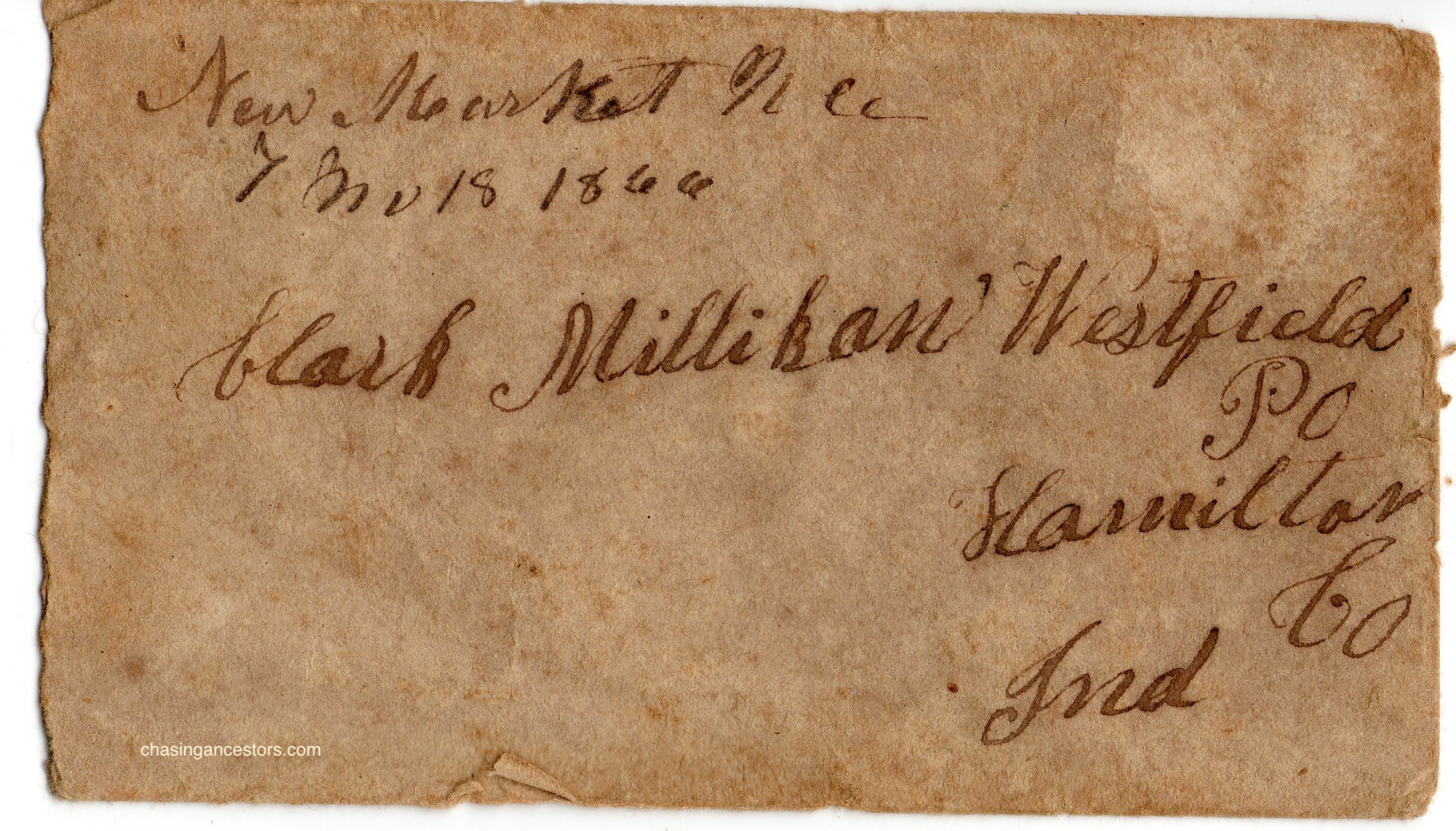
Anyway, if I remember correctly, this box held several of Clark’s property tax receipts, as well as other receipts and papers. One special item in the box was a small envelope addressed to Clark at Westfield Post Office, Hamilton County, Indiana. The envelope originated in New Market, North Carolina & was dated 7th month 18, 1866 [July 18, 1866].

1866 letter envelope copy

The envelope contained a single 9×12 inch piece of paper. Upon closer inspection, I realized the paper was actually divided into 4 sections when folded in half and looking at the front and back, so it was a “four page” letter.

The letter was from Asenath Powell to her brother, Clark Millikan. I scanned it in the four sections, partly because it was too big to scan as a single page and because it might be easier to decipher. Here is the scan of the first section:

1866 letter 1 copy

As mentioned, there was writing on both sides of the page and the ink obviously bled through, so it was a bit of a challenge to figure out what was written. Then I also discovered that, just like many old letters I had, there was no punctuation or capitalization in this letter.

Eventually, I was able to transcribe most of the letter & to make it easier to read, I corrected spelling and added punctuation. I also added a few notations about the people mentioned in the letter. Those notations are indicated by brackets.

(page 1)

July the first 1866

Much respected and often thought of brother and relations one and all, I take this great pleasure of writing you all a few lines to let you know we are all about, but not right well. Lindon [Asenath’s husband] is right poorly. Mother [Sarah Clark Millikan (1800-1869)] was, about five weeks ago, very bad off with bowel complaint and weakness but she is so she can go about a little again. She has been here twice since, but it is a pretty tiresome walk for her for she is very weak. Rebecca Lamb [neighbor] was not well the first of last week. Her mother is about like she has been. Louisa [Millikan] is still very poorly. She has been having the chills this last week but I have not heard of Ben [Millikan] having any one, but he has the fever, that is the Jink fever. As I do hope, those few lines will go so of to hand and find you all well and in good heart. I hope Lydia [Clark’s wife] has got over the chill before now.

(page 2)

1866 letter 2 copy

We have had a very wet Spring and Summer until a few days. It seems like dry weather and it has been very cool. There has been a little frost in very North yet and some think there has been frost there; for they said William’s [Millikan] folks was going to where green-backs grow on the white oaks and the biscuits grow on bushes and we heard that he wanted his wheat crop back that he sold and he was coming back. So they say the frost had bit the money and biscuits too. Wheat is tolerable good this year though not as good as I have seen. Most of the people have their wheat half in corn too. She’s tolerable well. Allen [Millikan] said tell Thee he had corn to buy and nothing to buy with and had a hard time and seen no pleasure at all and wrote no letters to Thee nor no one else.

(page 3)

1866 letter 3 copy

We heard Winborn [Powell] had to leave that country for having some unbecoming talk to a girl. We have not heard any thing but that from him since before Christmas and we have written letter after letter. I want thee to try to find out if Thee can seen anybody from Grant county. We are all very worried about him for fear that somebody has killed him or he is in a lead box some way. Just find out as sly as Thee can is all I have to say. Mother is wanting to hear from you all very bad. She goes to Jefferson once and a while but it doesn’t seem like Clark’s, though she thinks very well of Becca. And if Lydia doesn’t get better, I wish she was back just like she was once. But I do hope as long as you are there you will all get in better health and then you would be better satisfied. For it is a hard case anyway or anywhere though.

(page 4)

1866 letter 4 copy

From Asenath Powell and family To Clark Millikan and family and en…[?]

We must do the best we can. Luzena [Honey] and her great man went to Surry [county] last Spring. They wrote back that they found Aunt Jane well and hearty. They left Oliver at Esther Reicks and Sammy is at George Goddets. I still have to write on the nasty old Rebel paper but I hope I will have some that is better before I wrote any more. Cradling [cutting wheat using a cradle scythe that helped align the wheat stalks as cut] this year was two dollars for a bushel of wheat. Edman and Linsy are beginning to cut out weeds and sprouts from amongst the corn right smart and Woodard can play with the babe right smart and it can begin to sit alone. I am rocking it and writing. I will put in another marriage in this letter, Nancy Beckerdite and Joseph Spencer. I have not had the chance to finish this letter. I have had so much to do it is now the ninth of the month and I will try to finish it if nothing happens.

There was also another note with this letter, which seems to be the continuation of the letter a few days later:

(front) This is the 10th of the 7th month.     We are all well as common today and I hope you are all the same. Thomas Sawyer was hauling his wheat in last third day and his mare started before he was thinking about it and threw him off the wagon and broke his arm and put it out of place too. Jabez [Powell] got a letter from Nathan D. Wilson and Joseph Davidson about Winborn’s capers, so it’s not worth Thy while to bother anything about him. We have not had any rain to do any good for three weeks and corn and gardens are suffering very bad. It looks some like it might rain before long. Parthena [Powell] is very weakly; more so this Spring than common. Clark [Powell] is as well as common. Dock got four letters the other day for Ben [Millikan]. I have not heard whether

(back) there was any one from Thee or not. I think that …[page torn] and Azel’s [Millikan] were aiming to have moved to that country if William’s [Millikan] folks had been satisfied. I have not seen Angelina [Millikan] since the day Lydia started, but I think I will go to see her if I live. They were all well about three weeks ago. I heard that you had not gotten acquainted with but one woman. If that is so, I will never come there for I might get sick, or some of the family and no one to come to see us some rights. The people out there are so clever and so they are very unclever. But some are always up on extremes. When I read a letter from Thee I am certain what it says, so I hate …[page torn] to read them as often as naught. So write soon as Thee gets this for we are…[end of page]

So Asenath wrote to let Clark know how their friends and family were faring after the Civil War. New Market, NC was a small community in Randolph County, NC. Clark’s wife, Lydia, and his family had moved from there to Indiana in 1865, at the close of the war. As mentioned in a previous story about Clark, he had moved to Indiana after deserting from the North Carolina Infantry.

I found a little more information for the people Asenath wrote about:

from page 1:

  • Louisa Millikan=possibly Martha Louise Millikan (1855-1879), daughter of Benjamin Millikan who is mentioned next
  • Ben=Benjamin Millikan (1831-1915), cousin of Clark and Asenath who went to Indiana with Clark’s family, then returned to NC after his wife died. It is believed that Clark and Ben “traded” their land in Indiana and North Carolina.

from page 2:

  • William Millikan (1835-1875)=brother of Benjamin mentioned in page 1. He moved to Indiana. Per the letter, it seems they were looking for a place where “green-backs” (or money) grew on trees.
  • Allen Millikan (1839-1921)=brother to Asenath and Clark

from page 3:

  • Winborn Powell (1844-1911)=brother-in-law to Asenath, moved up to Indiana during the Civil War, probably to escape being drafted into the Confederate Army. Sounds like he was up to mischief in Indiana & Asenath was concerned about his welfare.
  • Jefferson & Becca=unsure who this is. I don’t know if Jefferson is a person or place. I wonder if “Clark’s” is talking about Clark Millikan’s farm?

from page 4:

  • Luzena Honey (1831-1915)=sister to Asenath and Clark. She first married Franklin McKindre Reichs/Rike/Rich (1833-1863). They had two sons, Lewis Oliver & Samuel. Luzena married Ambrose Honey in 1865. I can’t say I have much information on Luzena and her husbands, hence the question of her first husband’s last name. Esther Reicks may have been Franklin’s mother, but I will have to dig deeper to find that connection. I do not know who George Goddets is. Anyway, while Luzena and her new husband, Ambrose went traveling—perhaps on a honeymoon, they left her young boys in the care of family & friends.
  • Aunt Jane=possibly Jane Millikan, whom some sources list as sister to Samuel Millikan (1789-1870). I haven’t found much about her either.
  • Edman, Linsy, Woodard, “the babe”= Asenath’s children, Edmond (1860-1927), Thomas Linsey (1861-1940), Woodard Martin (1862-1939) and “the babe” would be Cornelius Calvin (1866-1898).
  • Nancy Beckerdite & Joseph Spencer=friends of the family, members of Marlboro Meeting, she was born in 1828 & he was born in 1800. She was his 3rd wife.

from the additional page:

  • Thomas Sawyer=neighbor, listed as 28 yrs old in the 1860 US Census.
  • Jabez Powell=probably Asenath’s father-in-law.
  • Nathan Wilson and Joseph Davidson=listed in Grant county, IN in the 1860 US Census, both were listed as born in North Carolina. Regardless, they were probably family friends who were able to find out about what Winborn Powell had been up to and could report back to his family that he was alright.
  • Parthena and Clark Powell=Parthena Millikan (1829-1905), sister to Asenath and Clark, married Thomas Clarkson Powell (1828-1913), brother to Asenath’s husband, Lindon Powell.
  • Azel Millikan (1829-1890)=cousin of Asenath and Clark.
  • William Millikan (1835-1875)=cousin of Asenath and Clark, brother of Azel. Also mentioned on page 2.
  • Angelina Millikan (1852-1926)=Clark’s daughter from his first marriage to Nancy Adams. She may have stayed with relatives for a while instead of traveling to Indiana with Clark’s wife, Lydia and the other children. In the 1870 US Census, she is listed as living with an aunt and uncle in North Carolina. Eventually she did move to Indiana with the rest of the family. She reportedly brought the little box with her.

What happened to Asenath and Lindon Powell and their family? They show up in the 1870 and 1880 US Census records in Hamilton County, IN, living near Clark and his family. After that, they moved to the town of Friend in Saline County, Nebraska, where they lived the rest of their lives. Lindon died in 1909, and Asenath in 1914. Several of their children also raised their families in Friend, NE.

One more thought: in her letter, Asenath complains about writing on “nasty old Rebel paper” but as bad as it was, that paper has held up through the 155 years since.

© MJM 2021

A 50th Wedding Anniversary Celebration

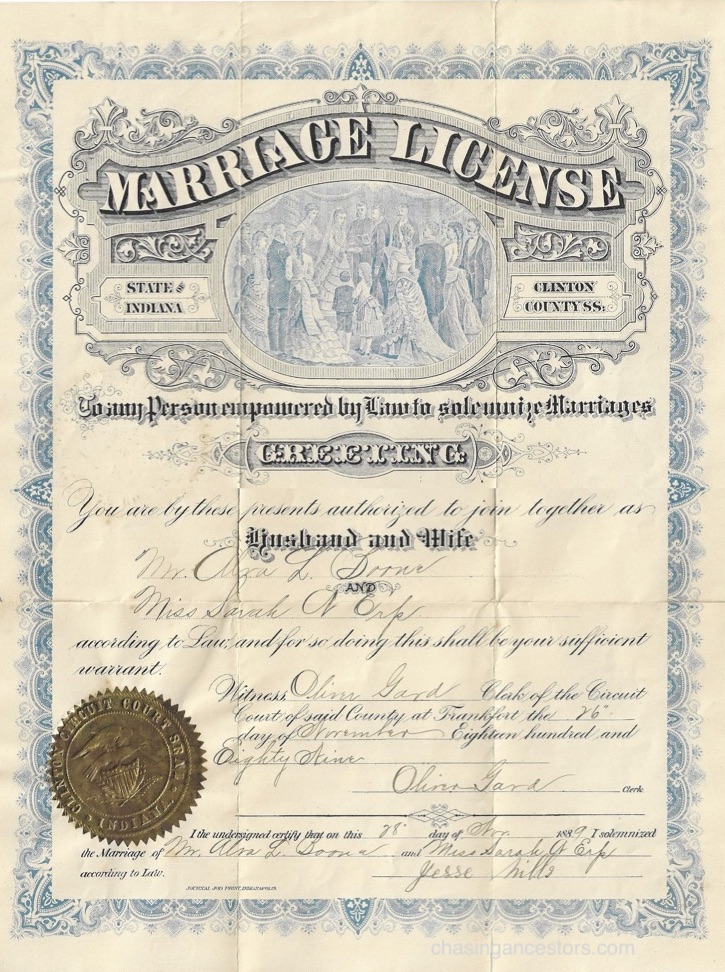
Alva Lorenzo Boone (1861-1945) and Sarah Alzada “Allie” Erp (1869-1955), my great great grandparents were married in Clinton County, Indiana on November 28, 1889.

AlvaAllieBooneMarriageCertif copy

Alva was 28 years old and Allie was 20. My grandmother, Margaret Millikan McKinley, told me that these two tintypes were of Alva and Allie at the time they got married.

The couple celebrated their 50th wedding anniversary in 1939. The event was noted in the Indianapolis Star, Noblesville Ledger, and Sheridan News. The newspaper clippings indicated that they “started housekeeping” in the Dillard community and moved to their home “on the cement road east of Sheridan” in 1909. They worked the farm most of their life together.

The following picture of Allie and Alva was published in the newspaper as well.

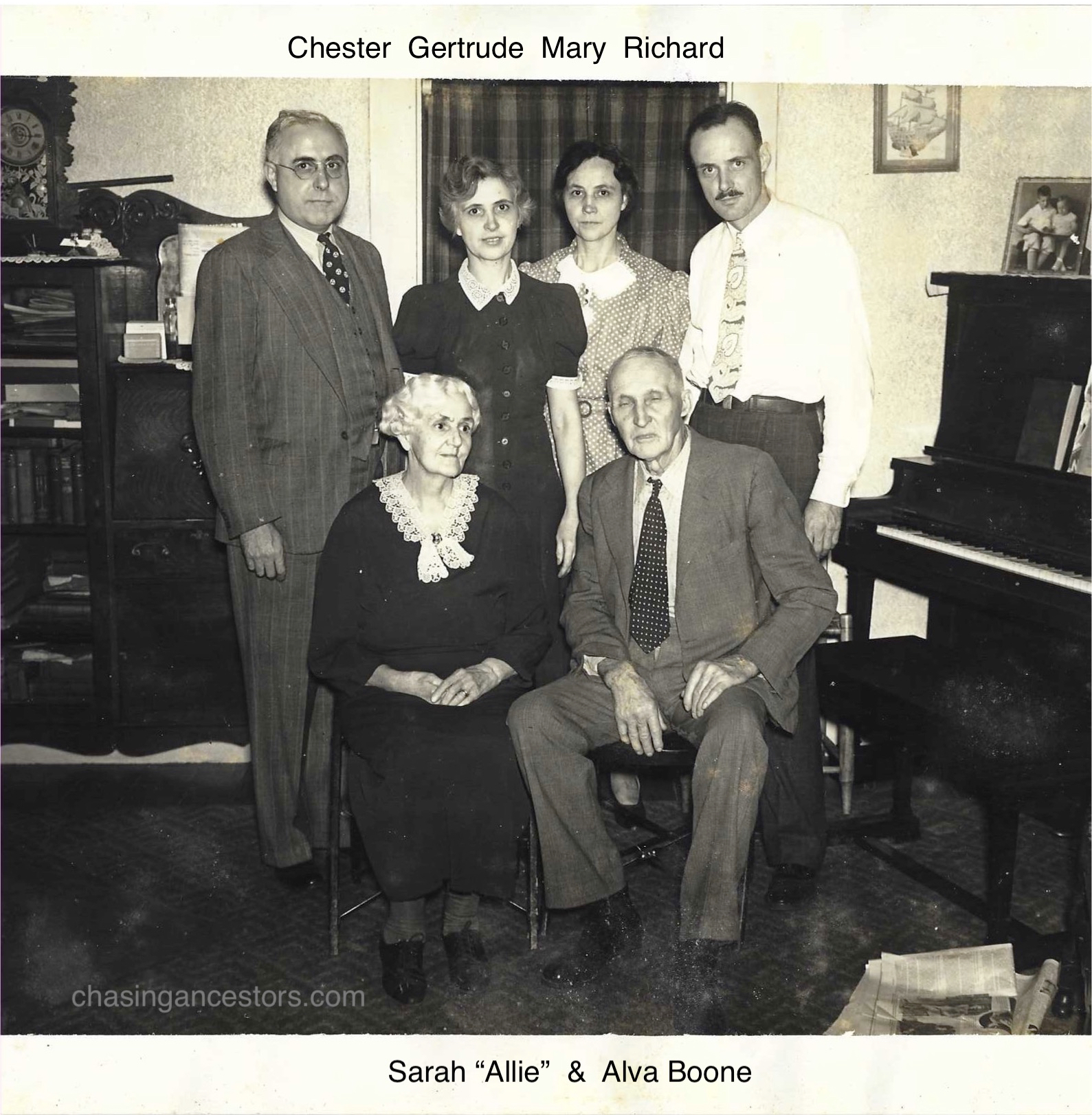
Allie&AlvaBoone50th_anniv_in_home copy

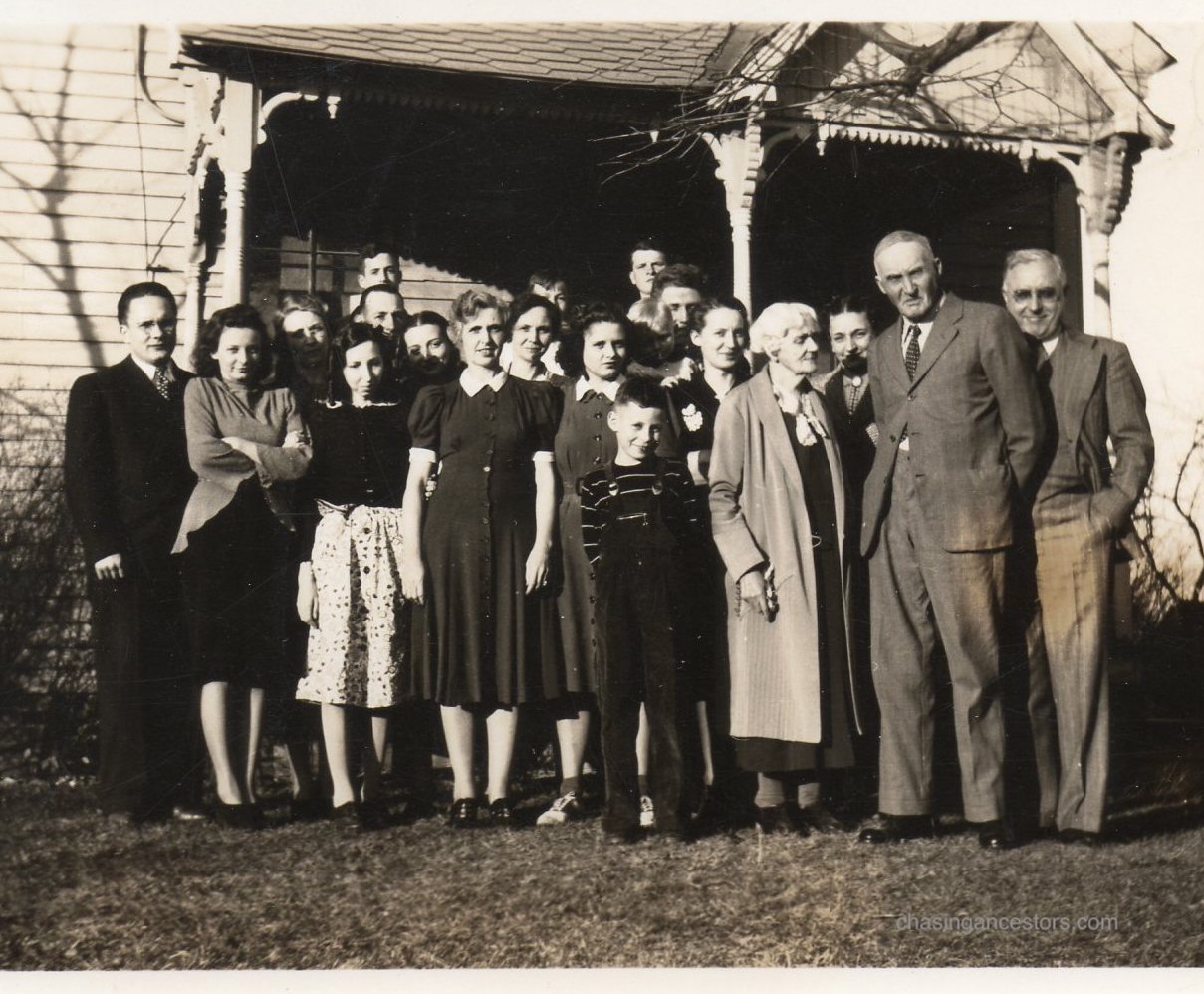
Their entire family of 4 children, Chester Emmett, Rachel Gertrude, Mary Geneva, Richard Edwin; 8 grandchildren James & John Boone, Keith & Barbara Parr, Margaret Millikan McKinley, Frances Millikan Haskett, Betty Lou Millikan, Arza Clark Millikan, and one great grandchild were at the celebration. Photos were taken of the whole group. Their son, Richard Edwin, is missing from this picture as I expect he was behind the camera.

lg_group_Boone50th_anniv copy

Pictures were also taken of each family group. Interesting to note that Allie shows up on the porch in the background of many of the pictures.

Chester Emmet Boone’s family came from Connersville for the festivities.

Chester_Boone_family1939 copy

Rachel Gertrude Boone Parr and her daughter, Barbara came from New Castle, IN. Her son, Keith and his wife, came from Indianapolis, IN.

Parr_family1939 copy

Mary Boone Millikan and her family all came from Sheridan, with the exception of her daughter Margaret Millikan McKinley and family who came from Lebanon, IN.

Millikan_family1939 copy

Back row: Loran McKinley & son, Loran Jr, Arza Clark Millikan, Margaret Millikan McKinley, Robert Haskett. Front row: Arza Millikan, Mary Boone Millikan, Betty Lou, Frances Millikan Haskett

Richard Edwin Boone and his wife, Pauline came from Indianapolis, IN.

REdwinPaulineBoone1939 copy

The anniversary party included decorations of “large yellow and bronze chrysanthemums, golden bell place cards and a large wedding cake, which was decorated in pink and gold.” The cake was provided by Keith Parr.

Allie&Alva50thAnniv_w_cake copy

All in all, seems like they had a good time celebrating this milestone.

One final picture of Allie and Alva and their children:

AllieAlvaFamily50thanniv copy

Allie and Alva stayed in their home east of Sheridan until 1945, when they moved to the home of their daughter, Mary. Alva died in 1945. Allie spent the rest of her life in Mary’s home, and died in 1955.

© 2020 MJM

The Trophy

When I visited my Grandmother, Margaret Millikan McKinley (1917-2007), through the years, I remember seeing a trophy high up on a bookcase. I never looked at that trophy very closely & never asked about it. Then, my Great Aunt, Frances Millikan Haskett (1918-2018), displayed that trophy at her 95th birthday party & gave it to one of her nephews.

IMG_1161

I finally looked at it and read the inscription: “Sheridan Dairy Assn. Awarded to Arza H. Millikan, Sweepstakes Bull, Sheridan Indiana, Aug. 16, 1916”

So then things started to make sense.

I found some Sheridan News articles about the Dairymen Association Picnics on the NewspaperArchive.com website.

The page-one article from August 18, 1916 indicated that the 1916 picnic was the 2nd annual event and hailed it as a “dairy picnic and bull show.” There were estimated to be two to three thousand in attendance. There were also “several exhibits of machinery silos, etc.” Not to mention the merry-go-round and ice cream stand! A letter I have that Arza’s Aunt Alice Millikan Cox (1864-1926) wrote to her daughter, Carrie (1888-1985), said that there were “200 gallons of ice cream given away and 30 men to dish it out.”

The article stated that “Sheridan has become, … one of the big milk producing centers of the country & the greatest in Indiana.” It listed the names of the Sheridan Dairy Association officers: M.M. Evans, President; A.H. Millikan, Vice President; C.O. Ogle, Secretary-Treasurer. The officers and the Dairy Association were commended for holding a dairy show which had “good talks on dairying and it offered a great opportunity for displaying and studying and selling high grade thoroughbred dairy cattle.”

The Sheridan News article listed the winners of the Cattle show. Turns out Arza won more than one award. He won 1st place for “Bull Class 1, 3yr. and over,” Sweepstakes Bull, Best Jersey Bull and Bulls Sold in Sale. Of the four silver cup trophies awarded, Arza won three, all for Jersey Bulls. He also won $77 in prize money with $70 of it being for one bull. I don’t know what happened to the other trophies.

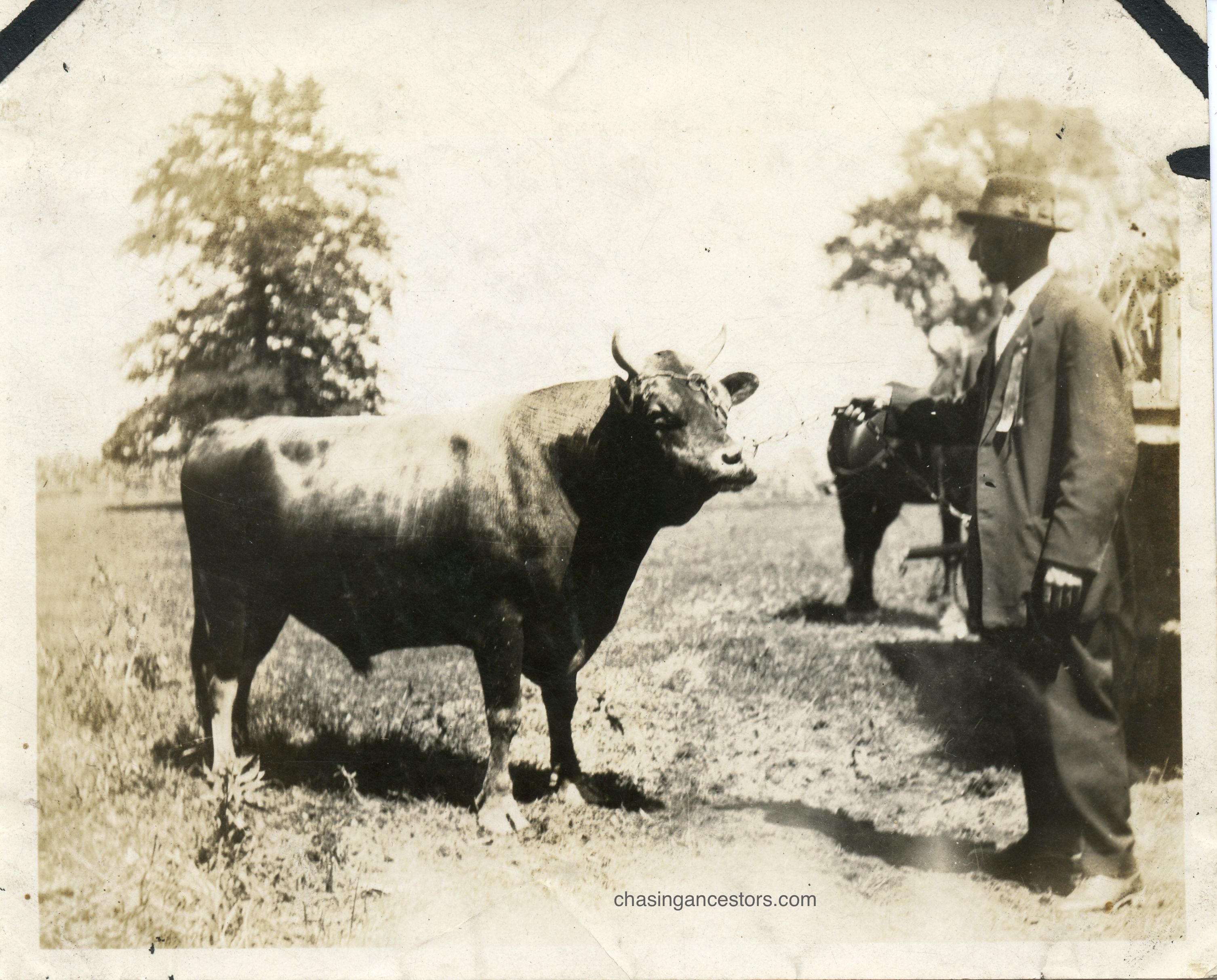
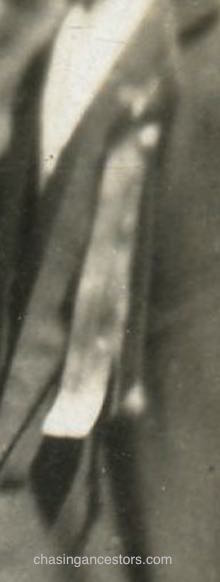
The letter from his Aunt Alice also mentioned his winnings. She said he got a “nice blue bow with a button and a bow with a picture of a bull on it” for a bull that he bought at the show. That may have confirmed something that I saw in a picture of Arza and a bull.

Millikan455Arzaprizebull

Is Arza wearing a ribbon on his jacket?AMribbon

Is this one of the prize-winning bulls from this Dairy Picnic? At this point I don’t know.

Turns out that Arza also won prizes for his cattle at the first Dairy picnic in August, 1915 and the third Dairy picnic in 1917. All of this was reported in the Sheridan News from August 20, 1915 and September 14, 1917.

In 1915, Arza won 1st prize for the Class 1 Bull category and the Sweepstakes Bull Prize. He also gave one of the instructional talks at the picnic.

In 1917, he won the $20 trophy for the Sweepstakes Bull, the $10 trophy for the best Jersey bull and the $25 prize for the “best heifer sired by a Park Farm’s bull.” He also won the $5 1st prize for the “Bull 1yr. old, under 2” and $2 3rd prize for the “Heifer 1yr. old, under 2.”

Two more pictures of Arza and his bulls:

Millikan460Arzabull

Millikan459Arzabull

Perhaps one of these was a “Prize Winner.”

Regardless, it seems that my Great-grandfather, Arza H. Millikan (1883-1964), was gaining a reputation for the quality and pedigree of his bulls & dairy cattle.

© MJM 2019


Farm Girls

FranMarg

Frances & Margaret Millikan


My Grandmother, Margaret Pauline Millikan, was born September 17, 1917. Her sister, Miriam Frances Millikan, was born November 20, 1918. Their parents were Arza Millikan (1883-1964) and Mary Boone Millikan (1897-1992). They grew up on the family farm on Mulebarn Road near Sheridan, Indiana. The two girls were almost inseparable growing up.


Farm life was full of responsibilities. Feeding the chickens was one chore the girls could do while they were rather young.

MargFranchickens

Grandma said they also had the responsibility of driving the cows “to the 30.” The two girls would take the herd of 8-10 cows from Arza’s farm down the road about half a mile to 30 acres of land that his Mother, Martha Ellen Barker (1858-1932), inherited. Grandma described this chore when I interviewed her in 2006:

“Frances and I drove the cows every day…We were 10 years old when we started herding the cattle from the barn lot down to the corner. You had to keep them from going west or south, you had to get them turned, be sure that the gates were locked on everybody’s fence…We drove those cattle from the home over and over again to the corner again, back up to the 30…We’d drive those cattle back and there was no fence. We had a lane we drove them back and part of the time that would be a big corn field clear back to the woods. You had to keep them on that lane and get them back to the 30…There was a big water tank like the old water tanks were that you pumped a full tank of water. And we’d pump a full tank of water and walk home. Then go back and get them in the evening. We’d pump a tank of water at the barn for when they got back. We did that for a long time.”

She also remembered other chores on the farm: “And Frances and I worked in the field. I remember one time when I—Daddy had plowed that big field over at the 30 that was East of the woods and I rode a drag. I mean a drag that was just heavy boards with a couple of 3 rocks on it to help hold it down. And it had dried out…and I could hardly ride the drag. ‘Course you stood up on it, but it just pulled my arms ’til I was nearly sick. That field was so rough and the disc just didn’t cut it down. Daddy had a tractor of course and we had disked it but it didn’t work. I never rode the disc—that was a little dangerous because you’ve got all those cutters. But I had a harrow and that drag and that was one of the hardest jobs I ever did in the field.”

Margaret and Frances helped load beans: “Daddy and Grandpa Millikan would pitch the beans, work on beans on a wagon…They’d pitch those up and we’d have to cram them down and move stuff around. We did the same thing with hay.” Grandma remembers one time when she was a teenager and almost had a heat stroke when helping with the hay. They also helped plant potatoes and load the silo with corn. “Those kind of were dirty jobs; you didn’t have any bathrooms or bath tubs to clean up in. Used water in an old tub.”

But farm work wasn’t all they did growing up. They would play tag in the yard at night with neighbor kids. They would read a lot. Their Father, Arza, worked his Grandfather’s farm when the girls were little (Clark Millikan died in 1926). They would accompany Arza to the farm either by wagon or in “the old open touring car” mornings and evenings when he would go to do chores. She remembers “we got roller skates and learned to skate on the sidewalk that went up to the front door.” And she remembered “turning somersaults in the yard, because they kept the yard mowed and we didn’t at home…Frances & I were turning somersaults in there one day and I don’t know if it was Aunt Allie or Aunt Angie that came out and told us the chickens had been in that yard and they didn’t want us to get the chicken manure in our hair. Such a crazy thing to remember.”

When Margaret started school, Frances went along. The two sisters stayed close all of their lives. They double dated when they were teenagers. They worked together at the Sheridan Grille restaurant before Margaret got married and Frances went to college. Margaret married Loran McKinley in 1936 & Frances married Robert Haskett in 1939. They started raising families & eventually Margaret settled in Sheridan and Frances in Westfield. Both ladies were active with the church & supported missions.

In the 1970’s Mary Millikan sold the farm and moved to a house next door to Frances in Westfield. Margaret and their other sister, Betty Lou, lived with Mary. Eventually, Margaret and Frances moved to a Quaker-run Senior Apartment complex in Westfield. Margaret died in 2007, she was 90 years old. Frances continued on until this year. She died April 1—Easter Sunday. She was 99 years old.

I’m sure there were many more stories that we would have loved to hear from Margaret and Frances. They shared what they wanted to, or what we asked them about. As it is, we do know they were shaped by their early years working hard on that farm near Sheridan, IN.

horseMargFranMargaret & Frances with one of the horses at their home near Sheridan, IN.

© MJM 2018