The Lectern Bible and the Small Town Church

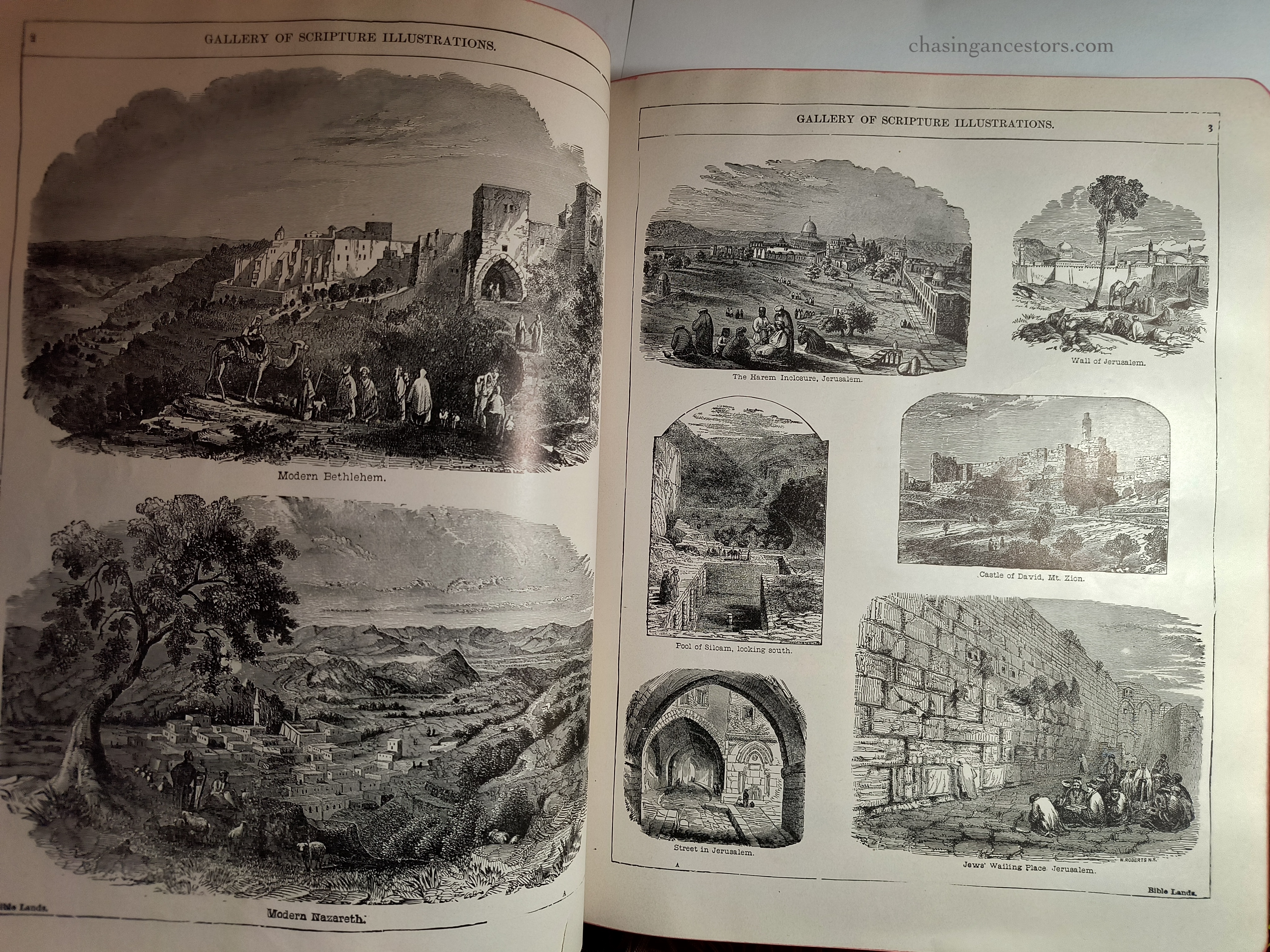
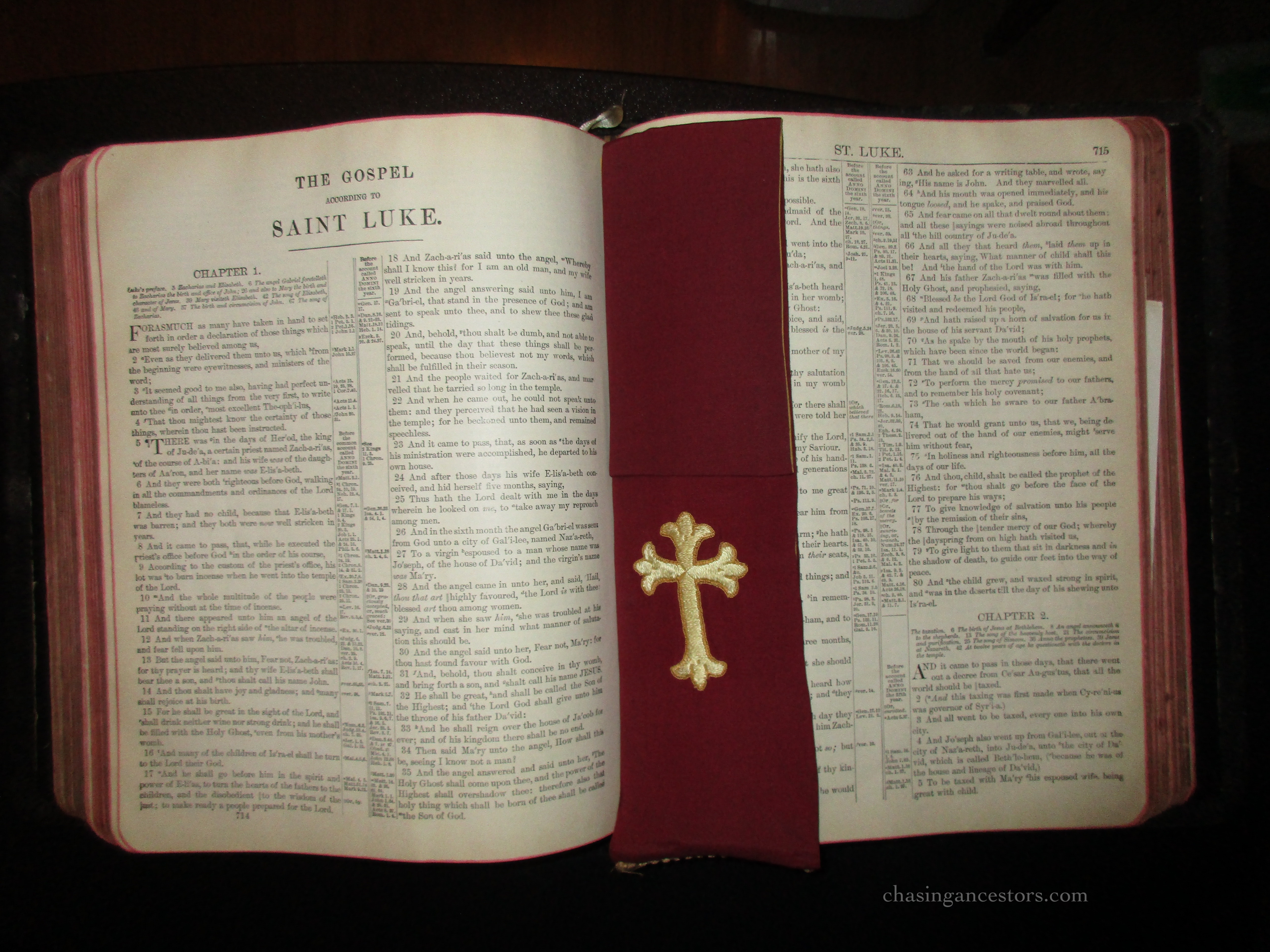
Several years ago my uncle, Leroy McKinley (1941-2023), gifted me with a box of Bibles. Among the many small personal Bibles were two large Bibles. One was the Erp family Bible & the other was what appeared to be the Lectern or Pulpit Bible from a church. I can’t remember where he said he got this Bible.

The Bible is a large black leather-bound book with reference pages and illustrations. There is no printing date that I could find.

IMG_20240121_115103867_HDR copy

It even contained the bookmark that would have matched the altar paraments.
IMG_1654 copy

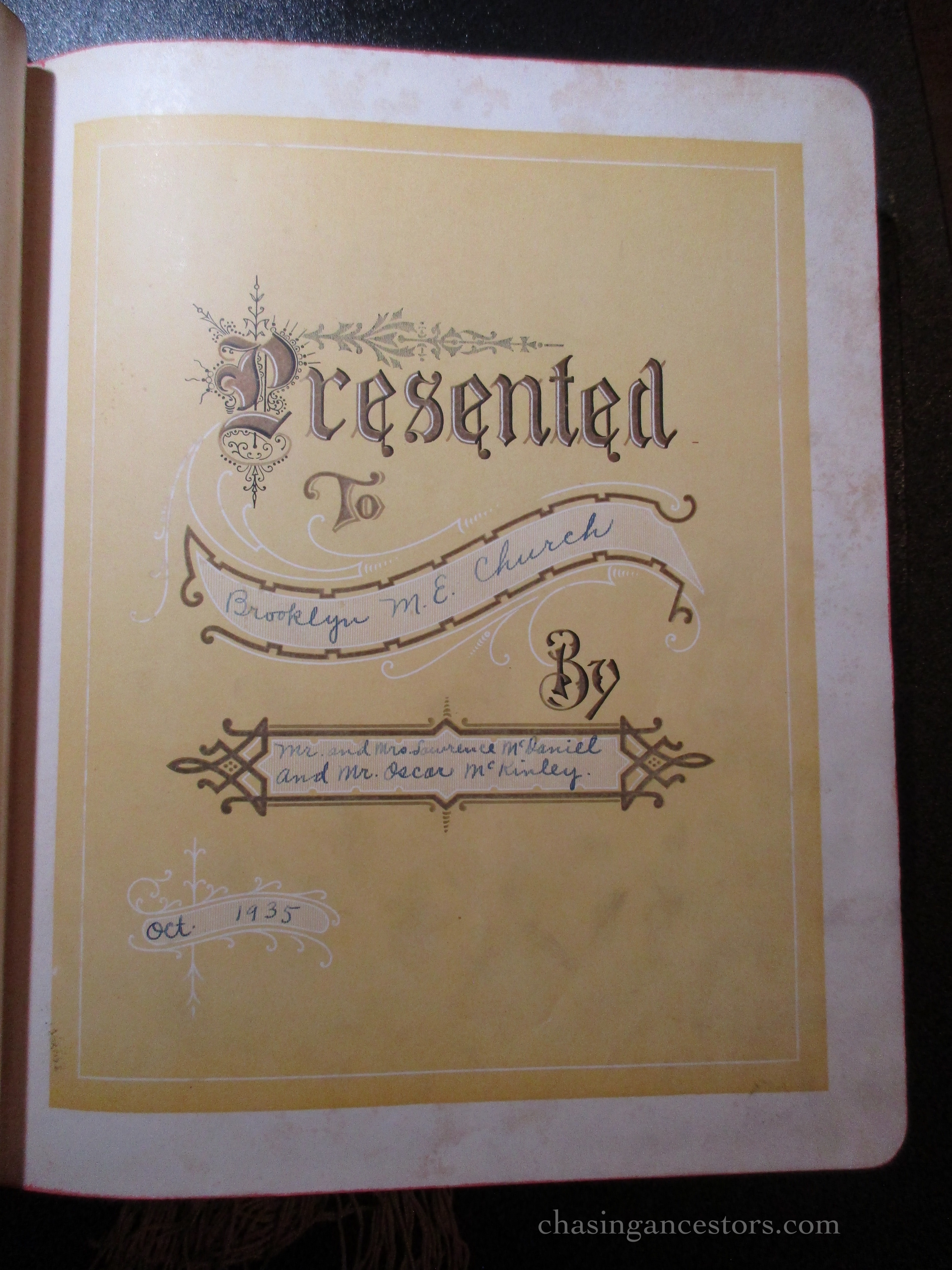
But what first intrigued me about this Bible was the inscription in the front:
IMG_1655 copy

The Bible was presented to Brooklyn M.E. Church by Mr. and Mrs. Lawrence McDaniel and Mr. Oscar McKinley in Oct. of 1935. Oscar McKinley (1887-1969) was my Great Grandfather.

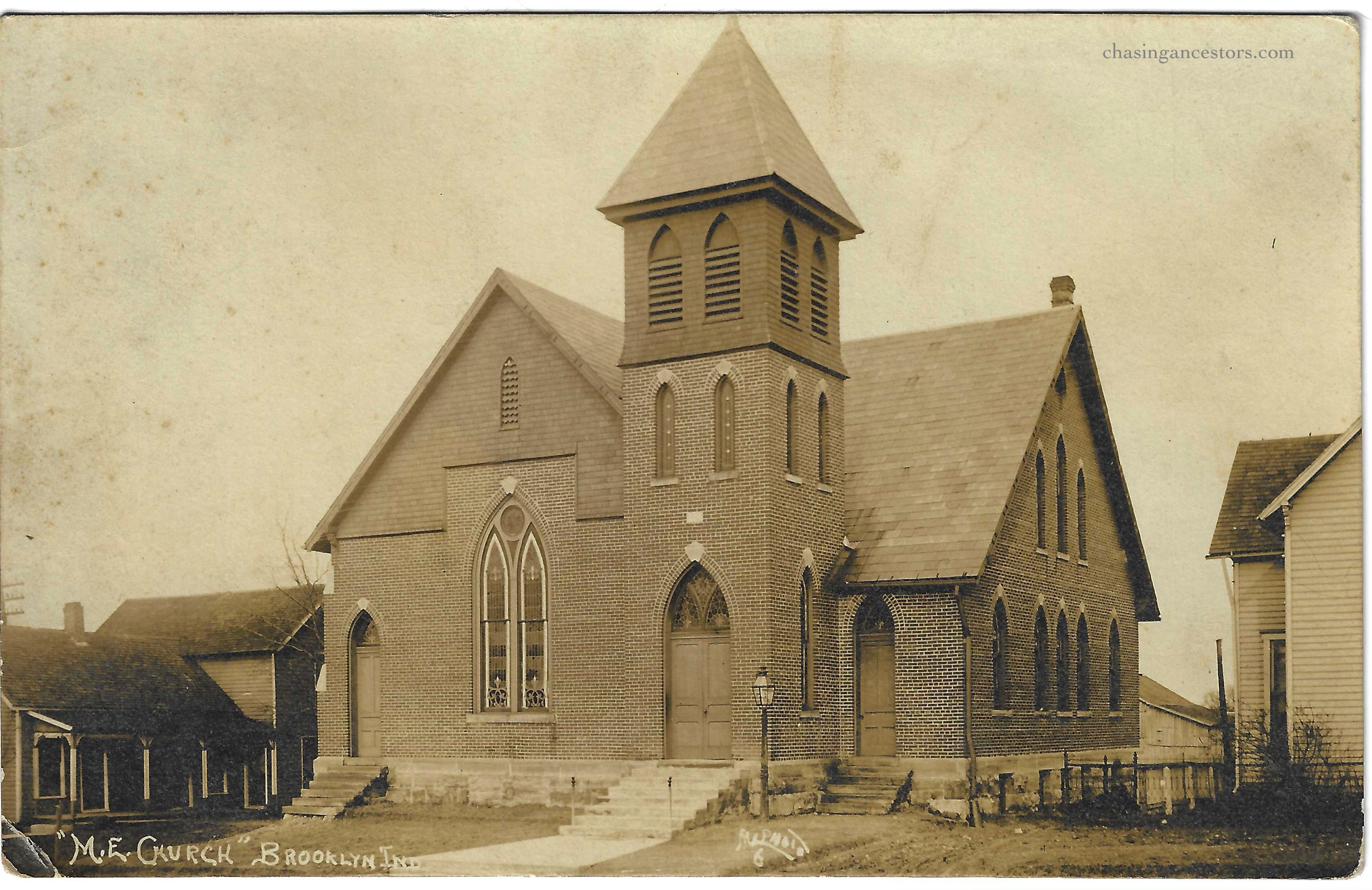
Brooklyn Methodist Episcopal Church was located in Brooklyn, Indiana, a small town in Morgan County. Brooklyn was where my Great Grandfather lived and where my Grandfather, Loran McKinley, Sr. (1916-2003) grew up.
BrooklynMEChurchpostcard copy

This undated postcard picture of the church was in the collection of photographs I received from my Grandfather.

The other fun thing about this Bible is the additional pages that listed the members of the church at the time the Bible was presented.

“Members of the Brooklyn, Ind. M.E. Church at the time this Bible was presented—October, 1935.”
Trustees: J.B. Abrell, Lawrence McDaniel, Oscar McKinley, R.C. Minton, Dr. John S. Spoor, Samuel Swope, H.C. Zenor

Members:
Abrell, J.B, Bertha, Forrest; Bradford, Georgia; Caldwell, Lee, Rilla, Ruby; Copeland, Mrs.
Clara, Lee, Martha; Clark, Minnie.
Clay, Mary, Viola, Ethel, Emma; Dillender, Fred; Edson, Nina, Roger, Robert; Forrester, Sarah, Andrew, Bennie, Ida, William, Mrs. Wm, Richard, Katherine; Fleenor, Maxine, Rex; Gilbert, Laura, Earl, Bill; Griggs, Loren; Hensley, William, Fannie.
Hornaday, Chas, Catherine; Holdaway, Mary E; Jones, Senith, Wallace, Mrs. Mabel; Kincaid, Otis; Matthews, Annie; Morgan, Avis; Morrison, Thelma, Mrs. Harvey; Minton, Carl R., Rose; Moulton, Roy, Mrs. Roy; Monical, F.S., Mrs. F.S.; McNeff, Clyde, Julia, Dorothy, Robert, Leslie. McDaniel, Lawrence, Eva, Sadie; McKinley, Oscar, Loren [Loran]; Plummer, Lillie, Jane; Powell, LeOtis, Beverly, Opal Theresa; Passmore, Josaphine; Riggs, Chester (Eugene, next page); Ritzler, Amelia, Charles; Richardson, Mrs. Dora; Rathrock, Hattie; Simpson, Edith; Rike, Effie; Rike, Mrs.; Rooker, Bernice; Rinker, George, Jr.; Rinker, Geo. W., Eliza, Ida Ann.
Rinker, Eli; Rober, Martha; Riggs, Eugene; Rymerson, Bessie; Swope, Samuel, Mrs. Celia, Clarence; Sanders, Martha; Self, Maude, Harry; Spoor, Dr. John S., Iola; Soots, Frank, Dolly, William; Stafford, Violena; Shelly, T.Z., Mrs. T.Z.; Smith, Mary, S.R., Armina, Betty Lou. Swarens, Rev. A.L. Pastor 1934-1936, Mrs. Mae; Throckmorton, Mrs. Perry; Wall, Hallie; Woodard, Pruah; Williams, Geo, Ida, Garnet; Waltz, Maude, Mary, Roy; Welty, Rose; Wiley, Rosemary, Kathleene, Rose; Young, Mrs. Gerald; Walker, Carl; Wratten, Lottie Mae; Zenor, Harry C., Mrs. Nellie.

I looked at the 1930 and 1940 US Census records on Ancestry.com and found that most of the members of the church lived in the town of Brooklyn. I also learned that some were the only family members listed on the roll, a husband or wife was not listed. I saw that not many children were listed, but I’m not surprised as children were probably not considered members until they reached teen or pre-teen age.

From the census information, I found that the church members had a variety of occupations. There were two telegraph operators for the Penn R.R. Co.; a station agent for the Interurban R.R.; a barber; a few bookkeepers for various industries; several teachers, both male and female, and a school principal and a superintendent. The Postmaster of Brooklyn was a member of the church as was a postal clerk. There were two attorneys, one of which was also a furniture buyer. One member owned and operated a filling station while another owned a garage. Of course there was a Dry Goods store owner. The two main industries in Brooklyn, the Brooklyn Brick Company and the Indiana Drain Tile Company were well represented in the membership w/ laborers as well as the superintendent for the Brick Company and the Secretary/Treasurer for the Tile Company.

I also found a few family connections on the membership roll. First, as mentioned already, my Great Grandfather, Oscar McKinley (1887-1969) was listed along with my Grandfather, Loran (1916-2003) who was 19 yrs old in 1935. Then there were the Caldwells. Lee Caldwell died in 1936 and his widow, Rilla (1894-1982) married Oscar McKinley on January 31, 1941. Oscar had been divorced from his first wife, Gertrude (Portis) McKinley (1888-1967) for several years by then. Another church member, Carl Minton (1867-1936) was an attorney and was a first cousin to Gertrude (Portis) McKinley, my Great Grandmother.

I searched newspapers from the area through Newspapers.com and found more surprising connections to my family. Violena “Lena” Stafford (1878-1968) was married to Benjamin Franklin Stafford (1874-1946) who was a half first cousin once removed to my Grandfather, Loran McKinley. Lena was the sister of another church member, Hallie Wall. Also, Mrs Laura Gilbert (1856-1946) was a 2nd cousin once removed from my Grandfather, Loran. She was the daughter of Noah J. Major who wrote “The Pioneers of Morgan County, Memoirs of Noah J. Major.”

There were other family groups who were part of the membership of the Brooklyn M.E. church. Georgia Bradford was a sister-in-law to Lawrence McDaniel. Maxine and Rex Fleenor were the grandchildren of Senith Jones. Catherine Hornaday was Maude Self’s sister. Mary Smith was the mother of Mrs. Roy (Ethel) Moulton. Hattie Rothrock was the mother of Edith Simpson. Eugene Riggs was the grandson of Charles Hornaday. Mrs. Perry Throckmorton was the mother of Rilla Caldwell. She was also the sister-in-law to Dolly Soots. Rosemary Wiley was the daughter of Jane Plummer. I expect these families celebrated many milestones and mourned losses with each other at the Brooklyn M.E. Church.

So what about the church? Why was the Bible in my possession and not still in the church? What is the history of this church and what happened to it? I searched Newspapers.com and a few other sources to find the answers. There were several articles in the Martinsville, IN Reporter-Times newspaper that chronicled the church’s history.

From what I could find, the Brooklyn Methodist Episcopal Church congregation was established in 1821 and first met in a shed on someone’s land. The first brick structure may have been erected in 1869 & was replaced by the present building in 1895. The stained glass windows were donated by prominent citizens who were members of the church. There were modifications made to the building through the years as noted in later photographs.

In 1908 they ordered 75 hymnals and organized a Sunday-school orchestra. In 1914, the congregation raised $500 for repairs to the church. There was a Ladies Aid society that had regular meetings and sold food and desserts at local fairs. One meeting in November, 1932 had the ladies “tacking two comforts” that they presented to a family who had lost their home to a fire.

In January of 1934, the church was the location of the funeral of Jap Miller, the “mayor of Brooklyn.” Mr. Miller was made famous by James Whitcomb Reilly in his poem, “Jap Miller down at Martinsville.” He also operated a store in Brooklyn.

The church was used for school graduation ceremonies in the 1930’s, both for the Clay township high school and the 8th grade graduates. It also hosted exhibits for the 4-H clubs and Home Economics clubs. In 1943, there was a sewing and cooking exhibit and home canning demonstration.
img479BrooklynMEchurchgroup copy

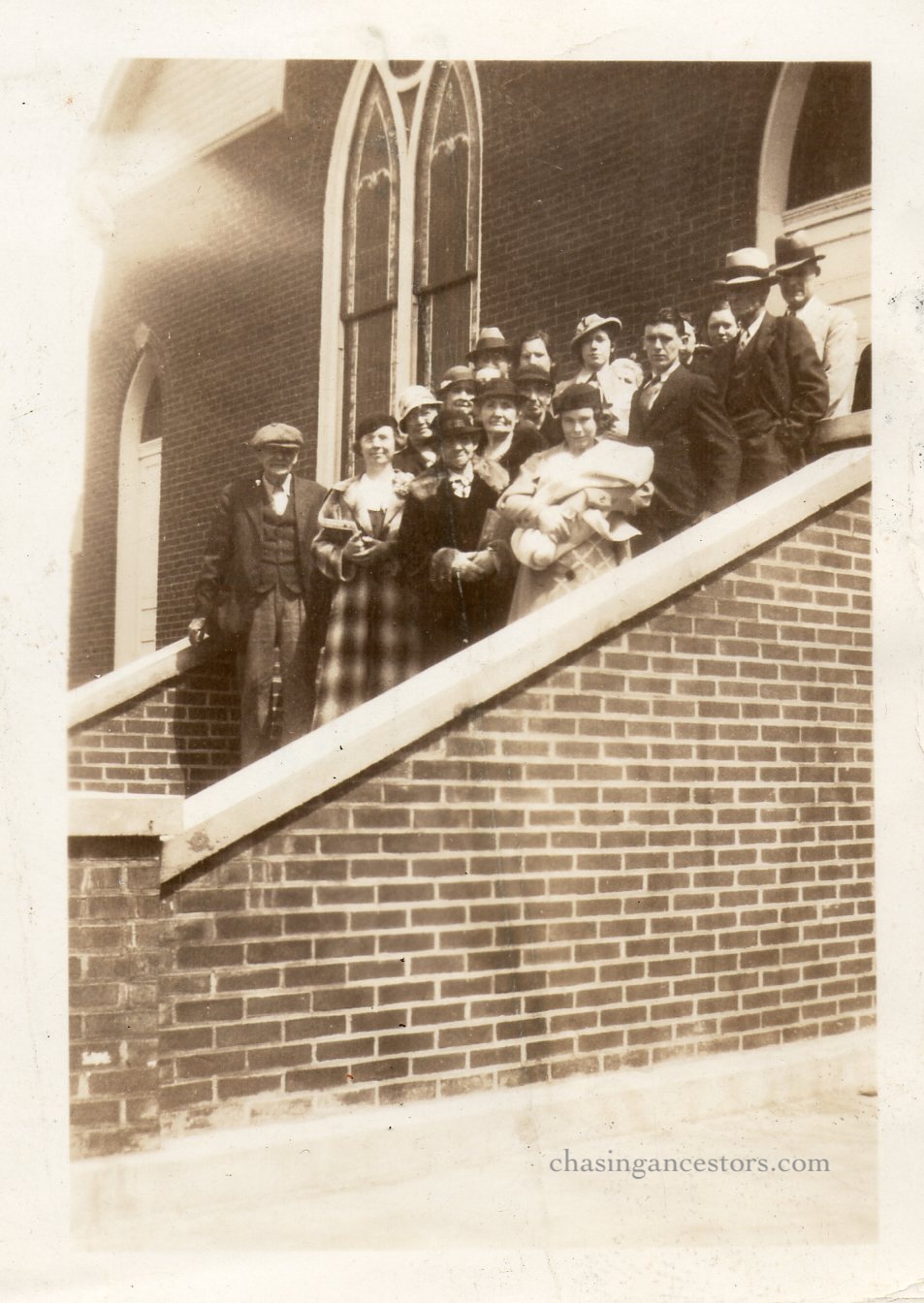
This undated photo was also in my Grandfather’s collection. I wonder if it commemorated the baby’s baptism. There was no identification given for any of the people in the picture, although I think my Great Grandfather, Oscar McKinley is the man at the top of the stairs in the light colored suit. This picture also shows how the stairs were modified from the earlier picture.

There was a special service held in August of 1940 to dedicate new memorial hymnals. Many were donated either in memory of or in honor of someone dear to them by the members of the congregation listed on the 1935 roll.

In the 1940’s they shared services with Monrovia Methodist Church in Monrovia, IN. The newspaper would indicate whether morning or evening services were at Monrovia. The attendance in March of 1942 was 72.

The first WWII casualty from Brooklyn was 20 year old Charles Arnold, Jr, who died in Italy. His memorial service was held in the church on January 16, 1944.

In September of 1945, the church had a special homecoming service and picnic to celebrate the 50th Anniversary of the morning worship period. So I guess the Bible may have been presented in 1935 in honor of the 40th Anniversary.

The church held ice cream socials and taffy pulls and spelling bees as well as other activities through the years. Revivals were also held at the church.

On May 25, 1969, the church closed as it could not meet the obligations to the denomination. Many children attended the church at that time and the assessment for financial obligation was determined by the number of people on the rolls. According to an article in The Martinsville Reporter- Times from June 2, 1969, and an article in The Martinsville Democrat June 6, 1969, the Sunday school attendance outnumbered the regular worship attendance by 2 to 3 times. Worship attendance was averaging around 30 people, while the rolls listed 142 names. The church was assessed $14.83 for each person on the roll & $33 for each $100 paid to the pastor. The church was reported to be financially solvent at that time, but not able to keep up the obligation to the Methodist Conference. Options to merge with other congregations were turned down for various reasons; as well as the possibility of staying open only as a Sunday school congregation. Apparently no deed could be found for the church, so the Conference was not able to claim the property.

The article from the Democrat mentioned a lady, Mrs. Frank Soots, age 83, who had been a member of the church since her childhood and who was present when the church doors closed. She was actually Dolly Throckmorton Soots & she was listed with her husband on the church roll from 1935.

The church building was used by other denominations & religious groups through the succeeding years. It is now listed on a Realtor site for sale as a commercial site. The address is 9 N Church St. Several photographs are posted of the interior and exterior of the building.

20240513brooklyninmechurchbldg1-copy

I took this picture a week ago on a recent trip through the area. The building is a bit run down, the stained glass windows are long gone & the yard is overgrown. It is just a building. The people who passed through its doors from generation to generation to gather as community to worship their Lord are the real legacy of Brooklyn M.E. Church.

©MJM 2024

Timeline of an Army Career

McKinley015

Margaret, Loran Jr, Loran McKinley Sr.

On May 26, 1938, my father, Loran R McKinley, Jr., “Mac,” was born in Sheridan, IN to Loran R McKinley (1916-2003) and Margaret Millikan McKinley (1917-2007). He spent his childhood on farms in Indiana, played basketball in high school as any Hoosier boy would do, and went off to Taylor University in 1956. He was quite the prankster in college. He told stories of stuffing toilet paper in the pipes of the pipe organ in the chapel and rigging a car up on blocks so it was just barely off the ground to clear the wheels so the person had no idea that it wouldn’t go anywhere until they tried to drive the car. He told me that he really wasn’t ready for college, and he eventually was suspended from Taylor University for the 1959-1960 school year after an incident involving “misuse of a test” or, in other words, for stealing a test. While the letter from the dean stated he could be reinstated after the suspension if he showed “evidence of rehabilitation,” Dad decided not to return.

Figuring that his draft number would be called soon, he joined the Army. If he volunteered, he would have some choice as to what program he could get into and as he said, “I chose the program with the longest training.” On May 8, 1959 he signed the papers to enlist and get training in Medical Laboratory Procedures. He was first assigned to Ft. Leonard Wood, MO for basic training then reassigned to Ft. Riley, KS. After Basic, he went to Ft. Sam Houston, TX for his initial Medical Laboratory training. In January, 1960, he was assigned to Madigan General Hospital, Tacoma, WA for four months, then on to Ft. Dix, NJ for transport via the USNS General William O. Darby to his next assignment at the 97th General Hospital in Frankfurt, Germany.

LRMcKinleyJrCameraWhile in Frankfurt, he volunteered for the job of medical photographer.  He said that during that time, every American death in Germany had to have an autopsy & the pathologist required photographs. While he didn’t have much experience in photography, he read up on it and learned the skills he needed to do the job. Photography was a life-long interest of his after that.

0027LRMcKJrLandstuhl1963 copy

He reenlisted in 1962 and was transferred to Landstuhl Army Medical Center in Landstuhl, Germany. He said that he transferred as the medical photographer, but also filled the Med Tech role that was open at Landstuhl. On October 12, 1962 he received the Good Conduct Medal. He stayed at Landstuhl through 1963, by which time he had married and started a family.

In 1964 he traveled with his family back to the US to Muncie, IN & was assigned to Ball State Teachers College for additional training in Medical Technology. While in Muncie, his family grew by one more child.

In March of 1965, the United States entered the Vietnam conflict.

In June of 1965, the family moved again to Ft. Sam Houston, TX where he was stationed to Brooke Army Medical Center. On April 4, 1966 he received his second Good Conduct Medal.

In January of 1967, he applied for an appointment to become a Commissioned Officer in the Army Reserve. At the same time he applied for Active Duty. This process was complete in August of 1967, when he was discharged from Enlisted status and commissioned as a Second Lieutenant in the Army Reserves with Active Duty status. On September 4, 1967, he took the Oath of Office of a Reserve Commissioned Officer.

He also received Certificate of Achievement on November 30, 1967 which stated that “Lieutenant Loran R. McKinley, Jr. (then Specialist Six) is cited for meritorious performance of duty while assigned to the Chemistry Unit, Pathology Service, Brooke General Hospital, …Lieutenant McKinley had the critical responsibility of monitoring the various types of apparatus used in Chemistry Unit procedures. By his keen intelligence and professional knowledge he was able to determine if the equipment was functioning properly and capable of producing correct physiological data. Particularly noteworthy were Lieutenant McKinley’s constant efforts to maintain and improve the system of automation in the section with the consequent conservation of time and personnel…”

In December 1967 he got orders to Walson Army Hospital in Ft. Dix, NJ. While at Ft. Dix, he received a Certificate of Achievement. The letter recommending this certificate stated that during his short time at Ft. Dix “2LT McKinley distinguished himself while assigned to the Pathology Service, US Walson Army Hospital as the Officer-in-Charge of the Blood Donor Center. The intelligence, efficiency, and conscientiousness he displayed while fulfilling his mission were notable. 2LT McKinley consistently directed his efforts towards collecting and processing over 500 pints of whole blood weekly for shipment to Southeast Asia. Largely through his leadership, sound judgment and attention to detail, the successful completion of this vital Fort Dix mission was possible.

Then in January, 1968 he was reassigned to the US Army Medical Center Ryukyu Islands (Okinawa). He arrived in Okinawa in June & his family settled on base in August. He was the Clinical Laboratory Officer of the Medical Center.

He was named on page 37 of the paper, “A History of the Army Blood Program” (by Edward A. Lindeke, Col. Ret. MS, US Army, 2020). “When Captain Loran McKinley (later, BBF class of ’71-72) arrived in Okinawa, he began his own blood collections.” I think this meant that the the blood could now be collected consistently and did not have to wait for someone to travel from Japan to hold a blood drive. Therefore, more blood from Okinawa could then be added to the supply needed for the Pacific Command. Dad said that they would collect blood from the soldiers who stopped in Okinawa on their way to Vietnam or from the Marines stationed on the island. He said they could figure out when a soldier was afraid to donate and would make up some reason such as low blood pressure to excuse that man from donating.

A valuable tool in the transportation of blood during the Vietnam conflict was the Collins Blood box—a styrofoam box developed in 1965 & used to ship units of blood. It may seem simple these days, but at that time it was a breakthrough. It was made of styrofoam & was lighter weight and significantly cheaper to produce than the original transport box, and it was disposable. (according to the Department of the Army paper “Vietnam Studies, Medical Support 1965-1970”) Dad salvaged at least one of those boxes and we used it for many years as a cooler.

Also stated in the US Army report, “for the first time in US military history, every unit of whole blood used to support the war was donated free of charge by military personnel, their dependents, and civilians employed at military installations.” Dad has a certificate recognizing his donation of 3 gallons of whole blood while in Okinawa.

His rank was difficult to follow. In May of 1969, there were Special Orders promoting him to Captain. But then in October of 1969 he was promoted to Reserve Commissioned Officer 1st Lieutenant. Then in July of 1970 he applied for a Commission in the Regular Army. December of 1970 he was promoted to Captain in the Reserves.

According to his military papers, he assumed the role of Commanding Officer of the US Army Medical Center Ryukyu Islands for a short term.196906LRMcKAssumeCommand copy

I assume this appointment must have been during a transition period waiting for the new Commander to arrive as there is only one set of orders he signed as Commanding Officer & within a few weeks there was a new Commander. His orders were then amended to Clinical Lab Officer. He had Top Secret Clearance. While in Okinawa, he had several “Court Martial Appointing Orders” to serve as a member or counsel. He took TDY (Temporary Duty) assignments to Taiwan & Japan. My uncle told me that Dad ended up across the “wrong border” on one of his trips & may have been in Laos. I never heard that from Dad.

In 1970 he started the application process for the Blood Bank Fellowship program at Ft. Knox, KY. He was granted entry into the program in April of 1971.

0036LRMcKJrMedalApr1971 copy

Also in April of 1971 he received the Army Commendation Medal. Unfortunately, there is no citation for this medal in his papers. However, he was very proud of how he helped coordinate the blood supply from Okinawa to support the needs for the troops fighting in Vietnam.

He then received travel orders to Ft Knox. He was at Ft. Knox, KY for about a year for the Blood Bank Fellowship (BBF) training program. As the website for this program states, the purpose was to “prepare selected career officers to become managers of large military hospital blood banks, transfusion services & blood donor centers.” He then received certification as a Specialist in Blood Banking.

In July of 1971, during his time at Ft. Knox, he was Appointed to the Regular Army. He attended the Army Medical Department Officer Advanced Course in March of 1972. He was promoted to 1st Lieutenant in Regular Army Medical Service Corp on July 10, 1972.

After that, in November 1972, he moved on to Fort Sam Houston, TX for a brief stay before taking his family overseas again to 2nd General Hospital, Landstuhl, Germany.

While at Landstuhl, he served as the Laboratory Officer. Just as in Okinawa, he also served as a member of Court Martial. He also received additional training on specialized laboratory equipment and participated in race relations training. On August 26, 1973 he was promoted to Regular Army Captain.

In December of 1975, he received a Certificate of Achievement for recognition of his direction of the renovation of the Laboratory. “With the result that 2nd General Hospital now has a laboratory which will be able to provide more efficient service to its physicians and patients…

In March of 1976, he received orders of assignment to Redstone Arsenal, AL.

In May of 1976 he received the Army Commendation Medal with first Oak Leaf Cluster. He was recognized for modifying equipment and procedures to allow the Laboratory to “increase its productivity by over 50,000 procedures a month without the necessity of additional manpower.” The citation also states that he spent “numerous off duty hours assisting in the painting of the laboratory area at a substantial savings to the US Government.

In August of 1976, established his final duty station at Redstone Arsenal Medical Laboratory. He was a member in the Society of Armed Forced Medical Laboratory Scientists. On November 1, 1977 he was promoted to Major.

While at Redstone Arsenal, he oversaw the transition of Laboratory services to a new hospital, Fox Army Hospital, which opened in September 1978.

On June 19, 1979, he received the US Army Health Services Command Award Meritorious Service Medal (first Oak Leaf cluster) with the citation stating, “Through his deep personal interest, tremendous depth of knowledge, initiative, and untiring devotion to duty, Major McKinley significantly upgraded the laboratory instrumentation resulting in a remarkable expansion of accuracy and capability of the department. As the only officer assigned to the department, he was solely responsible for the successful accreditation of the laboratory by the College of American Pathologists. Through sound advice, tact, and wealth of experience, he contributed immeasurably to overall mission accomplishment. Major McKinley’s exemplary performance of duty reflects great credit on him, the Army Medical Department, and the United States Army.

Looking through all of his Officer Evaluation Reports, he always received exemplary scores and remarks. He obviously worked hard and took pride in what he did. He retired from the US Army on June 30, 1979 after 20 years of service. The skills he developed served him well for many years in civilian life as he worked in hospital or private clinic laboratories.

Some things he learned in the Army never left him. I remember attending concerts or events with my folks when there would be a recognition of active duty or retired members of the military. My Dad would stand with the veterans. His ability to stand fully upright at attention waned as he got older but I noticed that regardless of that, he would always hold his hands with his thumbs along the side seams of his pants, as I’m sure he was taught so many years ago in Basic Training.

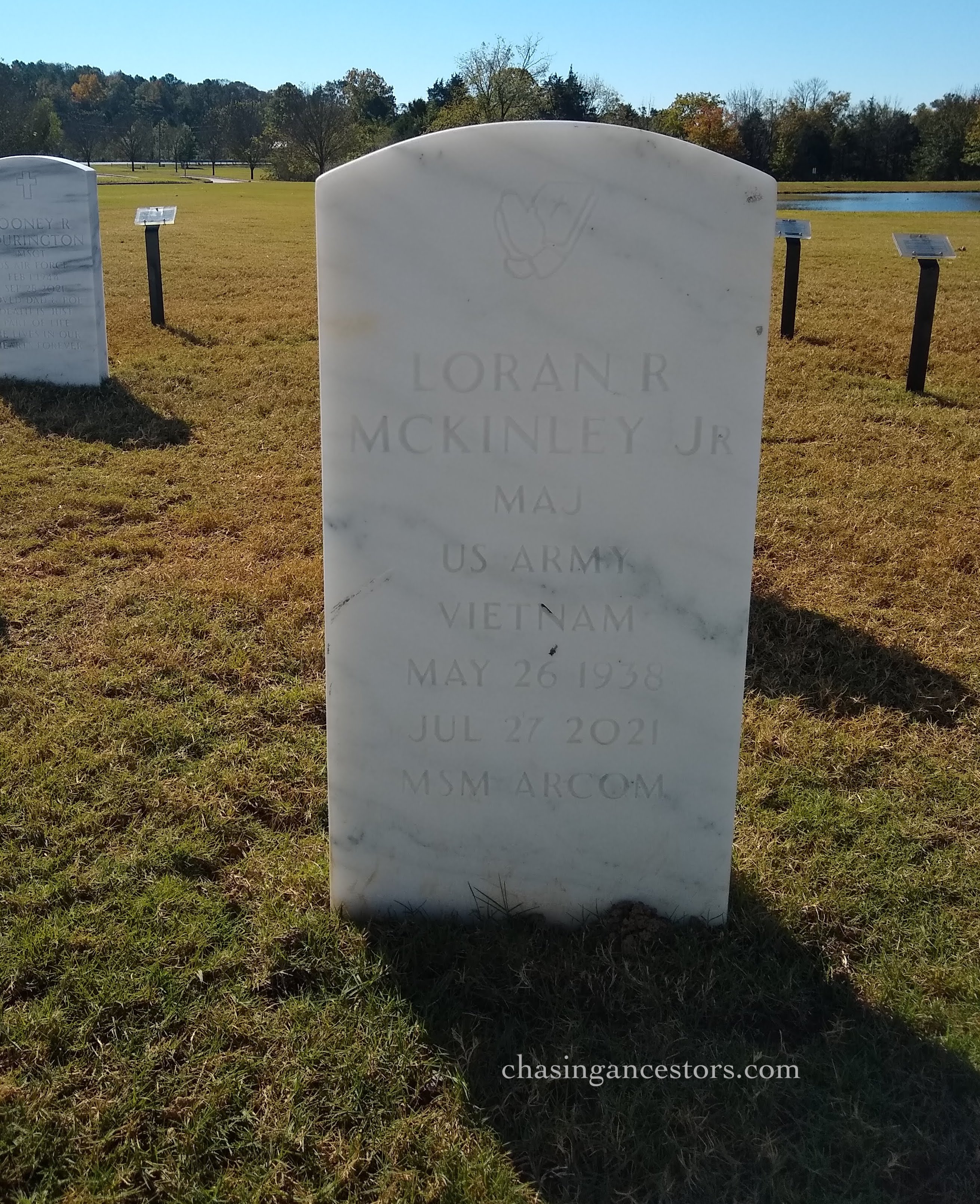
LRMcKJrHeadstoneWhile this story of a military career does not include any heroic battle scenes, it is the story of a regular guy who did an honorable job in support of his country during a time of war and a time of peace. Loran R McKinley, Jr died July 27, 2021. He is buried at the National Cemetery in Montevallo, AL.
Thank you for your service, Dad.

© MJM 2024

They Did What They Were Trained To Do

A few days ago I was talking with a young friend about history. He had recently finished a lesson about the American Revolution and was now learning about the Civil War in his history class. Like any 9 year old boy, he was fascinated with battlefields, strategy and weapons.

So this being Veteran’s Day, I’ve been thinking about who we honor today. Obviously, when we think of the military, like my young friend, we usually think of battles and weapons. But only a small percentage of military veterans ever saw combat. Those who did deserve all of our support, honor and respect as they carry “battle scars” both visible and invisible. The remainder of military veterans, all who honorably wore the uniform no matter what their role, also deserve our support, honor and respect. They may have worked in food service, supply service, medical corps, equipment maintenance, chaplain service, computer programing, secretarial service or other support services. Regardless of their service classifications, duty stations or roles, they all did what they were trained to do to serve and protect our country.

I met a veteran a few years ago who served in Europe in a weather monitoring and reporting unit during WWII. Another one had the job of ferrying VIPs and high-ranking officers in a small plane during the war. I met another man who served at both Pearl Harbor and Normandy. Donna-Mae Baldenecker Smith (1920-2010), the daughter of a friend of my Great grandfather, Arza Millikan, played the trumpet & “woke up the Army” as the first woman bugler of the US Military.

The stories of some of my ancestors who were veterans have been told in earlier blog posts. In the Civil War, young William Singleton Erp (1846-1862) was a drummer in the Union Army. His father, Allen Erp (1826-1885), was a soldier in the Union Army who, after an unfortunate accident with his rifle causing injury to his hand, took up the role of driving the ambulance wagon for the remainder of the war. Fred McKinley (1890-1972) never made it out of training during WWI due to contracting influenza and then being discharged with a disability. Chester Boone (1892-1954) went to France during WWI & worked in the supply depot. His brother, Richard Edwin Boone (1906-1980), a conscientious objector, was trained as a dental technician before going overseas during WWII. I don’t really think he used this part of his training in Europe, but he did work in the medical support service for Patton’s 3rd Army. At the end of the War, after the US forces entered Germany, he said he was painting signs—which was his civilian occupation. My Grandfather, John Chvarack (1916-1967), was drafted into the US Army toward the end of WWII, and served on the hospital ship USS Hope during its last voyages to Guam & the Philippines to evacuate the sick & wounded. He made the Army his career and primarily did office work except for a time in the early 1960’s when he did some classified work while in Germany. I’m still trying to find more information on what he was involved in then. My Father, Loran R McKinley, Jr (1938-2021), also made the US Army his career. He was in the medical laboratory service and while stationed in Okinawa, was involved in coordinating the blood supply needed for the soldiers in Vietnam. After that conflict was over, he continued to work in the medical laboratory in various military hospitals.

So these are just a few of the veterans in my family, who all had varied experiences in the military, but as far as I know, they did what they were trained to do, whether during wartime or peacetime. I thank them and all veterans for serving.

© MJM 2021

A 50th Wedding Anniversary Celebration

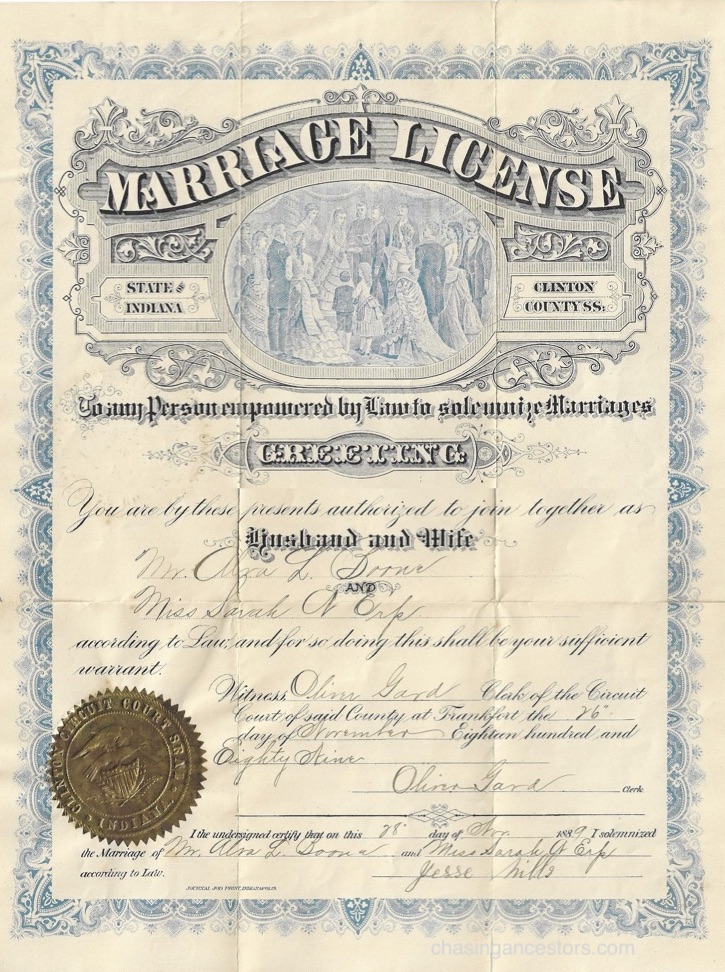
Alva Lorenzo Boone (1861-1945) and Sarah Alzada “Allie” Erp (1869-1955), my great great grandparents were married in Clinton County, Indiana on November 28, 1889.

AlvaAllieBooneMarriageCertif copy

Alva was 28 years old and Allie was 20. My grandmother, Margaret Millikan McKinley, told me that these two tintypes were of Alva and Allie at the time they got married.

The couple celebrated their 50th wedding anniversary in 1939. The event was noted in the Indianapolis Star, Noblesville Ledger, and Sheridan News. The newspaper clippings indicated that they “started housekeeping” in the Dillard community and moved to their home “on the cement road east of Sheridan” in 1909. They worked the farm most of their life together.

The following picture of Allie and Alva was published in the newspaper as well.

Allie&AlvaBoone50th_anniv_in_home copy

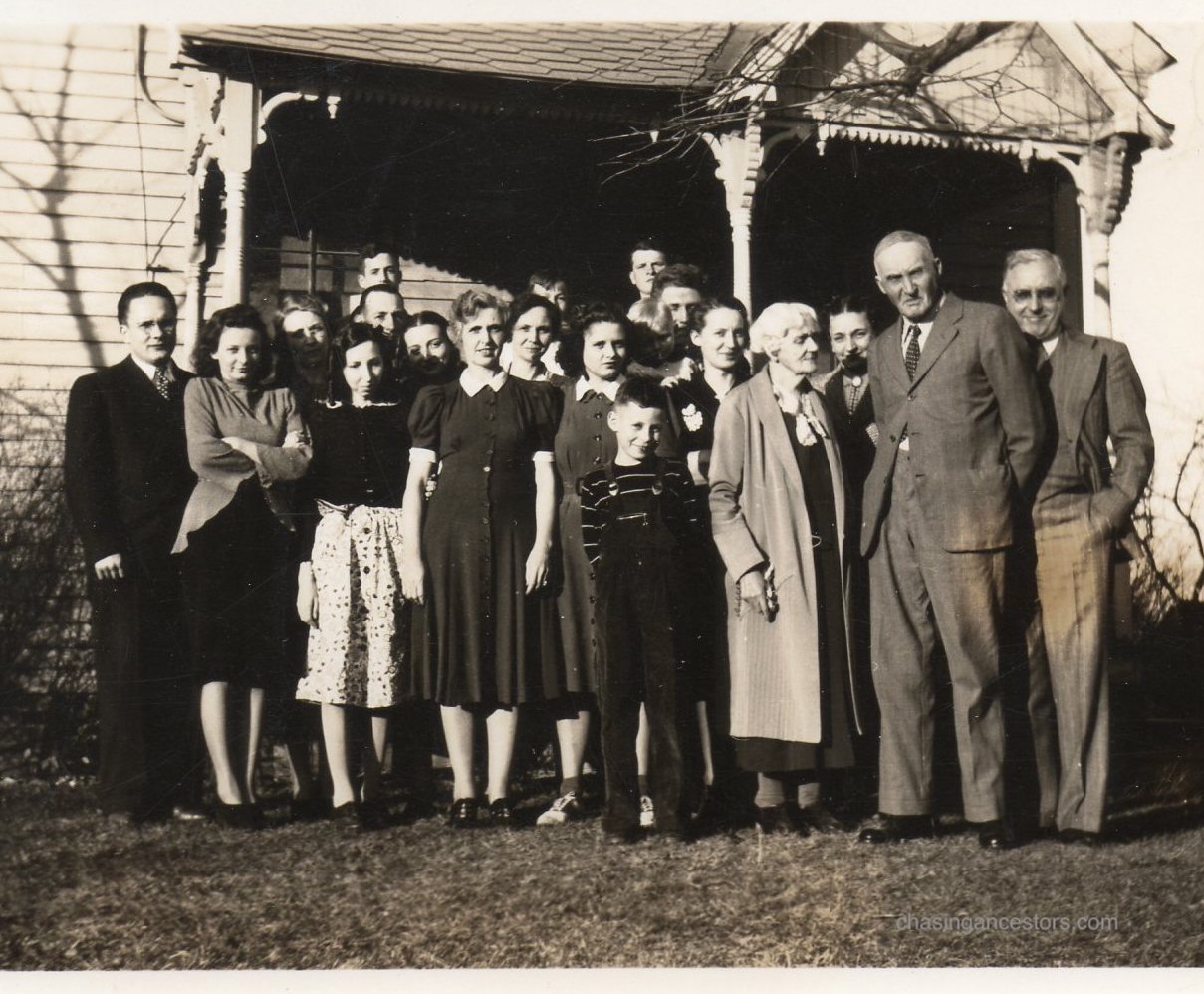
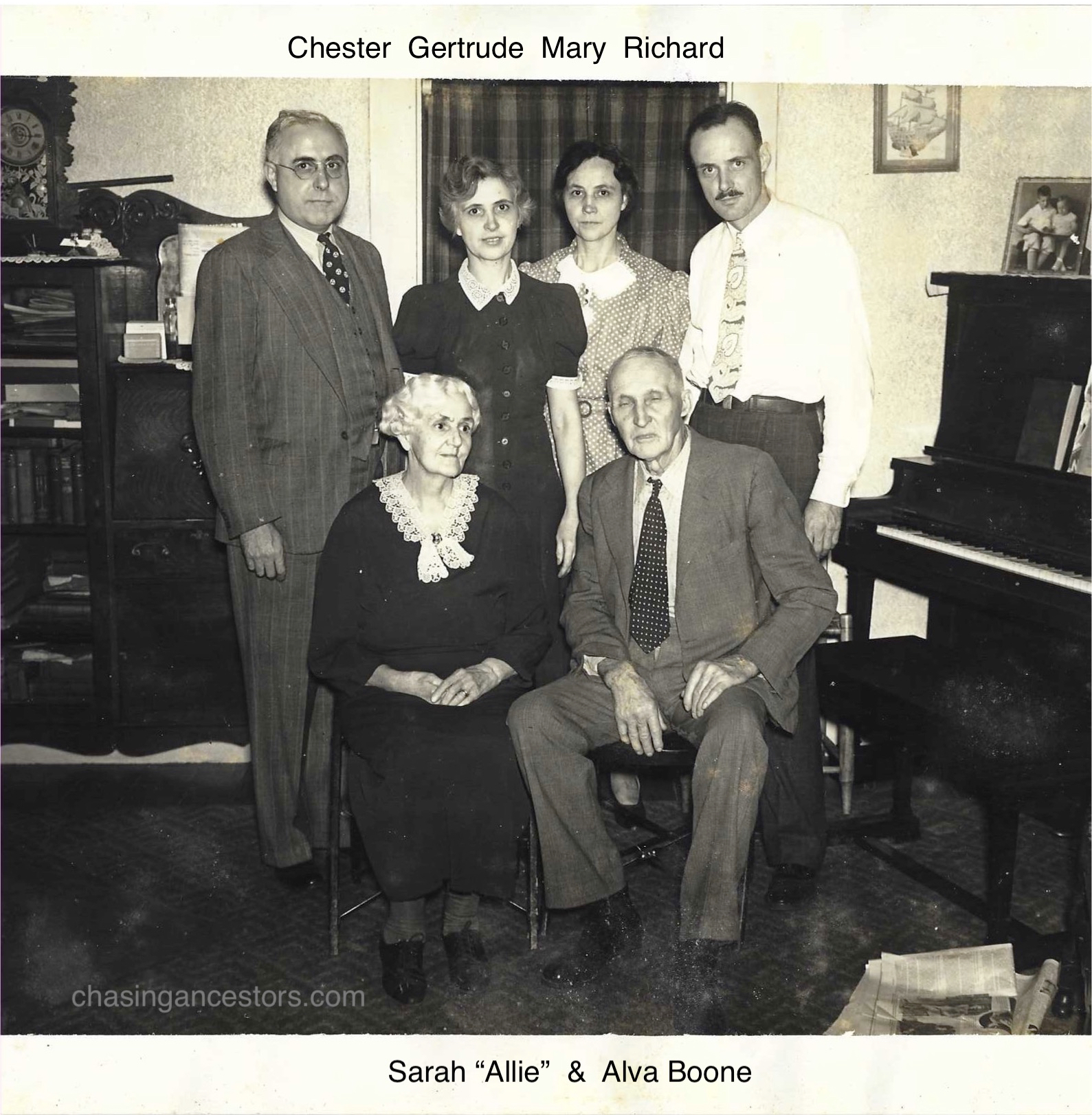
Their entire family of 4 children, Chester Emmett, Rachel Gertrude, Mary Geneva, Richard Edwin; 8 grandchildren James & John Boone, Keith & Barbara Parr, Margaret Millikan McKinley, Frances Millikan Haskett, Betty Lou Millikan, Arza Clark Millikan, and one great grandchild were at the celebration. Photos were taken of the whole group. Their son, Richard Edwin, is missing from this picture as I expect he was behind the camera.

lg_group_Boone50th_anniv copy

Pictures were also taken of each family group. Interesting to note that Allie shows up on the porch in the background of many of the pictures.

Chester Emmet Boone’s family came from Connersville for the festivities.

Chester_Boone_family1939 copy

Rachel Gertrude Boone Parr and her daughter, Barbara came from New Castle, IN. Her son, Keith and his wife, came from Indianapolis, IN.

Parr_family1939 copy

Mary Boone Millikan and her family all came from Sheridan, with the exception of her daughter Margaret Millikan McKinley and family who came from Lebanon, IN.

Millikan_family1939 copy

Back row: Loran McKinley & son, Loran Jr, Arza Clark Millikan, Margaret Millikan McKinley, Robert Haskett. Front row: Arza Millikan, Mary Boone Millikan, Betty Lou, Frances Millikan Haskett

Richard Edwin Boone and his wife, Pauline came from Indianapolis, IN.

REdwinPaulineBoone1939 copy

The anniversary party included decorations of “large yellow and bronze chrysanthemums, golden bell place cards and a large wedding cake, which was decorated in pink and gold.” The cake was provided by Keith Parr.

Allie&Alva50thAnniv_w_cake copy

All in all, seems like they had a good time celebrating this milestone.

One final picture of Allie and Alva and their children:

AllieAlvaFamily50thanniv copy

Allie and Alva stayed in their home east of Sheridan until 1945, when they moved to the home of their daughter, Mary. Alva died in 1945. Allie spent the rest of her life in Mary’s home, and died in 1955.

© 2020 MJM

Veterans of the Great War

The 11th Hour of the 11th Month, 1918. The time when all fighting would cease in France after the Armistice had been signed that morning. The end to the Great War. That was 100 years ago.

So I figured I would dig through my family history information and honor those ancestors who served during that war.

I already mentioned Fred McKinley (1890-1972), Brooklyn, IN; my Dad’s Great-Uncle on his Paternal side. He served in the US Army from April 27, 1918 to November 1, 1918.

Fred’s cousin, Frank B. Crider (1896-1978), Morgan County, IN. Served in the US Army from July 22, 1918 to January 16, 1919.

Then there was Chester Emmett Boone (1892-1954), Connersville, IN; my Dad’s Great-Uncle on his Maternal side. He served with the US Army 309th Supply Company, Quartermaster Corps, Private, #778964. He departed from Newport News, VA June 6 1918. He left Brest, France June 29, 1919. Arrived July 8, 1919 at Hoboken, NJ, listed as a Private 1st Class.

Chester’s cousin, William Hobart Boone (1896-1991), also served in the US Army. The only information I have about his service is that he served in 1918.

On Mom’s side of the family—they were first generation citizens at the time of the War. I wonder how they felt heading off to Europe to fight against what might have been their own relatives.

First, the brother of my Great Grandmother, Amanda Steinhaus Beiersdorf (1894-1973):

William Steinhaus (1896-1963) from Sheboygan, WI. Served as a Private in the US Army M D, Private, #2822606. Departed from Brooklyn, NY to Europe Sept 17, 1918 with Ambulance Company 342-311. Listed on roster of sick or wounded in Hospital in Bordeaux France 11/16/18 w/ Left Inguinal Hernia.

William’s father, Otto Steinhaus (1869-1954) had two cousins who also served:

Paul Richard Steinhaus (1892-1964), Sheboygan, WI, US Army, Private, #2822617. Departed from New York, NY to Europe Sept 9, 1918 with the 86th Div, 171st Infantry Brigade, Company D, 342nd Infantry. He left Brest, France on June 12, 1919. Arrived in Hoboken, NJ June 20, 1919. He is listed as part of the US Army Machine Gun Company, 55th Infantry.

Herbert August Steinhaus (1895-1957), Plymouth, WI, served with the US Army Field Remount Squadron #318, #2831867. He departed from Newport News, VA on Aug 14, 1918, listed as Acting Corporal. He left Brest, France on June 23, 1919. Arrived Boston, MA July 5, 1919, listed as a Private 1st Class.

Who would have thought when these men came home from their service, that their sons would once again take up arms in another war in Europe.

So, remembering just a few named veterans from my family tree who served during the Great War 100 years ago. I also thank the other veterans who served our country in other times of war and conflict

© MJM 2018

Grandpa’s Jobs

Another Labor Day holiday, so time to look again at the work some of my ancestors did. While most of Dad’s side of the family were farmers in the early years, eventually some of them found work off the farm.

My Grandfather, Loran McKinley, Sr. (1916-2003) worked several jobs in his lifetime. He compiled a list of those jobs, probably for a class reunion. Eventually, that list made it to my collection.

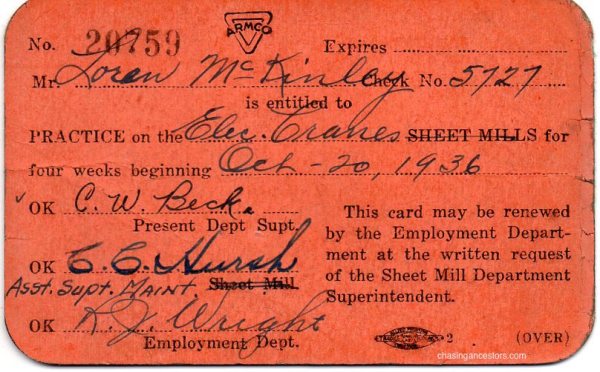
First, from 1936 to 1938, he worked at the American Rolling Mill (ARMCO Steel Mill) in Middletown, OH. The company produced rolled sheets of steel. He had this job when he got married to my Grandmother, Margaret. While there, he practiced and honed his skills as a crane operator. His first pay check for 40 hours of work was $36. The recession caused him to move on to another job.

ARMCOcard

 This card gave him access to practice on the cranes at the factory.

From 1939 to 1941, he worked for Interstate Foundry in Indianapolis, IN. He worked as a foreman and overhead crane operator. He made 40¢ per hour.

From 1941 to 1950, he was self employed. He had a farm & drove a milk route for Polk Dairy. No, he was not a “milk man.” He picked up milk from the dairy farmers and took it to the Polk Dairy in Indianapolis. I’ve been told that his job was considered “essential” and therefore he was not drafted into the military during WWII.

From 1950 to 1952, he worked for AVCO Corporation in Richmond, IN. He was Security Guard at this manufacturing plant.

Then, from 1953 to 1981, he worked for the Chrysler Corporation as a Security Guard. He indicated that 3rd shift pay was $3.56/hour.

He retired from Chrysler and moved to a farm near Sheridan, IN.

After I saw the list of jobs that he had, I asked Grandpa what was his favorite. He replied, “farmer.” So, even though he had experience in other areas of work, he still went back to the original family business, farming.

© MJM 2017

Things Found in a Billfold…

oscarbillfold

This sounds like a “Family Feud” category, but it isn’t. I have a small leather billfold in my collection. It obviously belonged to my Great-Grandfather, Oscar McKinley (1887-1969). While there wasn’t any money in it, there were a few interesting items tucked inside.

oscarmckcards

First, there were 3 of those paper “Identification” cards that come in wallets. All 3 had Oscar’s name & his address: Brooklyn, Indiana Box 56. He lived on South Main Street. His telephone # was 59. The emergency contact on 2 of the cards was Oscar’s brother, Fred. On the 3rd card, the emergency contact was his wife, Rilla. Oscar and Rilla Throckmorton Caldwell got married in 1941. Wonder why he had 3 cards.

oscarmckadamsidcard

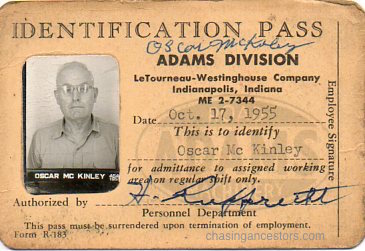
Then there was another official ID card for his job at Adams Division of the LeTourneau-Westinghouse Company in Indianapolis. It is dated Oct. 17, 1955.

hrupprechtcard

H. Rupprecht was having a birthday February 17 & there was a request for birthday cards. Notice on the above work ID card, H. Rupprecht signed the authorization as representative of the Personnel Department.

revhmmyrickcard

There was a business card for the Rev. H.M. Myrick, pastor of the Church of the Nazarene at 325 W Raymond, Indianapolis. H.M. Myrick was probably Herman Myrick, who was Oscar’s cousin.

oscarmckcheck

The bottom half of a check was also in the billfold. It was for 25 dollars for “Priscilla McKinley Est.” signed by Oscar. Priscilla McKinley was Oscar’s Mother & she died in 1941.

oscarmck1938tax

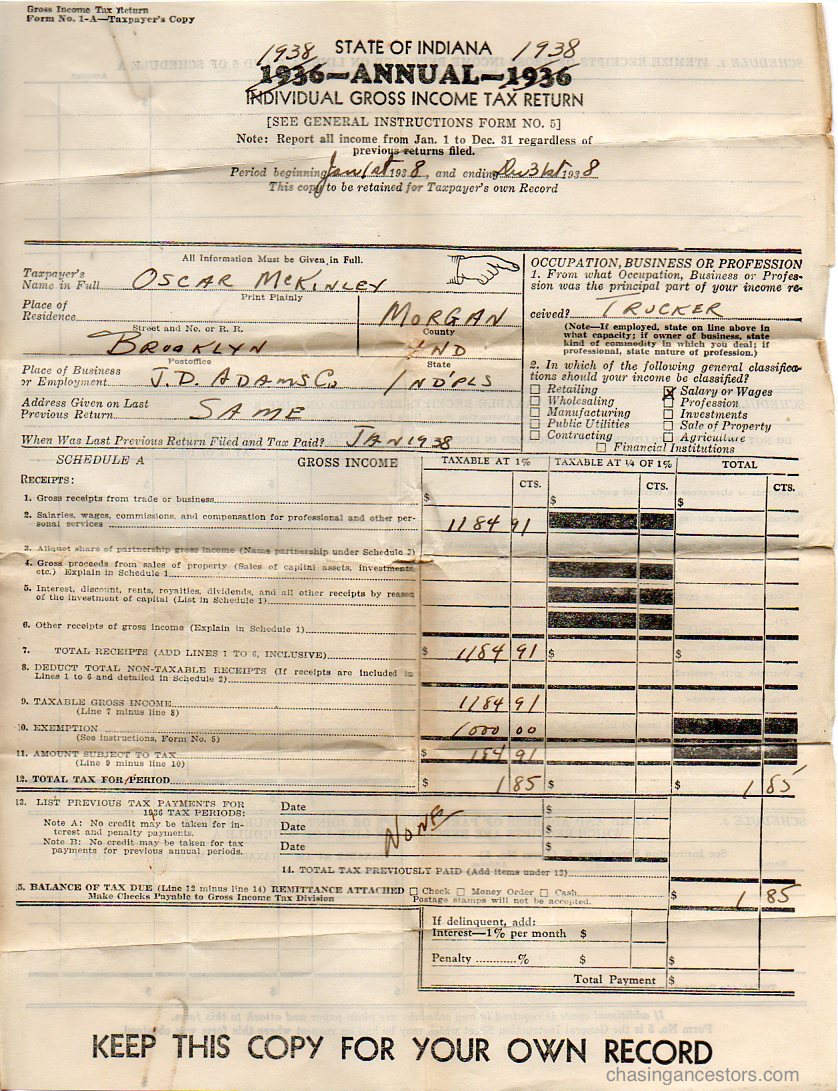
He kept his Indiana state tax form for 1938 in this billfold. According to the form, he worked as a trucker for J.D. Adams Co. Indianapolis. He made $1,184.91, had a $1,000 exemption and the tax due was $1.85.

oscarmckautoregistration


The 1939 Indiana Motor Vehicle Registration card was also in the billfold. He owned a Ford & paid a fee of $6.


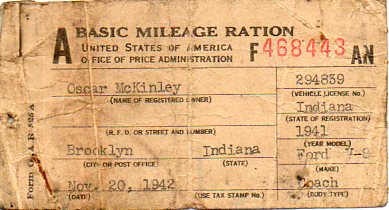
oscarmckgasolinerationThen there was the cover of a Basic Mileage Ration book from the U.S.A. Office of Price Administration, dated Nov. 20, 1942. It indicated Oscar drove a “Ford V-8 Coach.” It was an “A” ration book, which allowed Oscar 3-4 gallons of gasoline per week. It was the lowest priority for gasoline rationing during WWII.

Finally, there was a folded news clipping from a Martinsville, Indiana newspaper with no date. The title was “She Was a Teacher” with a woman’s photograph under the title.

While it does not give the full name of the woman, it mentions “Miss Asher,” who taught school for over 35 years. It appears to be a eulogy for Miss Asher. So who was Miss Asher & why did Oscar keep this clipping in his billfold? Turns out that there were 2 Asher sisters who were school teachers, Goldie and Grenda. The Indianapolis Star reported that the sisters completed their training for the “4 year elementary license” at the Indiana State Teachers College at Terre Haute in 1931. Obviously, they had been teaching for quite a while before then. According to the 1940 US Census, they lived in Jackson Twp, Morgan County, IN. Goldie never married & died December 19, 1942. She was 55 years old. It would make sense that she is the “Miss Asher” mentioned in the article, as notices on the back of the clipping mention Christmas. There is one more connection between Oscar and Goldie Asher: they were First Cousins once removed.

So there we have it, the things found in Oscar’s billfold. I wonder what people would find interesting about the things we carry today?

© MJM 2017

Did They Know Their Neighbors?

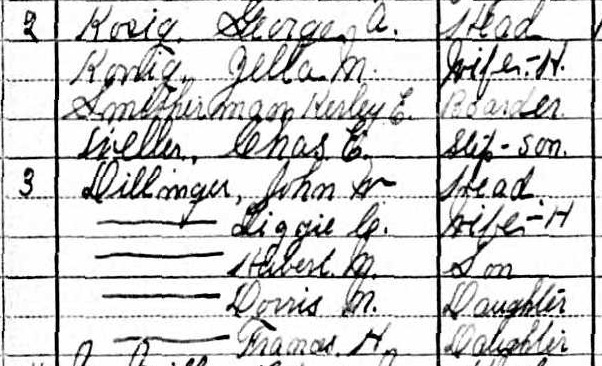
While researching the US Census records on Ancestry.com, I came across a famous name on the same page as one of my ancestors. The 1930 US Census record for Brown Twp of Morgan County Indiana has the George Konig family listed just before the John Dillinger family. Was this family related to THE John Dillinger? The thought was intriguing.

1930uscensuskonigdillinger

First, who was George Konig? His wife, “Zella,” on the census, was O’Zella Mae McKinley. She was the daughter of Jeremiah (1852-1934) and Polly (1859-1941) McKinley. She married 3 times, first to John Russel McCracken in 1917, next to Byron M. Weller in 1924, and finally to George Konig in 1927.

John W. Dillinger was the father of the notorious gangster, John Dillinger (1903-1934). General information about the Dillinger family from internet sources indicates that they moved from Indianapolis, IN to the Mooresville, IN area around 1920. John robbed a grocery store in Mooresville and went to prison. After he was released in 1933, at the height of the Depression, he continued his life of crime. He started robbing banks. He reportedly returned to Mooresville to visit his family through his final year. On July 22, 1934 he was killed by FBI agents after leaving the Biograph Theater in Chicago, IL. His body was returned to Mooresville before burial in Crown Hill Cemetery of Indianapolis.

So the question is, did George and O’Zella know about the son of their neighbor? Did they ever encounter him? How close was their residence to the Dillinger residence? It is not known exactly what the census enumerator’s route was—and I haven’t looked at a plat map for that timeframe to know if the homes were “next door” (or as close to that as farms would be) or across the road from each other.

Looking at the 1940 US Census, George and O’Zella have moved to Jacksonburg, Wayne Co, IN. The Census indicates that on April 1, 1935, they lived in Richmond, Wayne Co, IN. So, when did they leave the Mooresville area? Were they even there in 1934 when all of the excitement about John Dillinger’s last days was happening? Right now I don’t have an answer to those questions. But it is interesting to speculate that they at least knew about their famous neighbor.

© MJM 2017

Jerry McKinley was a Good Man

Jeremiah McKinley was the youngest of a family of seven children born to George & Polly McKinley. He was born in 1852 and had been a life long resident of Morgan Co. The parents, brothers & sisters preceded him in death.

Jan. 4, 1879, he was married to Priscilla Stafford. Six children came to gladden their home. His companion of fifty-five yrs., two sons, Oscar & Fred McKinley, his daughter Ozella Konig, and four grandchildren, all residents of Brooklyn, survive him.

It is with mingled feelings we hear the news of the passing of the few remaining pioneers of our Community.

jerrymckinley1926

Jeremiah McKinley 1926

We who knew Jerry best, with the family feel our loss.

Why? Because this tribute could be written in these words, “He was a faithful friend.” He didn’t go away from his home or Community to find a large place to fill, but he used the untold riches that were hidden in the depths of his heart.

He took what God gave. Some have been given more. Many have been given less. But he took what he had and made for his Soul a house of happiness & rendered a service near home.

Jerry made friends easily. His cleverness & humor gave us a tonic thought.

The goodness of his character attracted for him friends & the genuineness of his character kept them.

He was honestly & sincerely interested in his neighbors and this expressed itself in an open and understandable type of neighborliness & he and his family have created responsive neighborliness among us.

The many friends who have called at the home & those who are attending this service testify to the constructive influence of his happy friendly live.

Did you ever find the happiness flower? It isn’t so hard to find. It opens wide at the morning hour, In the meadows of Cheerful Mind.

–Eulogy for Jeremiah McKinley, 1934

A copy of this handwritten message is in my collection. There is no indication of who wrote it. However, I assume it was probably written by the pastor who presided at Jerry’s funeral. As mentioned below, that was the Rev. O.C. Haas.

On Thursday, January 18, 1934, there was the following notice on page 1 of The Mooresville Times: “McKINLEY RITES SATURDAY. Funeral services for Jeremiah McKinley, 81 yr old retired farmer will be held Saturday morning at the Brooklyn M.E. Church with the Rev. O.C. Haas in charge. Burial will be in Centerton. Mr. McKinley lived in Morgan Co. all his life. He was the son of George & Polly McKinley.”

So who was Jeremiah “Jerry” McKinley? For one thing, he was my GG Grandfather. As the eulogy says, he was born in 1852. His death certificate lists his birthday as May 28. He died January 18, 1934. He lived on South Main Street of Brooklyn, IN. He was a farmer in Morgan County, IN. His parents were George McKinley (b. ~1802) and Polly (Mary) Packwood (b. ~1807).

He married Priscilla Staffojerrypriscillamckinleyrd (1859-1941) January 4, 1879 in Morgan County, IN. The picture shown was given to me by my Grandfather & is actually a very small tintype with the oval opening in the frame approx 3/4 of an inch long. I do not have 100% proof that this is a picture of Jerry and Priscilla, but the features seem to match later pictures of them. They had the following children:

Oscar (1887-1969), Fred (1890-1972), Unnamed son (lived 4 days in April 1892), Perley (1893-1894), Ozella (1895-1980) and George (1900-1902).


I received the McKinley family Bible from my Uncle and the children are listed on the “Births” and “Deaths” pages.

mckinleybiblebirths

McKinley Bible Births

mckinleybibledeaths

McKinley Bible Deaths

The Agricultural Census Schedule for 1880 has Jeremiah listed in Clay Township, Morgan County, line 5. At that time he was renting his farm “for shares of product.” The farm consisted of 21 acres of improved land and 19 acres of “woodland & forest.” The value of the farm was $400 for the farm land, fences & buildings; $200 for farming implements & machinery; and $250 for livestock. The estimated value of all farm productions, (sold, consumed or on hand) in 1879 was $400. He had 1 horse, 1 milch cow and produced 100lbs of butter. There was 1 swine on the farm. Jerry had 36 barn-yard chickens, producing 200 eggs in 1879. He had 9 acres of oats, producing 200 bushels. The rest of the farm was orchard, 6 acres in apples (400 trees) producing 300 bushels & 5 acres in peaches (400 trees) with no listed production. The total value of orchard products was $150. He cut 30 cords of wood at a value of $100.

By 1920, Jerry and Priscilla had moved to town. They show up in the US Census in Brooklyn, IN with their son, Fred. Their other son, Oscar and his family are listed just above them on the census.

By the way, the eulogy mentions 4 grandchildren who were living when Jerry died. They were Oscar’s sons, Myron and Loran (my Grandfather) and Ozella’s son and daughter. Ozella had another daughter later in the year.

So there it is, information on the life of Jerry McKinley. If it weren’t for the eulogy, there would just be a selection of facts, but that added a little more insight to the kind of man he was, besides a farmer, Jerry McKinley was a good man.

© MJM 2017

Uncle Fred–US Army Veteran

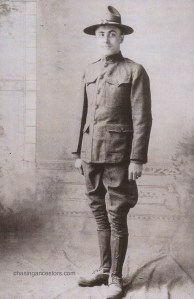
Fred McKinley was born in Morgan County, Indiana, March 21, 1890. He was my Grandfather Loran McKinley’s Uncle. His parents were Jeremiah (1852-1934) and Priscilla (1851-1941) McKinley.fredmckwwi

He was 27 years old & single when he registered for the draft in 1917. His card # is 28. He was living in Clay Twp, Morgan County, Indiana. He worked as a farmer. He was of medium height and medium build, had blue eyes and brown hair.

The Martinsville Democrat newspaper was a source of information regarding the draft. On July 13, 1917 it lists Fred with draft #822 of 1501 registrants from Morgan county. He was not called in the first draft.

Then on April 26, 1918, 58 men were called to Martinsville to the conscription station. Thirty of those men were selected to go to Camp Taylor, Kentucky for training. This is to “fill Morgan county’s quota on the first call of the second draft.” It said that farmers would be given “deferred classification for the present if their cause merits it.”

Even though Fred was a farmer, he did not get the deferred classification & on Friday, May 3, 1918, he is included as part of the group of 33 men who left for training camp the Saturday before “to make themselves ready for actual service on Uncle Sam’s firing line in his great fight to make the world safe for democracy.” It is said that there was a large group of friends and family members at the train station to see the men off.

I got a copy of his service record card from the Indiana State Archives. It states he had the rank of Private in the 159 Depot Brigade, which was essentially the training brigade at Camp Taylor. He was inducted on April 27, 1918 in Morgan County, IN. He was discharged November 1, 1918. He did not go overseas.

The story is that Fred got the flu while in the Army and this is why he was not shipped out. In searching for more information regarding the flu epidemic during the war, I came across a blog post from January 4, 2011 from the Filson Historical Society <filsonhistorical.org>. It mentioned that at Camp Zachary Taylor in Louisville, KY, there was an influenza outbreak in 1918 that killed 824 soldiers and caused 13,000 to be hospitalized. I expect Fred was one of those 13,000.

Fred’s service record card also lists his honorable discharge as S.C.D. When I searched the internet for this code, I found that it is “Service Connected Disability.” His card states that “in view of occupation he was, on date of discharge, reported 10% disabled.” So I guess his experience left him with some kind of permanent disability. I guess I’ll have to do more searching on what exactly his issue was.

Grandpa had a large oval photograph of Uncle Fred that he gave me. It is the same picture as above. It is very cumbersome & the frame is broken, so it sits in a box in my closet instead of hanging on the wall. There were also a few less formal photographs of him in uniform that were given to me by Grandpa.

Once he returned home, Fred spent the rest of his life in the Brooklyn, IN area, continued farming and served as the sexton of the Brooklyn cemetery. He never married. He died at age 81, March 8, 1972 at the Veterans Hospital in Marion, Indiana. Grandpa also had Fred’s burial flag. It is now in my collection as well.

One more thing: On November 15, 1918, the Martinsville Democrat had the front page story of “The end of the war, the world war, the greatest conflict between man and peoples that, we hope, will ever be recorded in this world’s history.” Unfortunately, there were more wars to come. But the end of the “Great War” is commemorated each November 11 as Veteran’s day. Thank you to all who have served.

© MJM 2016