An Unfinished Story

I was looking through some of my old genealogy files, trying to organize things & I opened the file of old letters. This letter seemed simple enough and I wanted to find out more about the author, and while I did find some records to fill in his story, I didn’t find enough to complete it. 

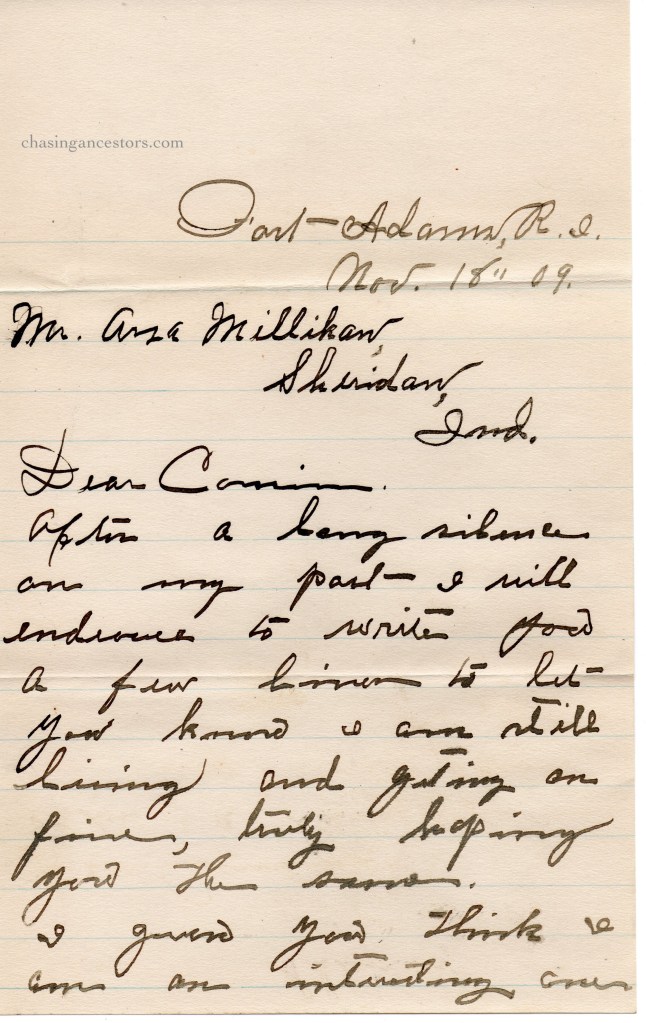
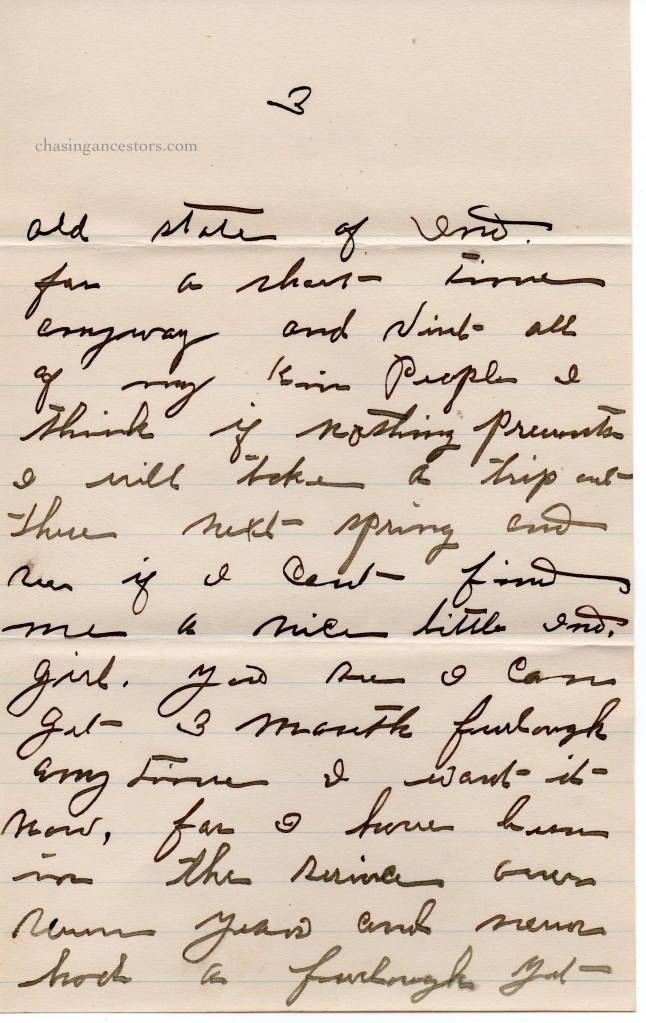
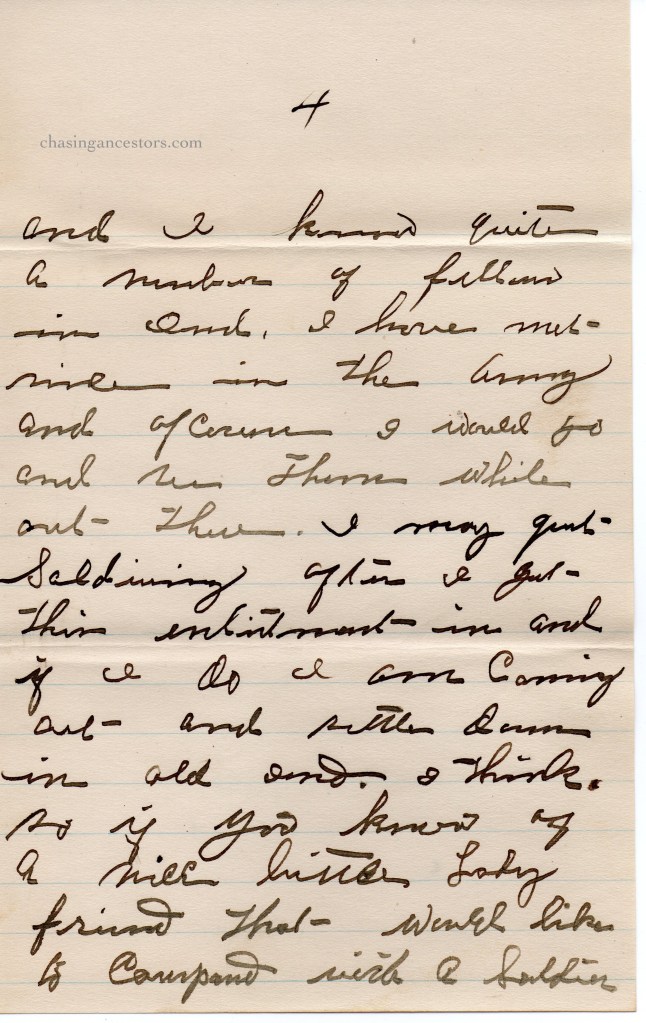
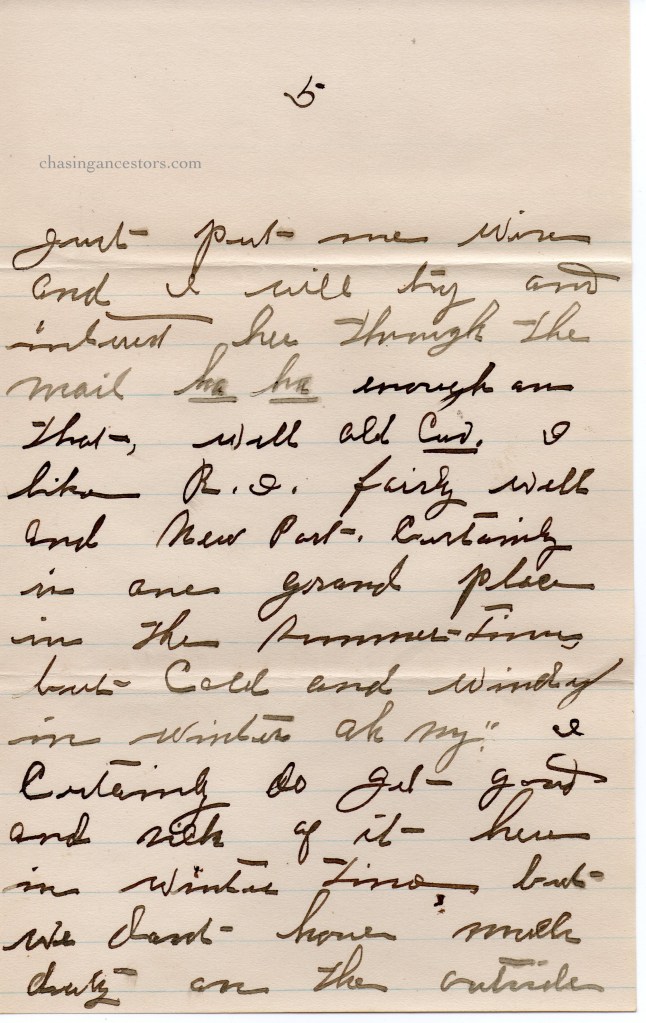
The letter: To Arza Millikan (1883-1964), my paternal Great Grandfather. From Wm. C. Millikan. It was postmarked from Newport, R.I. on Nov 20, 1909. And the first page gives more information as to the origin: Fort Adams, R.I. The salutation is “Dear Cousin.”

The transcription is:

Port Adams, R.I.; Nov. 18” 09.; Mr. Arza Millikan, Sheridan, Ind. 
Dear Cousin.
After a long silence on my part I will endeaver to write you a few lines to let you know I am still living and geting on fine, truly hoping you the same. I guess you think I am an interesting one
(2) to correspond with, don’t you?
Well I must admit I am very careless about writing sometimes I fail to write home for weeks at the time and they will wonder what has become of me, You see after a fellow has been away from home so long as I have he gets negligent and fails to write to his own people.
Well I would like to be out in the good
(3) old state of Ind. for a short time anyway and visit all of my kin people I think if nothing prevents I will take a trip out there next spring and see if I can’t find me a nice little Ind. girl. You see I can get 3 month furlough any time I want it now for I have been in the service over seven years and never had a furlough yet
(4) and I know quite a number of fellows in Ind. I have met since in the Army and of course I would go and see them while out there. I may quit Soldiering after I get this enlistment in and if I do I am coming out and settle down in old Ind. I think. So if you know of a nice little Lady friend that would like to correspond with a soldier
(5) just put me wise and I will try and interest her through the mail ha ha enough on that, well old Cus. I like R.I. fairly well and New Port certainly is one good place in the summer-time but cold and windy in winter oh my. I certainly do get good and sick of it here in winter but we don’t have much duty on the outside
(6) in winter time you see we have indoor instructions here in the cold weather we do guard duty of course but we only go on guard about once every three weeks and then only lasts 24 hrs at the time 2 hours on duty and 4 off so we certainly have an easy time and more fun in the summertime than a little.
I think there is more girls in the state of R.I.
(7) than any state I was ever in in all my life. Say Cus when are you going back to New Mexico to live and how do you like that part of the country write and tell me all about yourself and don’t forget to get me a lady friend to correspond with in Ind.
So give all my best regards and tell the Riggs family hello for me.
Your cousin Wm. C. Millikan

So, of course the question is, “Who is Wm. C. Millikan?” Clues in the letter indicate he is a “cousin” of Arza’s. He has been in the military for 7 years. He is familiar with Indiana, where Arza lives & would like to visit again. He is looking for a girl—so he is single. He mentions the Riggs family. There were Riggs who show up on the same page as Arza in the 1900 and 1910 census records for Hamilton County, Indiana. I assume this is who he mentioned in the letter.  

First, perhaps his military service records would give more information as to who he was. I was able to find through Ancestry.com some “US Army Register of Enlistment” files from 1798-1914. These files had a William C Millikan listed for several years:

In 1902 he was listed as enlisting on October 8, in Tampa Florida by Lt. Smith for 3 yrs. He was born in Randolph Co, NC; age 26 & 2 months; occupation Farmer; eyes Blue; hair light brown; complexion fair; height 6ft 1 1/2 inches. This connects w/ 7 years in the military as the postmark on the envelope was 1909. 

Looking at the clues from this register, William was born in Randolph County, NC in roughly 1876. I went back to my genealogy files for Millikan’s from Randolph County, NC—there were a lot of them. One that fit the date of birth was William C. Millikan, son of Thomas Franklin Millikan (1846-1924). This William was the grandson of John Kelly Millikan (1826-1908) who was the brother of Clark Millikan (1824-1926), the grandfather of Arza Millikan (1883-1964), to whom the letter was written. William and Arza would have been 2nd cousins. One assumption is that William may have visited Indiana to work on Clark Millikan’s farm for a season. There were other relatives who did this. 

I don’t have good sources for William C Millikan. Records from other researchers indicate he was born in 1876. He shows up as a 3-year-old in his father’s household in the 1880 US census in Randleman Township, Randolph County, NC.

The 1900 US Census has him listed with his brother, Joseph. They are still in North Carolina, Randleman town of Randleman Township, Randolph County. He is listed as a 23-year-old farmer. His birth date was listed as July 1876. So this seems to coincide with the other records regarding age.

But this is about where the family record ends. I found an obituary for Thomas Millikan,  father of William C. He died in 1924 and the obituary stated that only one of his children, Joseph, was still living. W.C. is in the list of deceased children. The obituary of another brother, Samuel Bentley, who died in 1915, also indicated that all other siblings except Joe had passed away. Other siblings of William had passed away before this letter was written. I have not been able to find an obituary for William. But right now the indication is that he died before 1915. 

So, now that I have some idea of who William might have been, I figured I would look a little more at his military records. As I mentioned, I found records of enlistment on Ancestry.com. The first record from 1902 stated that he was in the “CA” or Coast Artillery, Company 107-117. (The Coast Artillery Corps was a US Army corp established in 1901 to defend the coastlines using heavy artillery.) Continuing on with the enlistment records, William re-enlisted in 1905 and again in 1908. 

Fold3.com had additional records for William’s military service. The “US, Returns from Regular Army Coast Artillery Corps Companies, 1901-1916” records essentially gave a status report of William’s service through the years. 

The first record for Company 117, Coast Artillery for February 1903 has William joining on Feb 3, ’03. He was a private. He was a Sergeant on the report from May 1905 and on Detached service at Ft. Monroe, VA. The report from October 1905 showed that he was discharged on October 7 and reenlisted on October 8 at Fort Fremont, SC. His character was “excellent.” He transferred to the 127th Company at Ft Fremont, SC on June 8, 1907.

In 1908, William was listed as a Private again and was discharged from the 127th Company, Coast Artillery Corps at Ft. Fremont on October 7 with final statement given of his service being “honest & faithful” and his character “very good.” He reenlisted with rank of Private to the 117th Company Coast Artillery Corps at Fort Slocum, NY on October 16th. 

He was on detached service to Ft. Wetherill, RI in January 1909. Then in 1910, he is at Fort Adams, RI which is just across the harbor from Ft. Wetherill. As a side note, most of the forts mentioned are no longer military installations, but several have been preserved as state parks. 

He shows up again in the US Census in 1910 in Newport city, Newport County, RI, Ft Adams. This entry has him listed along with the other soldiers at Ft. Adams. He is reported as being 30 years old.

The last Coastal Artillery return reports that I can find reference his desertion July 8, 1910 from Ft. Adams. The next report indicates that he was “apprehended at Newport, RI and returned to Military Control at Fort Adams RI Aug 6, ’10.” The final “Return of the 117th Company of the Coast Artillery Corps, for the month of September 1910”:

William is listed as being sentenced by a General Court Martial on September 25, 1910 to be Dishonorably Discharged. His services was “not honest and faithful.” So I wonder what happened to William during his time in the Coast Artillery that he went from being a Sergeant with faithful service to a Private, dishonorably discharged for desertion and service that wasn’t honest & faithful. 

This seemed to end what I could find about William. Then I took one more look on Familysearch.org & used their “full-text” search tool. I found some general index cards for Adjutant General communications. There was an index card for his reenlistment in 1908. Then there were cards regarding his desertion July 10 and apprehension August 9, 1910. The last card was from January 24, 1911 regarding clemency. William was listed as a “Mil. Convict, Ft. Adams, R.I.” I then looked at the National Archives to see if the Adjutant General Communication files were listed there but did not find files for 1911. 

So this is the end of the trail on “cousin” William C. Millikan. I haven’t been able to locate any more records for him. My assumptions for his identity may be correct or not. Maybe someday I’ll be able to find another record that completes this unfinished story.

MJM © 2025


Gone Fishing

I went fishing today at a little pond not too far from my house. Caught a few small bluegill and a nice big catfish. The pond is “catch and release” so no taking anything home. 

But I got to thinking about a picture in my collection of my Great Grandfather, Herman Beiersdorf (1895-1983).

Herman is the one in the center who seems to be dressed a little too formally to go fishing. The picture was taken sometime after he was married in 1916 as he is wearing a wedding ring. 
I don’t know who the other two men are, but I wonder if the one on the right is his brother, August C. (1884-1974).

Herman is holding basic fishing gear—bamboo poles. No reels or bobbers. Just a pole, line and hook. I wonder what they used for bait? I expect they fished in the Sheboygan river. Looks like they managed to catch a good “mess of fish.” And I bet that was dinner for the day. 

I wouldn’t be surprised to learn that they went fishing frequently. I hope they had fun. 

©MJM 2025

Did You Hear the Story?…

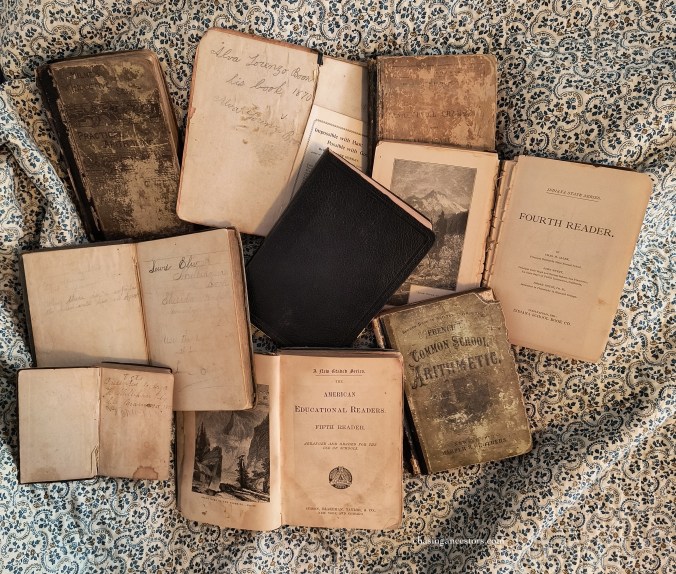
A little over a year ago, one of my Father’s cousins was passing through this area and stopped in to show us a box of old books that had belonged to our ancestors. He said his family members didn’t want the books and would be happy to give them to me. He is related through Arza Clark Millikan (1925-1975) who was the brother of my Grandmother, Margaret Millikan McKinley (1917-2007).

The box contained several early school books that belonged to my Great Grandfathers Alva Boone (1861-1945) & Arza Millikan (1883-1964); as well as my Great Great Grandfather Lewis Elwood Millikan (1855-1949).

In the Forth Grade Reader, there was a fragile 3-page report on the robin, written by Arza. The first paragraph is shown here:

Another item that was in the box with the books was the following program announcing the commencement of the Washington Township, Hamilton County, IN school district. Arza was listed in the program as one of the graduates. He would have been 14, so this was an 8th grade graduation. I don’t know that he went further in school as I have not found a high school graduation record for him.

While we visited, Dad’s cousin would often say “Did you hear the story?…” and start with a question about the family. We had a good visit and talked through many of the family stories. 

He asked “Did you hear the story that we had the old family Bible?” I said I hadn’t & I didn’t know of a family Bible other than the ones I had in my possession. Then reaching the final book in the box, there it was, the old Millikan family Bible! The cover was falling off and many pages were loose.

The title page indicated that the Bible was published in 1849. I wonder if when it was brand new it was given to our ancestor, Clark Millikan (1824-1926) when he married his first wife in 1851? It would have come with the family in the wagon on the trip from North Carolina to Indiana after the Civil War. 

The records pages were lying loose in the front of the Bible. Usually I find them in the center section, between the Testaments. Thankfully they were in pretty good condition and the writing was legible. The handwriting is a pretty close match to Clark Millikan’s.

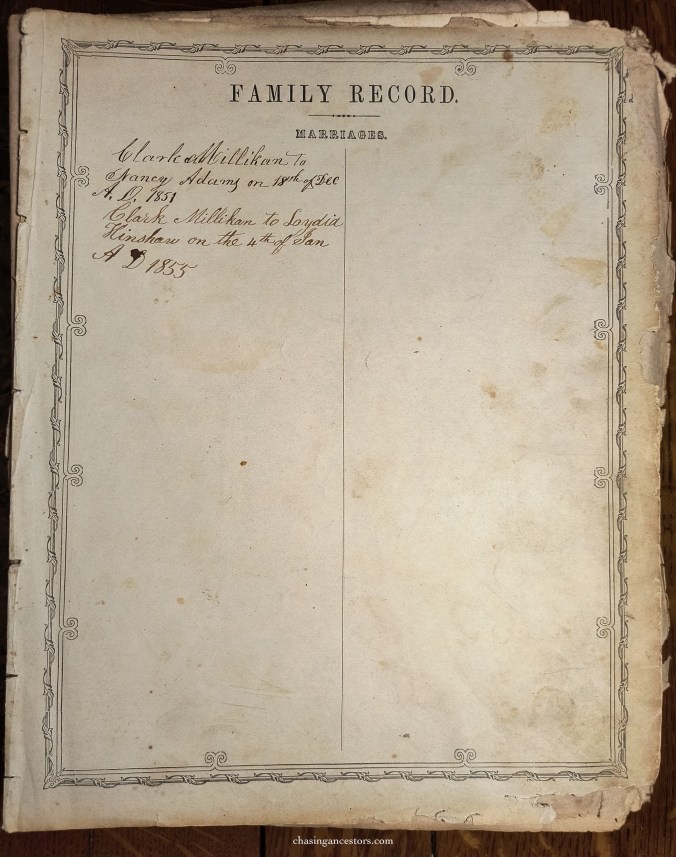
First the Marriage record page with two entries:  “Clark Millikan to Nancy Adams on 18th of Dec A.D. 1851. Clark Millikan to Lydia Hinshaw on the 4th of Jan A.D. 1855.”

Next, the record of Births:

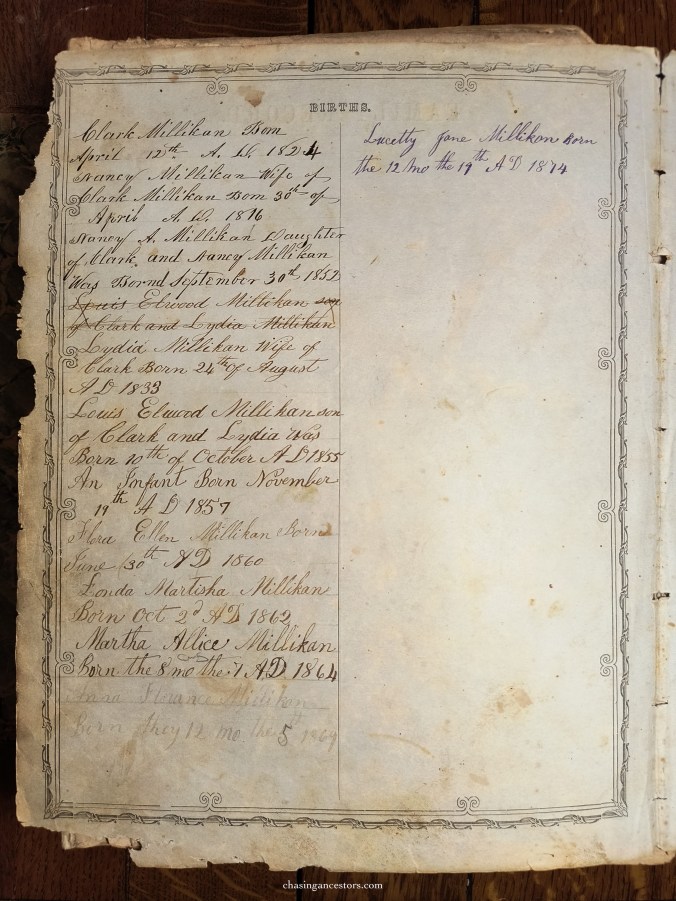
Clark Millikan Born April 12th A.D. 1824. Nancy Millikan Wife of Clark Millikan Born 30th of April A.D. 1816. Nancy A. Millikan Daughter of Clark and Nancy Millikan Was Bornd September 30th, 1852. Lydia Millikan Wife of Clark Born 24th of August AD 1833. Louis Elwood Millikan son of Clark and Lydia was Born 10th of October AD 1855. An Infant Born November 19th AD 1857. Flora Ellen Millikan Born June 30th AD 1860. Londa Martisha Millikan Born Oct 2d AD 1862. Martha Alice Millikan Born the 8 mo the 7 A.D. 1864. Anna Florance Millikan Born they 12 mo. the 5th 1869. Lucetty Jane Millikan Born the 12 mo the 19th A.D. 1874.

A couple of comments on the Births entries—The entries from Clark to Nancy A seem to have been written at the same time. The ink color changes a bit for the next entries. And there is even an entry written in pencil. I wonder if Clark intended to mark Louis’ birth, but realized his mother, Lydia hadn’t been recorded so crossed out the entry to put Lydia first. Also, all other records I have seen have Louis spelled “Lewis.” I have always thought as well that “Londa” was actually “Lunda” Martisha.

Finally, the Death Record:

Nancy Millikan Wife of Clark Millikan Departed this life October 11th A.D. 1852. An Infant Departed this life December 8th A.D. 1857. Lucetty Jane Millikan daughter of Clark & Lydia Departed this life they 8 mo the 30th 1878.” There were no other entries.

Completing the entries for deaths:  Lydia died Sept. 18, 1917. Flora Ellen died June 2, 1923. Clark died Feb. 1, 1926. Martha Alice died March 13, 1926. Nancy Angeline died April 17, 1926. Anna Florance died Feb. 21, 1945. Londa Martisha died Dec. 14, 1947. Louis Elwood died March 16, 1949.

So there really was a family Bible & Arza Clark’s family did have it. I wouldn’t have known it existed unless that cousin had come by with a box of books. The Bible went back home with him to give to one of his family members.

©MJM 2025

The Choir

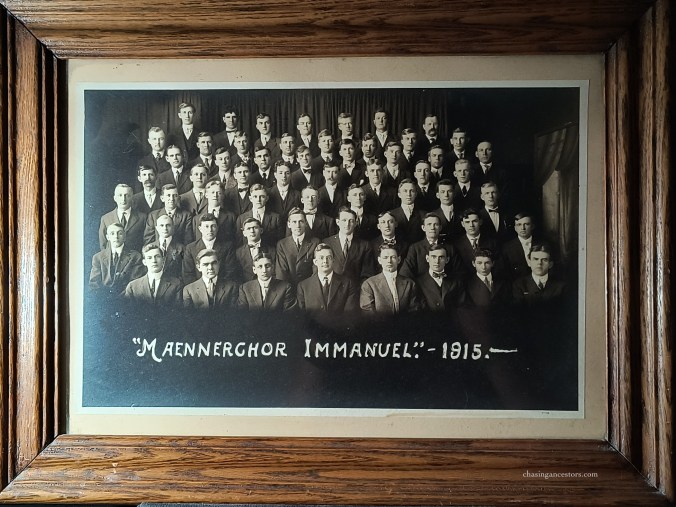
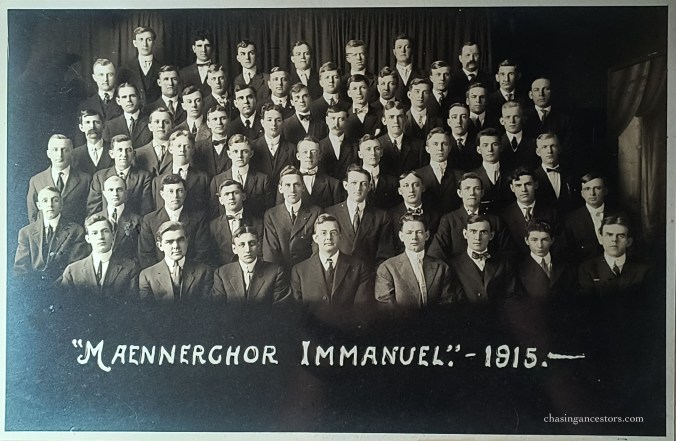
One of the treasures I have from my Maternal side of the family is a group photograph labeled “Maennerchor Immanuel—1915.” This photo hangs in my living room. I always wondered what the story was behind it.

One thing I did know was that my Great Grandfather, Herman Beiersdorf (1895-1983) was in the photo. Looking closer, I also found his older brothers, Fred (1882-1963) and August (1884-1974) in the group. Herman is on the bottom row, 2nd from left. August is on the same row, far right. Fred is on the fifth row, far left.

But what was the group that the three brothers were a part of? I recognized the name “Immanuel” as the church the Beiersdorf family attended in Sheboygan, WI. The word “Maennerchor” translated to “men’s choir.” So the brothers were part of the Immanuel Lutheran Church men’s choir. 

I wanted more information about the choir, and I was hoping to find a list of all of the men in the picture, so I contacted Immanuel Lutheran Church in Sheboygan, WI. I was put in touch with a woman who keeps the archives for the church and she sent me a wealth of information about the Maennerchor. 

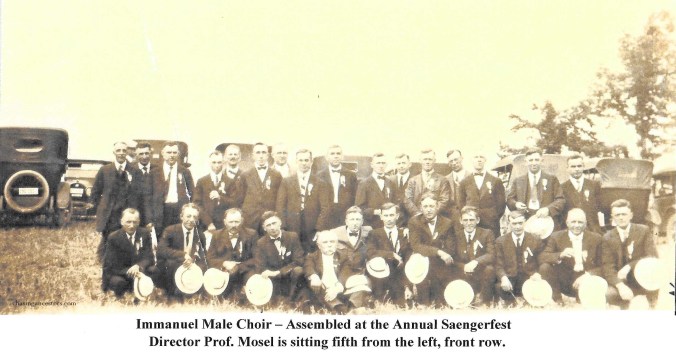
From the church’s 25th anniversary booklet (translated from German): “This choral society was founded on November 27, 1911. The purpose of the men’s choir is to cultivate spiritual and secular singing and to promote close cooperation within the community.” In essence, it was a men’s club focused on singing and fellowship. Choir rehearsals were held at 8 p.m. in order for members to have “time to work in their gardens.” They had to pay an entrance fee of $1.00 and monthly dues of 15¢. Fifty men were part of the original choir. The choir sang during the church services and community events. They joined an association of male choirs of Lutheran churches in Wisconsin and participated in many Saengerfests or “singing festivals” through this organization. During the flu epidemic in 1918, choir members sang at funerals, giving solace to families who had lost loved ones during that terrible time. Another reference from the church indicated that the Men’s choir would join with the Mixed choir and the church band for a special Christmas concert for the children of the Immanuel Lutheran school & would give special gift bags to the children. 

I also received the full list of members in the photograph:

Seventh Row: Emil Klewin, Herman Erdmann, Herman Bendler, William Guether, Erwin Nack, Emil Marquardt, Ernst Oberheu

Sixth Row: Hugo Kaems, Paul Mahnke, Charles Grimmer, Elmer Doege, Arthur Kaems, William Schild, Herman Wesener, Robert Perl

Fifth Row: Fred Beiersdorf, August Lutze, Fred Schoening, Nels Nelson, Otto Marquardt, Louis Falk, Frank Becker, Barney Schneidewind

Fourth Row: Albert Falk, William Daehnert, Ernst Leikip, Fred Schoen, William Steffen, Sr., Herman Kohls, Herman Daehnert, Edgar Reinholz

Third Row: Gustave Littman, Charles Pantel, Albert Nack, Carl Bendler, Oswald Wolfgram, Charles Lutze, Otto Daehnert, Richard Klatt, William Busse

Second Row: Hugo Overbeck, George Gauger, Henry Zinkann, Erich Gauger, Theodore Burger, E.W. Fremder, Director, Oscar Uttech, Carl Vorphal, John Stengel, Adolph Littman

First Row (Bottom): Alfred Kowert, Herman Beiersdorf, William Zamzow, Rev. Theo. Laetsch, Sr., William Kolbe, Valentine Drews, Emil Erdman, August Beiersdorf

This confirmed that I was correct in the identification of the Beiersdorf brothers in the photo. But I also saw some other familiar family names on the list. William Kolbe could be a cousin to the Beiersdorfs—son of Herman & Minnie Juergen Kolb. And perhaps there is a typo in the list—4th row, Herman Kolbs—is this actually Herman Kolbe? If so, this would be the brother of William. Brothers Carl Bendler and Herman Bendler were brothers-in-law of August Beiersdorf—brothers of Helen Bendler Beiersdorf (1888-1962). 

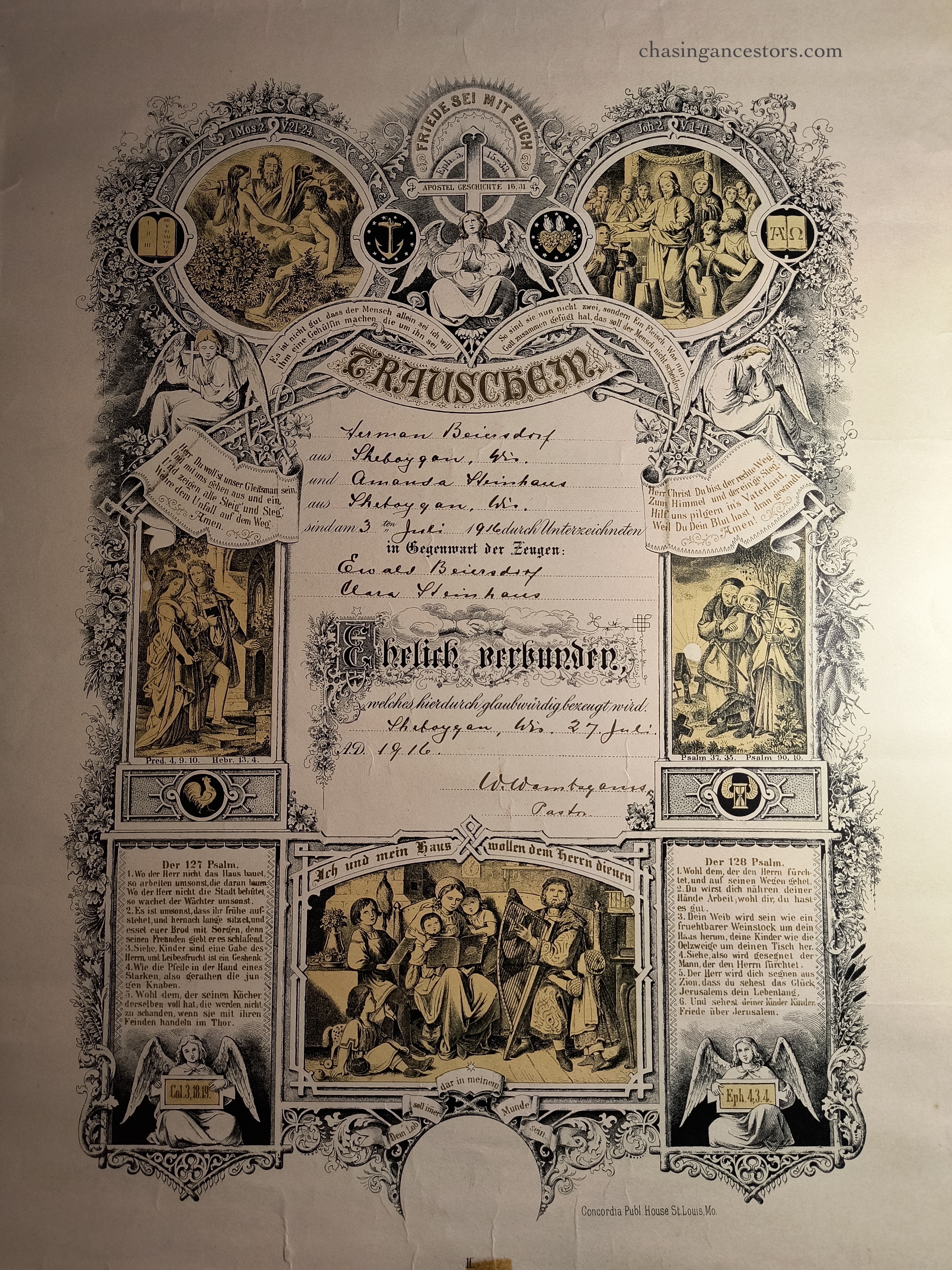
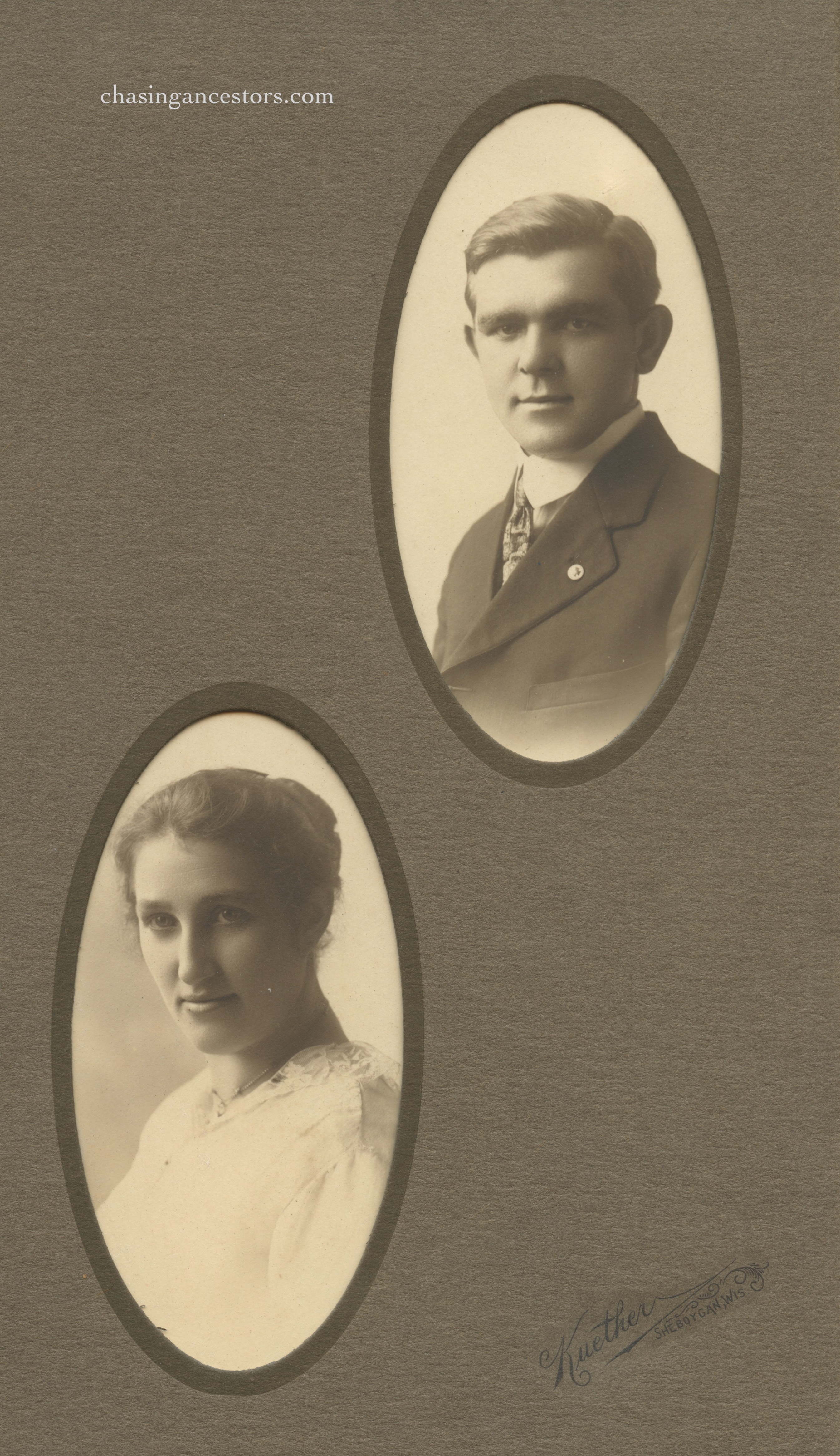
Regarding the Beiersdorf brothers tenure in the choir: Herman sang Second Tenor and was in the choir from 1913 to 1917. He married Amanda Steinhaus (1894-1973) in 1916 and started attending her family church, Bethlehem Lutheran after that. Fred sang First Bass and was in the choir from 1915 to 1923. August sang Second Bass and was a part of the choir from 1915 to 1926. 

Of course I still wanted to find out more about the choir. As I usually do when I’m looking for a story, I went to Newspapers.com and searched for any information about the choir, particularly in the Sheboygan Press. I found an article from April 9, 1915 announcing a concert on April 11 with the Philharmonic Orchestra. 

Then in November, there was another announcement for a concert with the Philharmonic Orchestra to be held November 21 at the “new” Bethlehem (Lutheran) Church hall. The announcement included the exact same photograph of the choir that I had! The group was to sing two numbers with the orchestra and there would also be “several amusing selections, such as solos trios & dialogues.” On Saturday, November 20, there was a notice that the concert had sold out so they would repeat the program again on Monday the 22nd. I guess the choir was a hit.

There were several more articles and announcements in the Sheboygan Press about choir programs through the years. There were also mentions of the choir participating in “Saengerfests.” The official translation of Saengerfest is “singer festival.” In essence, choirs would come together for a day of singing, with competitions and parades & picnics.

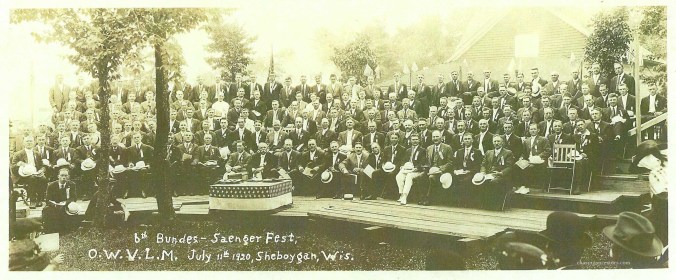
I had also received from the Immanual Lutheran Church archives two pictures referencing the July 11, 1920 Saengerfest of the O.W.V.L.M. (Ost-Wisconsin Verband Lutherische Maennerchore) or Eastern Wisconsin Association of Lutheran Men’s Choirs. The festival was held at Sheboygan, WI.

According to an article in the Sheboygan Press on July 6, 1920, a chartered special excursion train would bring “500 singers & guests from Two Rivers, Maintowoc and Newton” on the morning of the festival. The choirs and bands from Sheboygan would meet the train at the depot. There would then be a parade from the depot to the Immanual hall on S Seventeenth Street and Illinois Avenue. The mass choir of over 200 voices would rehearse before marching to the Lake Front Shooting park for the festival. A stage was constructed just for this event. They expected “several thousand people” to attend and were prepared to serve meals to everyone.

The program for the festival was also published in German in the article from July 6. The first part would start at 10:30a.m. with a worship service with community singing, Scripture reading, a selection by the mass choir, a sermon given by Pastor Theo Laetsch, a special collection for missions, and prayer and blessing. The second part of the festival would start at 2:00p.m. with a singer’s march, a welcoming speech from Sheboygan’s mayor, Herman Albrecht, and songs by the different choirs as well as the mass choir. The last musical number was to be a medley of “The Best-Loved Southern Melodies” which seemed out of place with all of the German music listed in the program. 

Being a part of the Association of Men’s choirs gave the choir the opportunity to sing at many  venues and events.The choir continued to participate in several more Saengerfests through the years. The Immanuel Choir is said to have manned the “Beer stand” at the festivals—this was their means of raising money. 

An article in the Sheboygan Press from November 23, 1946 announced the 35th anniversary celebration for the choir. At that time the choir consisted of 16 men with two members of the original choir still singing, Albert Nack & Louis Falk. The choir would sing at both the German and English worship services on November 24. The 16 men in the choir would be joined by 10 former members for that day. 

Due to declining membership, the choir was disbanded on November 9, 1982. The organization had served the congregation and community well for 71 years. From what I gather, the choir was more than just a “church choir,” it was an organization that celebrated good music performances & good fellowship for the men involved. 

©2025 MJM

Dear Cousin Mattie…

As I have mentioned before, my Grandmother, Margaret Millikan McKinley (1917-2007), kept many family papers and photographs. Some of what she saved were letters from various family members. I wonder why some letters were saved and many more were discarded. But I am grateful for those letters that give a glimpse of family life & maybe even a little more insight into family relationships. Here is one such letter:

HJL1890en copy

The envelope indicates this letter was sent to Martha E. Millikan, Sheridan, Ind. (Hamilton Co.)

It was sent from Moffits Mills, NC with the postmark of Oct 1, ’90.

Note the 2¢ stamp! Things have really changed!

MarthaEMillikancrop copy

Martha E. Millikan was Martha Ellen (Barker) Millikan. She was born May 25, 1858 in Randolph County, North Carolina. She moved to Hamilton County, Indiana in 1866, with her parents, Elihu Barker (1822-1910) and Hannah Jane (Allen) Barker (1825-1899); and siblings, Amelia Ann (1855-1890), John Gurney (1860-1942) & William Capres (1865-1880). She married Lewis Elwood Millikan (1855-1949) in 1882. Lewis and Martha or “Elwood” and “Mattie” as they were commonly known, were my Great-Great Grandparents. Mattie died Feb. 27, 1932.

As for the letter in the envelope, the handwriting is beautiful! I’ve heard that cursive isn’t taught much anymore in school, so I wonder if young people can even read this. 

On the top right of the first page, it says “Kemps Mills, NC” while the postmark said “Moffit’s Mills, NC.” I found only one map online that shows the location of these two places. The map is dated to 1873 and hand-drawn by J.W. Bean & can be found in the digital archive of the University of North Carolina.(https://dc.lib.unc.edu/cdm/ref/collection/ncmaps/id/223) Essentially these communities were centered around family-owned grist mills on Richland Creek about 10 miles southeast of Asheboro, NC. My guess is that the Post Office was at Moffit’s Mill at the time the letter was written. 

The transcribed letter:

Kemp’s Mills, N.C.

9 mo. 29th 1890 

Dear Cousin Mattie:–

Thy interesting letter of 8 mo. was duly received. Were truly glad to hear from so many of our relations. We are in usual health:–all able to help in the common cares of life. Our relations are mostly well so far as we know except Simeon Barker, we hear is quite sick. I was at Uncle Seth’s in last month:–They seemed lively enough considering their age & were able to get out to Quarterly Meeting at Marlboro. Suppose you have heard of their son, Benjamin’s death.

It was brother Jno’s right arm that was taken off. There was a tumor on it near the shoulder which was thought to have been caused by a severe bump he received from the plow handle while 

[pg 2] plowing several years ago. During the past year or so, the tumor increased so rapidly in size, and hurt so much, that it became evident something had to be done more than outward appliances, so he went to what is said to be the best Surgical Hospital in Phila. to have it removed. When they commensed the operation all the doctors agreed that in order to save his life the arm would have to be severed, which they did by unjointing at the shoulder. In thirty days he was able to leave the Hospital. Has got well and enjoys good health but has not been home:–Writes that he hopes to visit us sometime at least. He is employed by Rhoads & Co. 229 Market St. Phila. to keep books and help clerk in a Rubber & Belting store. Has learned to write tolerably well with his left hand, also can operate the typewriter. We miss him much but are 

[pg 3] glad to know he is doing well where he can enjoy life perhaps better than here considering his condition.

The Teacher’s Institute at Asheboro commences today but I am not expecting to teach this winter so have not gone, much as I enjoy attending. Brother Jno. and I both attended last fall. We have an abundance of rain. Wheat was very light last year and if the rain continues, it will be difficult to get any sowed soon. People here have good corn. No peaches the past summer worth relating and only a moderate apple crop. Late ones are rotting; we have been canning and preserving some of ours. Cotton fields are looking white and ready to pick; have ours partly picked out. There is a fine crop of persimmons beginning to ripen but we make little use of them except that the pigs eat them.

How is Cousin Amelia and family? 

[pg 4] I believe thee did not write anything in thy last letter about them. I would be pleased to visit thee and others but do not know that I can do so soon. Mother often talks of writing to relations in Ind. Aunt H. Hockett in particular, knowing her lonely condition but can not see and write so well as when younger. 

Aunt Catharine Barker was here not long ago on a visit; seems and looks real cheerful but cannot hear very well.

Gideon and Asenath Cox staied with us two nights. I believe they honestly think Texas the place to live. Thee may let thy father’s folks read this if they wish to hear about brother’s arm.

It is nearly bedtime so no more at present. Write soon. Thy cousin, H.J. Littler

Jno’s address is 229 Market St. as I have written, but he says so many letters come to the store that he prefers having letters directed to his lodgings which is at 480 N. 5th St. Phila. Penn. I think he would be pleased to hear from any of you. H.J.L.

The letter was written by Mattie’s cousin, H.J. Littler on September 29, 1890. It was written in response to Mattie’s letter a month earlier. Note the use of “Thee” & “Thy” which were commonly used by Quakers in speaking to their close relatives. 

H.J. Littler turns out to be Hannah Jane Littler (1863-1945). Her Mother was Tamar (Barker) Littler (1827-1919) who was the sister of Mattie’s father Elihu Barker. Hannah was a teacher, which may explain her beautiful handwriting. 

Hannah mentions several family members in her letter, many of them Barker cousins. I had some notes regarding this family, but had to verify some information so I used Ancestry.com, Findagrave.com and Newspapers.com to clarify the details of the relationships. 

Enoch Barker was the patriarch of this family. He was born in 1776 in Guilford Co, NC & he married Elizabeth Davis November 23, 1800 in the Holly Spring meeting house in Randolph County, NC. Elizabeth was born in 1782 in Chatham Co, NC. She died in 1834 and Enoch died in 1848. From what I know, they were both lifelong residents of North Carolina. They lived and raised their family in the community near the Holly Spring Friends (Quaker) meeting house. Their children were: Sarah (1801-1846), Daniel (1803-1892), Nicholas (1805-1886), John (1807-1890), Isaac (1810-1820), Seth (1812-1894), Mary (1815-?), Hannah (1818-1899), Elihu (1822-1910), and Tamar (1827-1919). 

Starting at the beginning of the letter, Hannah mentions Simeon Barker, who was probably her cousin. He was born in 1835 to Nicholas Barker (1805-1886) and Catharine Cox (1806-1896). I expect this Catharine was the “Aunt Catharine Barker” mentioned later in the letter. She would have been 84 years old when she visited Hannah. 

She then mentions “Uncle Seth” and his son, Benjamin. Uncle Seth Barker (1812-1894) was married to Margaret Cox (1812-1891). Seth and Margaret would have been in their late 70’s at the time Hannah wrote this letter. The “Quarterly Meeting” was a regional meeting of Quakers held at the Marlboro Meeting House in Sophia, NC. Their son, Benjamin, was born in 1850 and died June 6, 1890. He was 40 years old and left a wife, Esther and family.

Hannah’s brother, John Oxley (“Jno” is an abbreviation for John), was having a rough time with the surgical amputation of his right arm at the shoulder. He spent 30 days in the hospital. But as Hannah wrote, it seems he had recovered well after the surgery and was adjusting to his disability and was working as a clerk & bookkeeper. John Littler was born July 2, 1859. He is listed in the 1880 census as being a student at the Westtown boarding school in Westchester, PA. The school was founded by Philadelphia Quakers. This explains how he ended up in the Philadelphia area. He died September 8, 1891.

Hannah then mentions the status of farming in the region. Sounds like they were having a good year for some crops while others were hampered by the weather. 

Hannah asks about “Cousin Amelia.” This would be Mattie’s sister, Amelia Ann Barker. She was born in Randolph County, NC September 24, 1855. She married Simeon Fesmire (1852-1925) in 1889 but as Simeon’s obituary stated, “she only lived 11 months” after they were married. She died November 29, 1890, only 2 months after Hannah’s letter was written. 

Then there is “Aunt H. Hockett” who lived in Indiana. Hannah Barker Hockett (1818-1899) was married to Mahlon Hockett (1808-1885) in Holly Spring MH in 1858. He was a widower with 4 children. From what I can tell, they had no additional children. They moved to Rush County, IN sometime before the 1880 US Census was taken. He died there in 1885. According to my Grandmother’s notes, Hannah later lived with her brother, Elihu near Sheridan in Hamilton County, IN, not far from where Mattie and Elwood lived.  

At the end of the letter, Hannah mentions Gideon and Asenath Cox, from Texas. Asenath was Hannah’s cousin, daughter of Daniel Barker (1803-1892). She was born in 1829 and married Gideon Cox (1822-1892) in 1858. She was his second wife. They moved to Estacado, TX in 1881, following his son, Paris Cox who had a vision of establishing a Quaker community there. Gideon & Asenath would have been in their 60’s when they visited the folks back home. Gideon died in Texas & Asenath died in Whittier, California, where she had been living with their son, Manley. One more family relationship: Gideon’s half-brother, Thomas was the husband of Sarah Barker Cox (1801-1846), Hannah’s aunt. The Cox and Barker families had many branches and intermarried through many generations so these relationships are somewhat difficult to decipher. 

So again, I wonder why this letter was kept through the years, but I’m glad it was. It shows how over 130 years ago the family was able to stay connected while living so far apart from each other. 

© MJM 2024

The Lectern Bible and the Small Town Church

Several years ago my uncle, Leroy McKinley (1941-2023), gifted me with a box of Bibles. Among the many small personal Bibles were two large Bibles. One was the Erp family Bible & the other was what appeared to be the Lectern or Pulpit Bible from a church. I can’t remember where he said he got this Bible.

The Bible is a large black leather-bound book with reference pages and illustrations. There is no printing date that I could find.

IMG_20240121_115103867_HDR copy

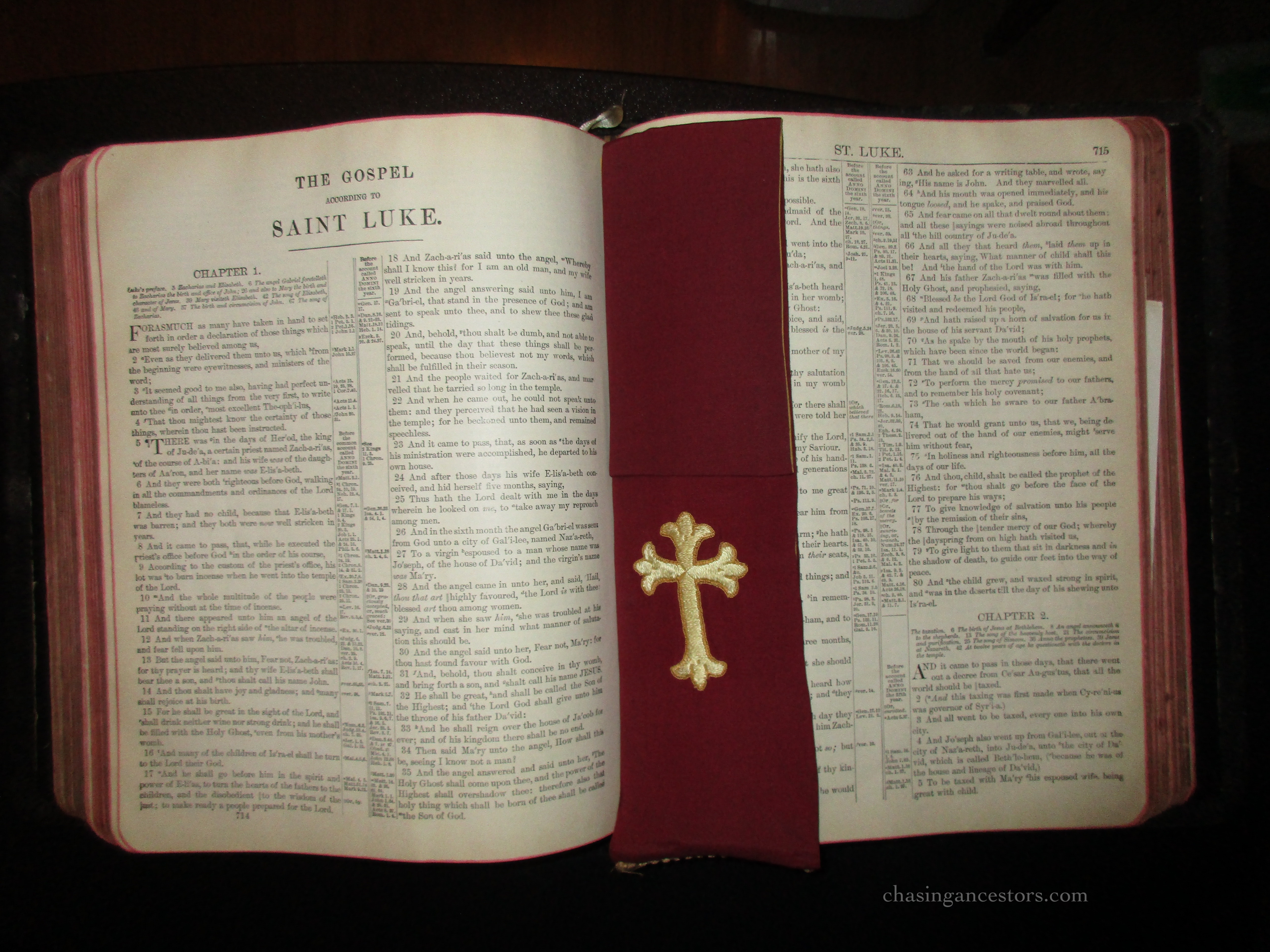
It even contained the bookmark that would have matched the altar paraments.

IMG_1654 copy

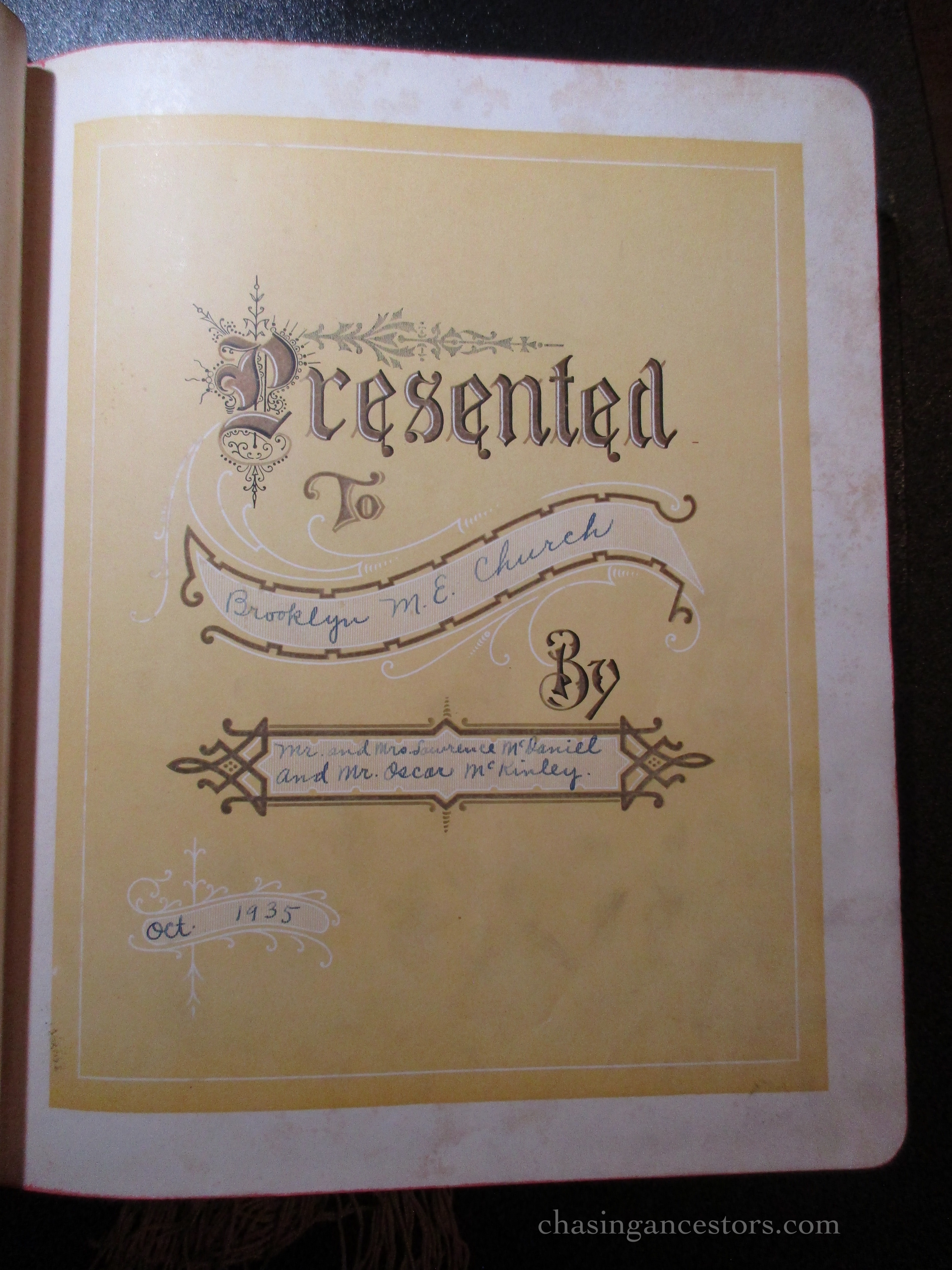
But what first intrigued me about this Bible was the inscription in the front:

IMG_1655 copy

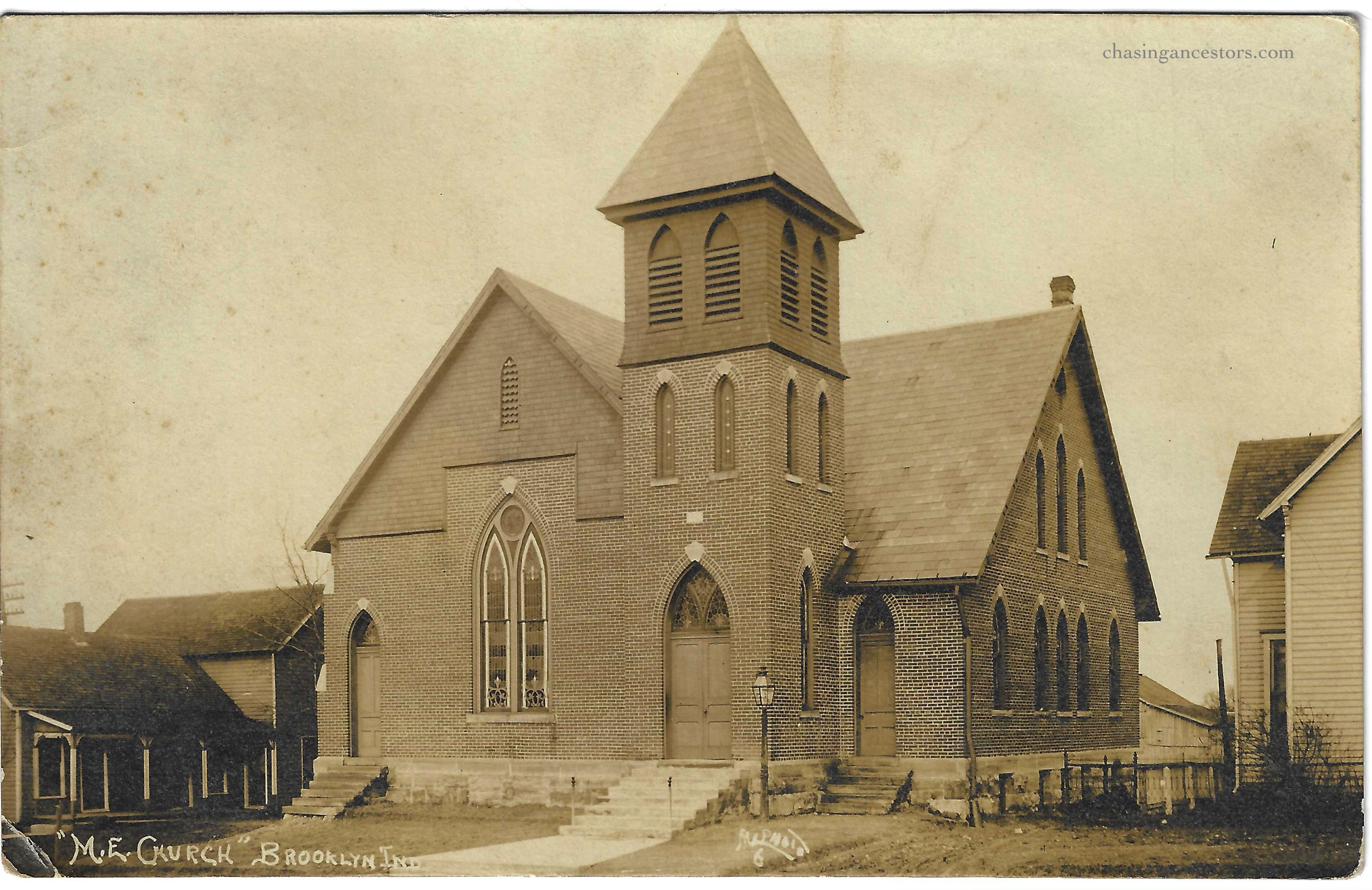
The Bible was presented to Brooklyn M.E. Church by Mr. and Mrs. Lawrence McDaniel and Mr. Oscar McKinley in Oct. of 1935. Oscar McKinley (1887-1969) was my Great Grandfather.

Brooklyn Methodist Episcopal Church was located in Brooklyn, Indiana, a small town in Morgan County. Brooklyn was where my Great Grandfather lived and where my Grandfather, Loran McKinley, Sr. (1916-2003) grew up.

BrooklynMEChurchpostcard copy

This undated postcard picture of the church was in the collection of photographs I received from my Grandfather.

The other fun thing about this Bible is the additional pages that listed the members of the church at the time the Bible was presented.

“Members of the Brooklyn, Ind. M.E. Church at the time this Bible was presented—October, 1935.”
Trustees: J.B. Abrell, Lawrence McDaniel, Oscar McKinley, R.C. Minton, Dr. John S. Spoor, Samuel Swope, H.C. Zenor

Members:
Abrell, J.B, Bertha, Forrest; Bradford, Georgia; Caldwell, Lee, Rilla, Ruby; Copeland, Mrs.
Clara, Lee, Martha; Clark, Minnie.
Clay, Mary, Viola, Ethel, Emma; Dillender, Fred; Edson, Nina, Roger, Robert; Forrester, Sarah, Andrew, Bennie, Ida, William, Mrs. Wm, Richard, Katherine; Fleenor, Maxine, Rex; Gilbert, Laura, Earl, Bill; Griggs, Loren; Hensley, William, Fannie.
Hornaday, Chas, Catherine; Holdaway, Mary E; Jones, Senith, Wallace, Mrs. Mabel; Kincaid, Otis; Matthews, Annie; Morgan, Avis; Morrison, Thelma, Mrs. Harvey; Minton, Carl R., Rose; Moulton, Roy, Mrs. Roy; Monical, F.S., Mrs. F.S.; McNeff, Clyde, Julia, Dorothy, Robert, Leslie. McDaniel, Lawrence, Eva, Sadie; McKinley, Oscar, Loren [Loran]; Plummer, Lillie, Jane; Powell, LeOtis, Beverly, Opal Theresa; Passmore, Josaphine; Riggs, Chester (Eugene, next page); Ritzler, Amelia, Charles; Richardson, Mrs. Dora; Rathrock, Hattie; Simpson, Edith; Rike, Effie; Rike, Mrs.; Rooker, Bernice; Rinker, George, Jr.; Rinker, Geo. W., Eliza, Ida Ann.
Rinker, Eli; Rober, Martha; Riggs, Eugene; Rymerson, Bessie; Swope, Samuel, Mrs. Celia, Clarence; Sanders, Martha; Self, Maude, Harry; Spoor, Dr. John S., Iola; Soots, Frank, Dolly, William; Stafford, Violena; Shelly, T.Z., Mrs. T.Z.; Smith, Mary, S.R., Armina, Betty Lou. Swarens, Rev. A.L. Pastor 1934-1936, Mrs. Mae; Throckmorton, Mrs. Perry; Wall, Hallie; Woodard, Pruah; Williams, Geo, Ida, Garnet; Waltz, Maude, Mary, Roy; Welty, Rose; Wiley, Rosemary, Kathleene, Rose; Young, Mrs. Gerald; Walker, Carl; Wratten, Lottie Mae; Zenor, Harry C., Mrs. Nellie.

I looked at the 1930 and 1940 US Census records on Ancestry.com and found that most of the members of the church lived in the town of Brooklyn. I also learned that some were the only family members listed on the roll, a husband or wife was not listed. I saw that not many children were listed, but I’m not surprised as children were probably not considered members until they reached teen or pre-teen age.

From the census information, I found that the church members had a variety of occupations. There were two telegraph operators for the Penn R.R. Co.; a station agent for the Interurban R.R.; a barber; a few bookkeepers for various industries; several teachers, both male and female, and a school principal and a superintendent. The Postmaster of Brooklyn was a member of the church as was a postal clerk. There were two attorneys, one of which was also a furniture buyer. One member owned and operated a filling station while another owned a garage. Of course there was a Dry Goods store owner. The two main industries in Brooklyn, the Brooklyn Brick Company and the Indiana Drain Tile Company were well represented in the membership w/ laborers as well as the superintendent for the Brick Company and the Secretary/Treasurer for the Tile Company.

I also found a few family connections on the membership roll. First, as mentioned already, my Great Grandfather, Oscar McKinley (1887-1969) was listed along with my Grandfather, Loran (1916-2003) who was 19 yrs old in 1935. Then there were the Caldwells. Lee Caldwell died in 1936 and his widow, Rilla (1894-1982) married Oscar McKinley on January 31, 1941. Oscar had been divorced from his first wife, Gertrude (Portis) McKinley (1888-1967) for several years by then. Another church member, Carl Minton (1867-1936) was an attorney and was a first cousin to Gertrude (Portis) McKinley, my Great Grandmother.

I searched newspapers from the area through Newspapers.com and found more surprising connections to my family. Violena “Lena” Stafford (1878-1968) was married to Benjamin Franklin Stafford (1874-1946) who was a half first cousin once removed to my Grandfather, Loran McKinley. Lena was the sister of another church member, Hallie Wall. Also, Mrs Laura Gilbert (1856-1946) was a 2nd cousin once removed from my Grandfather, Loran. She was the daughter of Noah J. Major who wrote “The Pioneers of Morgan County, Memoirs of Noah J. Major.”

There were other family groups who were part of the membership of the Brooklyn M.E. church. Georgia Bradford was a sister-in-law to Lawrence McDaniel. Maxine and Rex Fleenor were the grandchildren of Senith Jones. Catherine Hornaday was Maude Self’s sister. Mary Smith was the mother of Mrs. Roy (Ethel) Moulton. Hattie Rothrock was the mother of Edith Simpson. Eugene Riggs was the grandson of Charles Hornaday. Mrs. Perry Throckmorton was the mother of Rilla Caldwell. She was also the sister-in-law to Dolly Soots. Rosemary Wiley was the daughter of Jane Plummer. I expect these families celebrated many milestones and mourned losses with each other at the Brooklyn M.E. Church.

So what about the church? Why was the Bible in my possession and not still in the church? What is the history of this church and what happened to it? I searched Newspapers.com and a few other sources to find the answers. There were several articles in the Martinsville, IN Reporter-Times newspaper that chronicled the church’s history.

From what I could find, the Brooklyn Methodist Episcopal Church congregation was established in 1821 and first met in a shed on someone’s land. The first brick structure may have been erected in 1869 & was replaced by the present building in 1895. The stained glass windows were donated by prominent citizens who were members of the church. There were modifications made to the building through the years as noted in later photographs.

In 1908 they ordered 75 hymnals and organized a Sunday-school orchestra. In 1914, the congregation raised $500 for repairs to the church. There was a Ladies Aid society that had regular meetings and sold food and desserts at local fairs. One meeting in November, 1932 had the ladies “tacking two comforts” that they presented to a family who had lost their home to a fire.

In January of 1934, the church was the location of the funeral of Jap Miller, the “mayor of Brooklyn.” Mr. Miller was made famous by James Whitcomb Reilly in his poem, “Jap Miller down at Martinsville.” He also operated a store in Brooklyn.

The church was used for school graduation ceremonies in the 1930’s, both for the Clay township high school and the 8th grade graduates. It also hosted exhibits for the 4-H clubs and Home Economics clubs. In 1943, there was a sewing and cooking exhibit and home canning demonstration.

img479BrooklynMEchurchgroup copy

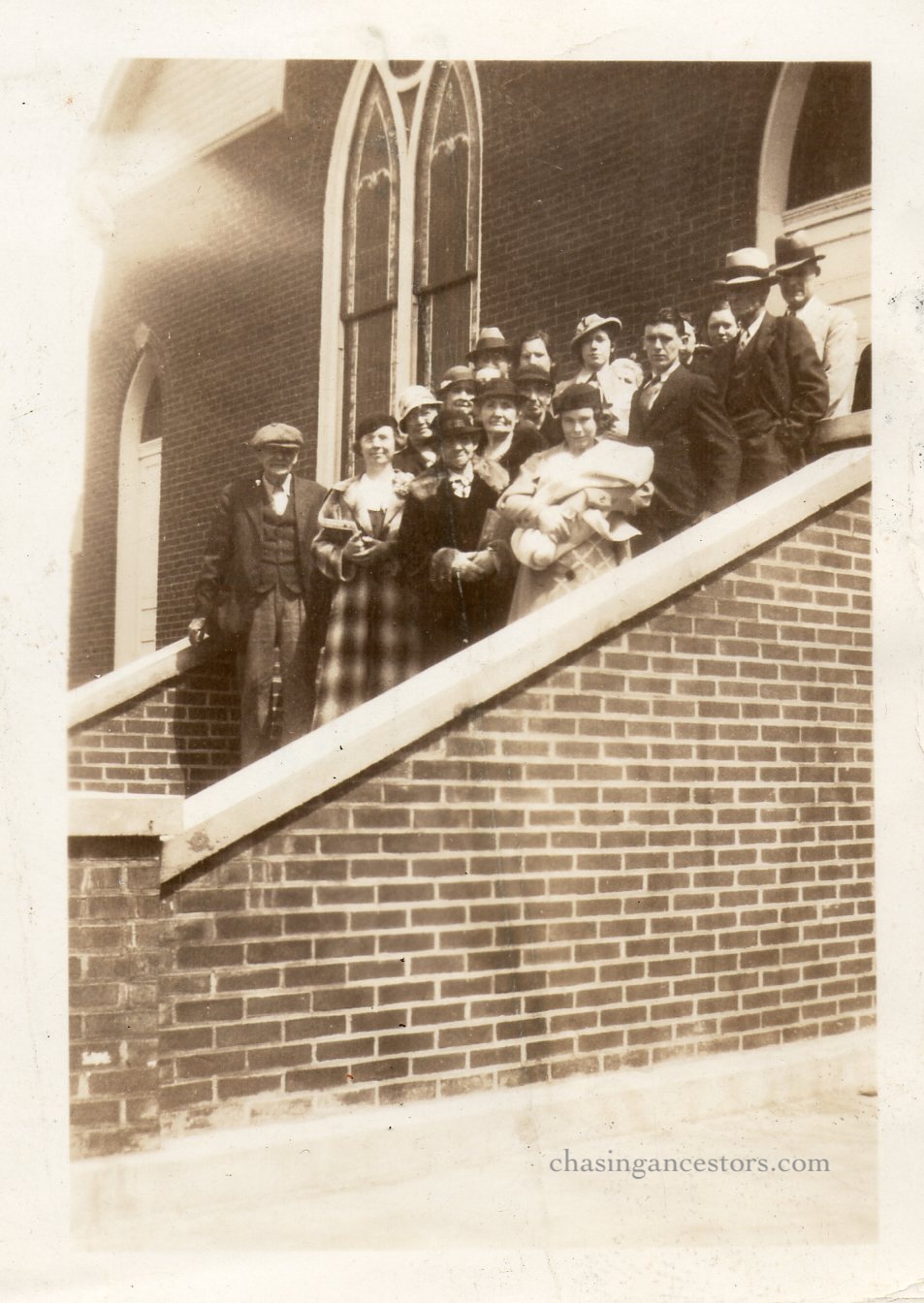
This undated photo was also in my Grandfather’s collection. I wonder if it commemorated the baby’s baptism. There was no identification given for any of the people in the picture, although I think my Great Grandfather, Oscar McKinley is the man at the top of the stairs in the light colored suit. This picture also shows how the stairs were modified from the earlier picture.

There was a special service held in August of 1940 to dedicate new memorial hymnals. Many were donated either in memory of or in honor of someone dear to them by the members of the congregation listed on the 1935 roll.

In the 1940’s they shared services with Monrovia Methodist Church in Monrovia, IN. The newspaper would indicate whether morning or evening services were at Monrovia. The attendance in March of 1942 was 72.

The first WWII casualty from Brooklyn was 20 year old Charles Arnold, Jr, who died in Italy. His memorial service was held in the church on January 16, 1944.

In September of 1945, the church had a special homecoming service and picnic to celebrate the 50th Anniversary of the morning worship period. So I guess the Bible may have been presented in 1935 in honor of the 40th Anniversary.

The church held ice cream socials and taffy pulls and spelling bees as well as other activities through the years. Revivals were also held at the church.

On May 25, 1969, the church closed as it could not meet the obligations to the denomination. Many children attended the church at that time and the assessment for financial obligation was determined by the number of people on the rolls. According to an article in The Martinsville Reporter- Times from June 2, 1969, and an article in The Martinsville Democrat June 6, 1969, the Sunday school attendance outnumbered the regular worship attendance by 2 to 3 times. Worship attendance was averaging around 30 people, while the rolls listed 142 names. The church was assessed $14.83 for each person on the roll & $33 for each $100 paid to the pastor. The church was reported to be financially solvent at that time, but not able to keep up the obligation to the Methodist Conference. Options to merge with other congregations were turned down for various reasons; as well as the possibility of staying open only as a Sunday school congregation. Apparently no deed could be found for the church, so the Conference was not able to claim the property.

The article from the Democrat mentioned a lady, Mrs. Frank Soots, age 83, who had been a member of the church since her childhood and who was present when the church doors closed. She was actually Dolly Throckmorton Soots & she was listed with her husband on the church roll from 1935.

The church building was used by other denominations & religious groups through the succeeding years. It is now listed on a Realtor site for sale as a commercial site. The address is 9 N Church St. Several photographs are posted of the interior and exterior of the building.

20240513brooklyninmechurchbldg1-copy

I took this picture a week ago on a recent trip through the area. The building is a bit run down, the stained glass windows are long gone & the yard is overgrown. It is just a building. The people who passed through its doors from generation to generation to gather as community to worship their Lord are the real legacy of Brooklyn M.E. Church.

©MJM 2024

Timeline of an Army Career

McKinley015

Margaret, Loran Jr, Loran McKinley Sr.

On May 26, 1938, my father, Loran R McKinley, Jr., “Mac,” was born in Sheridan, IN to Loran R McKinley (1916-2003) and Margaret Millikan McKinley (1917-2007). He spent his childhood on farms in Indiana, played basketball in high school as any Hoosier boy would do, and went off to Taylor University in 1956. He was quite the prankster in college. He told stories of stuffing toilet paper in the pipes of the pipe organ in the chapel and rigging a car up on blocks so it was just barely off the ground to clear the wheels so the person had no idea that it wouldn’t go anywhere until they tried to drive the car. He told me that he really wasn’t ready for college, and he eventually was suspended from Taylor University for the 1959-1960 school year after an incident involving “misuse of a test” or, in other words, for stealing a test. While the letter from the dean stated he could be reinstated after the suspension if he showed “evidence of rehabilitation,” Dad decided not to return.

Figuring that his draft number would be called soon, he joined the Army. If he volunteered, he would have some choice as to what program he could get into and as he said, “I chose the program with the longest training.” On May 8, 1959 he signed the papers to enlist and get training in Medical Laboratory Procedures. He was first assigned to Ft. Leonard Wood, MO for basic training then reassigned to Ft. Riley, KS. After Basic, he went to Ft. Sam Houston, TX for his initial Medical Laboratory training. In January, 1960, he was assigned to Madigan General Hospital, Tacoma, WA for four months, then on to Ft. Dix, NJ for transport via the USNS General William O. Darby to his next assignment at the 97th General Hospital in Frankfurt, Germany.

LRMcKinleyJrCameraWhile in Frankfurt, he volunteered for the job of medical photographer.  He said that during that time, every American death in Germany had to have an autopsy & the pathologist required photographs. While he didn’t have much experience in photography, he read up on it and learned the skills he needed to do the job. Photography was a life-long interest of his after that.

0027LRMcKJrLandstuhl1963 copy

He reenlisted in 1962 and was transferred to Landstuhl Army Medical Center in Landstuhl, Germany. He said that he transferred as the medical photographer, but also filled the Med Tech role that was open at Landstuhl. On October 12, 1962 he received the Good Conduct Medal. He stayed at Landstuhl through 1963, by which time he had married and started a family.

In 1964 he traveled with his family back to the US to Muncie, IN & was assigned to Ball State Teachers College for additional training in Medical Technology. While in Muncie, his family grew by one more child.

In March of 1965, the United States entered the Vietnam conflict.

In June of 1965, the family moved again to Ft. Sam Houston, TX where he was stationed to Brooke Army Medical Center. On April 4, 1966 he received his second Good Conduct Medal.

In January of 1967, he applied for an appointment to become a Commissioned Officer in the Army Reserve. At the same time he applied for Active Duty. This process was complete in August of 1967, when he was discharged from Enlisted status and commissioned as a Second Lieutenant in the Army Reserves with Active Duty status. On September 4, 1967, he took the Oath of Office of a Reserve Commissioned Officer.

He also received Certificate of Achievement on November 30, 1967 which stated that “Lieutenant Loran R. McKinley, Jr. (then Specialist Six) is cited for meritorious performance of duty while assigned to the Chemistry Unit, Pathology Service, Brooke General Hospital, …Lieutenant McKinley had the critical responsibility of monitoring the various types of apparatus used in Chemistry Unit procedures. By his keen intelligence and professional knowledge he was able to determine if the equipment was functioning properly and capable of producing correct physiological data. Particularly noteworthy were Lieutenant McKinley’s constant efforts to maintain and improve the system of automation in the section with the consequent conservation of time and personnel…”

In December 1967 he got orders to Walson Army Hospital in Ft. Dix, NJ. While at Ft. Dix, he received a Certificate of Achievement. The letter recommending this certificate stated that during his short time at Ft. Dix “2LT McKinley distinguished himself while assigned to the Pathology Service, US Walson Army Hospital as the Officer-in-Charge of the Blood Donor Center. The intelligence, efficiency, and conscientiousness he displayed while fulfilling his mission were notable. 2LT McKinley consistently directed his efforts towards collecting and processing over 500 pints of whole blood weekly for shipment to Southeast Asia. Largely through his leadership, sound judgment and attention to detail, the successful completion of this vital Fort Dix mission was possible.

Then in January, 1968 he was reassigned to the US Army Medical Center Ryukyu Islands (Okinawa). He arrived in Okinawa in June & his family settled on base in August. He was the Clinical Laboratory Officer of the Medical Center.

He was named on page 37 of the paper, “A History of the Army Blood Program” (by Edward A. Lindeke, Col. Ret. MS, US Army, 2020). “When Captain Loran McKinley (later, BBF class of ’71-72) arrived in Okinawa, he began his own blood collections.” I think this meant that the the blood could now be collected consistently and did not have to wait for someone to travel from Japan to hold a blood drive. Therefore, more blood from Okinawa could then be added to the supply needed for the Pacific Command. Dad said that they would collect blood from the soldiers who stopped in Okinawa on their way to Vietnam or from the Marines stationed on the island. He said they could figure out when a soldier was afraid to donate and would make up some reason such as low blood pressure to excuse that man from donating.

A valuable tool in the transportation of blood during the Vietnam conflict was the Collins Blood box—a styrofoam box developed in 1965 & used to ship units of blood. It may seem simple these days, but at that time it was a breakthrough. It was made of styrofoam & was lighter weight and significantly cheaper to produce than the original transport box, and it was disposable. (according to the Department of the Army paper “Vietnam Studies, Medical Support 1965-1970”) Dad salvaged at least one of those boxes and we used it for many years as a cooler.

Also stated in the US Army report, “for the first time in US military history, every unit of whole blood used to support the war was donated free of charge by military personnel, their dependents, and civilians employed at military installations.” Dad has a certificate recognizing his donation of 3 gallons of whole blood while in Okinawa.

His rank was difficult to follow. In May of 1969, there were Special Orders promoting him to Captain. But then in October of 1969 he was promoted to Reserve Commissioned Officer 1st Lieutenant. Then in July of 1970 he applied for a Commission in the Regular Army. December of 1970 he was promoted to Captain in the Reserves.

According to his military papers, he assumed the role of Commanding Officer of the US Army Medical Center Ryukyu Islands for a short term.196906LRMcKAssumeCommand copy

I assume this appointment must have been during a transition period waiting for the new Commander to arrive as there is only one set of orders he signed as Commanding Officer & within a few weeks there was a new Commander. His orders were then amended to Clinical Lab Officer. He had Top Secret Clearance. While in Okinawa, he had several “Court Martial Appointing Orders” to serve as a member or counsel. He took TDY (Temporary Duty) assignments to Taiwan & Japan. My uncle told me that Dad ended up across the “wrong border” on one of his trips & may have been in Laos. I never heard that from Dad.

In 1970 he started the application process for the Blood Bank Fellowship program at Ft. Knox, KY. He was granted entry into the program in April of 1971.

0036LRMcKJrMedalApr1971 copy

Also in April of 1971 he received the Army Commendation Medal. Unfortunately, there is no citation for this medal in his papers. However, he was very proud of how he helped coordinate the blood supply from Okinawa to support the needs for the troops fighting in Vietnam.

He then received travel orders to Ft Knox. He was at Ft. Knox, KY for about a year for the Blood Bank Fellowship (BBF) training program. As the website for this program states, the purpose was to “prepare selected career officers to become managers of large military hospital blood banks, transfusion services & blood donor centers.” He then received certification as a Specialist in Blood Banking.

In July of 1971, during his time at Ft. Knox, he was Appointed to the Regular Army. He attended the Army Medical Department Officer Advanced Course in March of 1972. He was promoted to 1st Lieutenant in Regular Army Medical Service Corp on July 10, 1972.

After that, in November 1972, he moved on to Fort Sam Houston, TX for a brief stay before taking his family overseas again to 2nd General Hospital, Landstuhl, Germany.

While at Landstuhl, he served as the Laboratory Officer. Just as in Okinawa, he also served as a member of Court Martial. He also received additional training on specialized laboratory equipment and participated in race relations training. On August 26, 1973 he was promoted to Regular Army Captain.

In December of 1975, he received a Certificate of Achievement for recognition of his direction of the renovation of the Laboratory. “With the result that 2nd General Hospital now has a laboratory which will be able to provide more efficient service to its physicians and patients…

In March of 1976, he received orders of assignment to Redstone Arsenal, AL.

In May of 1976 he received the Army Commendation Medal with first Oak Leaf Cluster. He was recognized for modifying equipment and procedures to allow the Laboratory to “increase its productivity by over 50,000 procedures a month without the necessity of additional manpower.” The citation also states that he spent “numerous off duty hours assisting in the painting of the laboratory area at a substantial savings to the US Government.

In August of 1976, established his final duty station at Redstone Arsenal Medical Laboratory. He was a member in the Society of Armed Forced Medical Laboratory Scientists. On November 1, 1977 he was promoted to Major.

While at Redstone Arsenal, he oversaw the transition of Laboratory services to a new hospital, Fox Army Hospital, which opened in September 1978.

On June 19, 1979, he received the US Army Health Services Command Award Meritorious Service Medal (first Oak Leaf cluster) with the citation stating, “Through his deep personal interest, tremendous depth of knowledge, initiative, and untiring devotion to duty, Major McKinley significantly upgraded the laboratory instrumentation resulting in a remarkable expansion of accuracy and capability of the department. As the only officer assigned to the department, he was solely responsible for the successful accreditation of the laboratory by the College of American Pathologists. Through sound advice, tact, and wealth of experience, he contributed immeasurably to overall mission accomplishment. Major McKinley’s exemplary performance of duty reflects great credit on him, the Army Medical Department, and the United States Army.

Looking through all of his Officer Evaluation Reports, he always received exemplary scores and remarks. He obviously worked hard and took pride in what he did. He retired from the US Army on June 30, 1979 after 20 years of service. The skills he developed served him well for many years in civilian life as he worked in hospital or private clinic laboratories.

Some things he learned in the Army never left him. I remember attending concerts or events with my folks when there would be a recognition of active duty or retired members of the military. My Dad would stand with the veterans. His ability to stand fully upright at attention waned as he got older but I noticed that regardless of that, he would always hold his hands with his thumbs along the side seams of his pants, as I’m sure he was taught so many years ago in Basic Training.

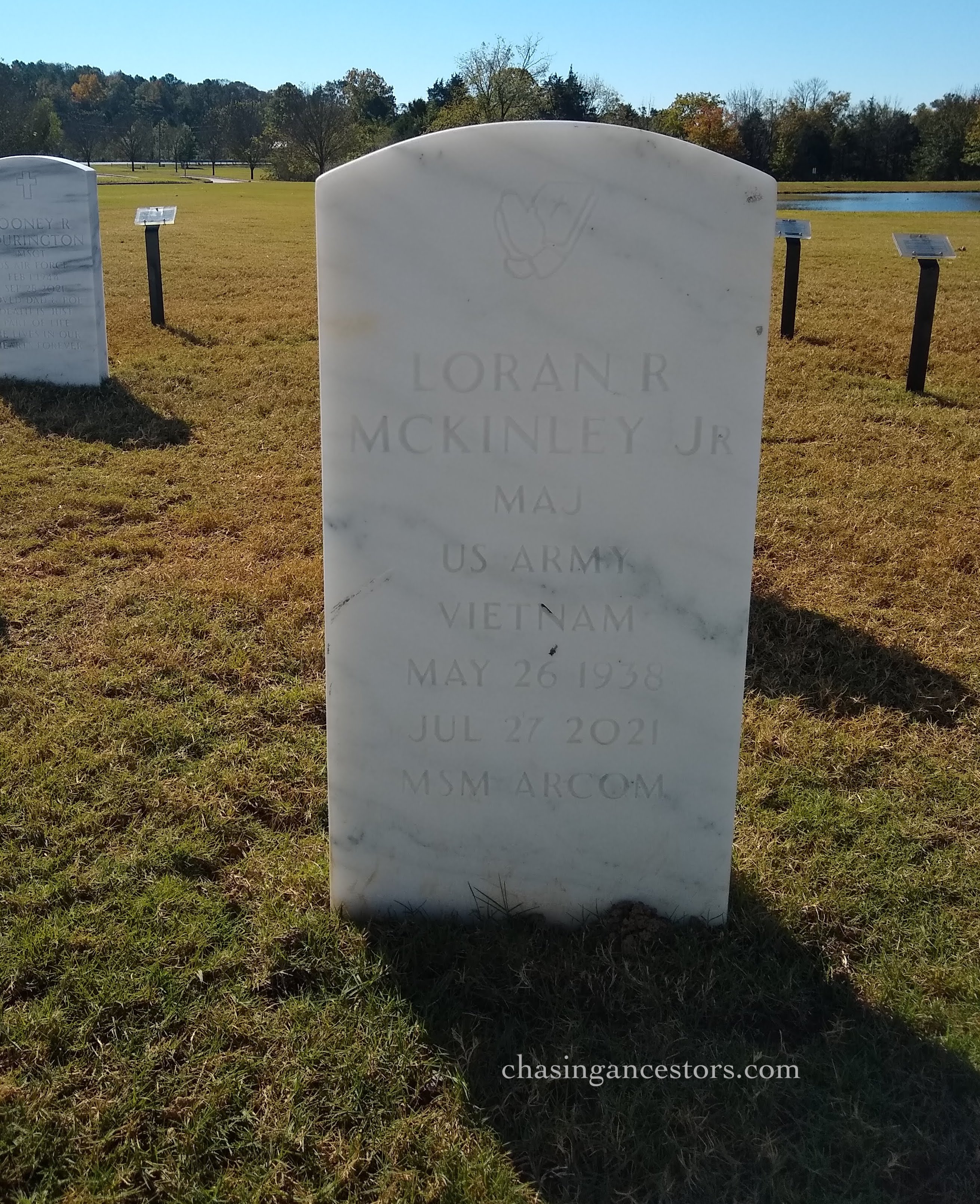
LRMcKJrHeadstoneWhile this story of a military career does not include any heroic battle scenes, it is the story of a regular guy who did an honorable job in support of his country during a time of war and a time of peace. Loran R McKinley, Jr died July 27, 2021. He is buried at the National Cemetery in Montevallo, AL.

Thank you for your service, Dad.

© MJM 2024

A Hoosier in New Guinea

When I look at names and dates on the many branches of my family tree, certain things catch my eye and I want to look further to maybe find a story there. One thing I notice is if the death dates for young men fall during the time of a war or conflict that the United States may have been involved in. Once such date led me to an interesting story. 

James Stafford, Jr. had a death date of 1944. The original birth date I had was 1916, but neither dates were confirmed by good sources. So I decided to look a little closer. 

First, James, Jr. is related through my Paternal ancestors. His father, James Stafford, Sr. (1857-1928) was the brother of my GG Grandmother, Priscilla Stafford McKinley (1859-1941). Per his Indiana Birth Certificate available on Ancestry.com, he was born January 1, 1917 in Indianapolis, IN to James Stafford & Catherine Loring at home, 2913 McPherson Avenue.

He shows up in the US Census records in Indianapolis through 1940. At that time he was listed as an Order Clerk for a Wholesale Drug company. 

His WWII Draft card, also available on Ancestry.com gives his residence as 3247 Schofield, Indianapolis, IN. He works for Kiefer Stewart Co. On the back of the card, he is described as 5ft 10 3/4in, 200 pounds, with brown eyes, brown hair and ruddy complexion. 

WWII Draft card James Stafford (from Ancestry.com) front

The Ancestry.com database of US World War II Army Enlistment records 1938-1946 indicates that he enlisted at Indianapolis, IN on January 16, 1943. He married Alberta Grass (1913-2011) the next day, January 17, 1943. James and Alberta were co-workers at the Kiefer-Stewart Company. 

According to his obituary in The Indianapolis News, he entered the service on January 27, 1943 and received his basic training at Camp Wheeler, GA. He went overseas after Basic and was stationed in Australia. From there he went to New Guinea.

Searching a little more, I found a link from Ancestry.com to Findagrave.com. This site indicated that James died on New Guinea. There was also part of a transcribed article recounting his last hours that had no source citation, only that it was from the “Chicago Tribune Press Service.” So on to another search, this time on Newspapers.com to see if I could find the original article & I got lucky. 

The full article was on the front page of the Friday, May 12, 1944 issue of the Chicago Tribune. The title was “YANK FIGHTS TO LAST HEARTBEAT. His Commander Writes Hoosier’s Epitaph.” It was written by Arthur Veysey and attributed to the Chicago Tribune Press Service out of Hollandia, Dutch New Guinea, May 11:

The Hoosier infantryman staggered as he came out of the swamp into the tall Dutch Guinea grass. If only he could rest for a while. For three days he had been beating thru the jungle, sloshing in mud, wading in chest-high swamp water, plowing thru grass sometimes over his head. Twenty-four miles the infantryman and his buddies had gone.

Haven in Sight. But now, this April 25, the end was in sight. Just across a grass flat and over a ridge lay the Cyclops airdrome. Then there would be rest. So Pvt. James Stafford of Indianapolis, Ind., gritted his teeth harder, took a new grip on his Garand rifle and in the low crouch that becomes the natural stance in jungle fighting pressed on thru the grass. Three times he fell, but each time stood again. “Better fall out,” his sergeant said. Stafford shook his head. “Then take it easier.” Stafford nodded. Now they were going up a knoll. Twice more Stafford slumped into a heap, but both times got up. At the crest the company paused. Stafford stretched out. Wild shouts roused him. There was the crackle of gunfire. Thirty [Japanese soldiers] were charging up the slope. After a while the gunfire died out momentarily, but there was no rest.

Fire and Reload! Then a second [Japanese] attack came. Thirty more this time, with bayonets fixed. Fire and reload! Fire and reload! The [Japanese] danced before Stafford’s eyes.

At last the enemy was wiped out. First aid men went along the firing line. They found Stafford unwounded but in a coma. In two hours he was dead. When Col. O.P. Newman heard about Stafford he recommended that the distinguished service cross be sent to his parents. Said the commander: “He gave his energy to the last drop.”

Private Stafford was one of many US Army soldiers who landed on New Guinea in April 1944. Only 3 days into the battle he most likely succumbed to heat stroke. Interestingly, his death date on his headstone is April 24, 1944. 

His death was reported in The Indianapolis News, Saturday, May 13, 1944, p1. The report indicated that his wife received word of his death May 6. The short article included this photograph:

Pvt. James Stafford, Jr.

A search on the American Battle Monuments Commission website <abmc.gov> gives the following regarding Private James Stafford: His service # 35581675, Unit 186th Infantry Regiment, 41st Infantry Division, buried in the Manila American Cemetery, McKinley Road, Fort Bonifacio, Philippines in Plot A Row 12 Grave 68. He is listed as receiving the Purple Heart and Silver Star. 

One final note about James Stafford, Jr. The findagrave.com site had another clipping of an unsourced news article that quoted his wife, Alberta. She states, “Jim’s death was not in vain. What we already have accomplished proves that. We must not stop. We must go on. I know inside what Jim died for.”

May we always remember what they all died for & the sacrifice they gave for the freedoms we have. 

© MJM 2023

1930’s Snow Days

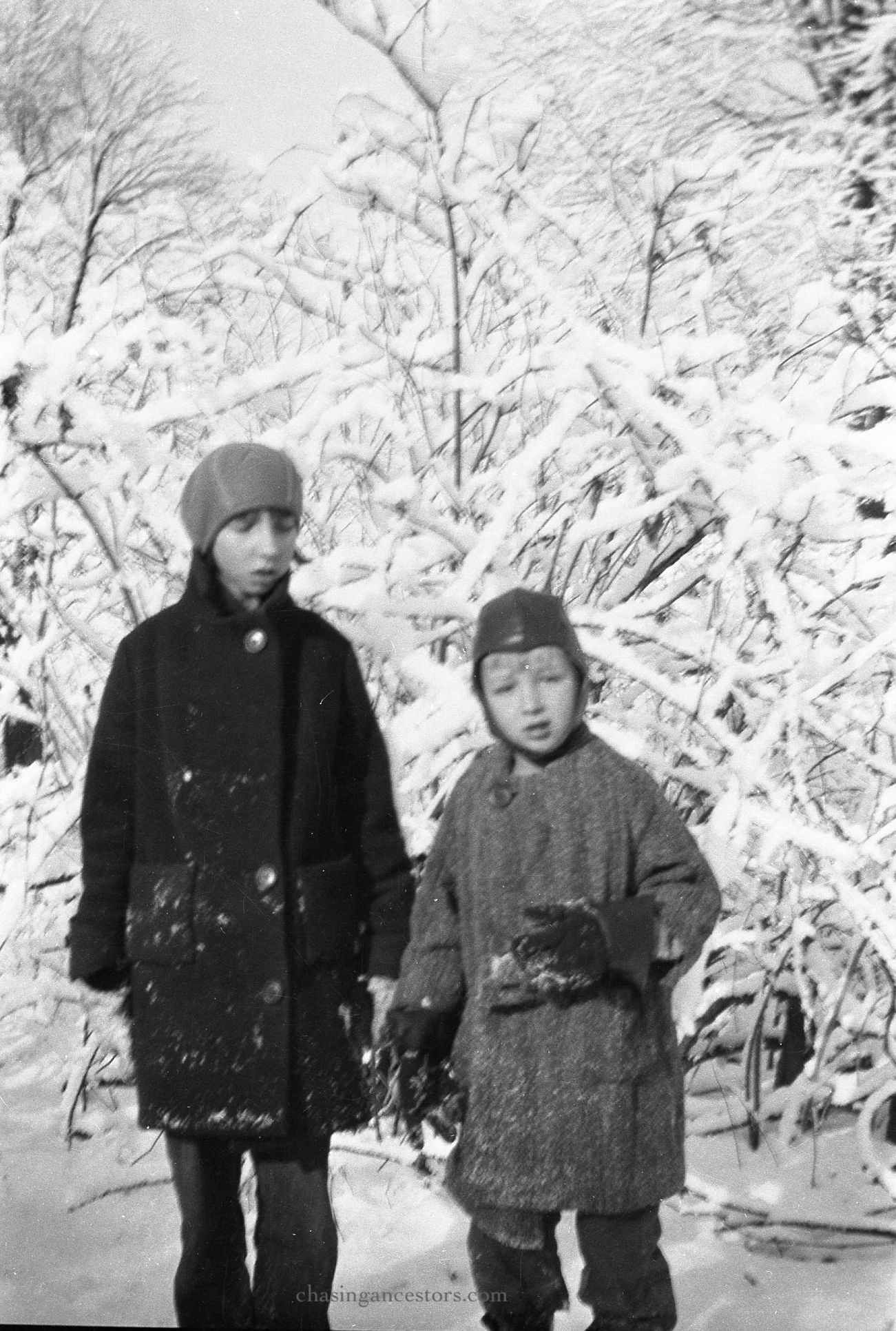
With the recent winter storms affecting the country, I got to thinking about some pictures taken of my ancestors after snow storms. I think these pictures date to sometime in the 1930’s.

First, pictures of the relatives from Indiana:

Millikan166nBetAClark copy

This is sister and brother, Betty Lou (1921-1990) and Arza Clark (1925-1975) Millikan, probably taken on or near their farm in Sheridan, IN. Looks like they may have enjoyed playing in the snow.

Then their older siblings, Miriam Frances (1918-2018) and Margaret Pauline (1917-2007) Millikan checked out the mound of snow left by the plows. Margaret was my paternal Grandmother.

Millikan101nFranMargsnow copy

Finally, a picture from Wisconsin:

LucilleSnow1 copy

This is my maternal Grandmother, Lucille Beiersdorf (1920-2011) pictured in front of her home at 2211 South 14thStreet, Sheboygan, WI. Looks like the plows did a good job of piling up the snow!

So I guess taking pictures in the snow seems to have been just as popular in the past as it is now. Glad to have these memories to share.

Happy New Year!

© MJM 2022

Turtle Soup

I was going through and scanning the many piles of photographs from my maternal side of the family and came across this picture:

1300groupmenturtlehunt copy

At first I couldn’t quite figure out what was going on in the scene. Taking a closer look, I see that the men are standing at the bank of a river and the one on the left with the guitar is sitting on a boat. Looks like there is a tent on the right side of the frame. Then, looking even closer, I noticed that there were three turtles hanging from the cross bar.

turtlecloseup

And there is what looks like a cooking pot sitting on logs behind the turtle on the right.

So what is this all about? Did people really catch turtles? Were they going to make turtle soup?

First, to set the location. Most of my maternal ancestors lived in Sheboygan, WI. The Sheboygan River runs through the city. I figured I would try to find out if there were any newspaper articles about catching turtles in Sheboygan.

Using Newspapers.com, I found that indeed, people did catch turtles in the Sheboygan River. There were a few references in the Sheboygan Press. A notice from July 9, 1909 stated that turtle season was now open & some large turtles had been caught “up stream.” It stated that “young men enjoy fishing” for the turtles & “Mr. Kempf has purchased 4 large ones which he will serve to his trade on Saturday night.” The next year, on April 22, 1910, there was an advertisement from Kempf’s that said a “Big Turtle Caught. Come and have the first Turtle soup of the Season at Kempf’s.” Another article in 1910 tells of some “turtle fishers” catching a 37 pound turtle in the Sheboygan river. In November 1921, instead of fishing, they were shooting mud turtles off the branches of trees.

There was another article in November of 1947 telling of a man who caught turtles and sold them to customers in New York. He said that snapping turtles would eat the fish in the streams and clearing out the turtles from the streams would improve the trout fishing. Instead of fishing for turtles, he would wade into the shallows and when a turtle was disturbed, he would “clamp a booted foot down on the turtle’s back, hook the prongs of his steel rod under the snapper’s back and lift it up to see which end is which.” Once the hunter determines which is the tail end, he grabs the turtle by the hind leg or tail to pick it up to put in the sack. He seemed to have a lucrative business, selling thousands of pounds of turtles a year.

The Milwaukee Public Library Digital Collection Historic Recipe File includes a recipe for Turtle Soup that was published in the Milwaukee Journal on April 4, 1964. The ingredients for this version of Turtle Soup were peas, carrots, celery, onion, barley, tomato pulp, egg dumplings. The seasoning for the soup included garlic, parsley, bayleaf, salt, pepper and sherry. Cooked turtle meat was added to these ingredients to make the soup. The recipe also includes quite detailed instructions for preparing & cooking turtle. Snapping turtles were the preferred variety over mud turtles which were considered too small. Preparing the turtle seemed like a labor-intensive process.

beerkegcloseup

So, back to the picture. It doesn’t look like these young men had been wading in the water to make their catch. My guess is they used the boat and baited hook and line to catch the snapping turtles.

Looks like they were having a good day of it. Also noted in the picture, almost every one of them is holding a glass of beer. The beer keg is in the foreground of the picture. So I expect they were celebrating a good catch and looking forward to a good meal & a good time with their buddies.

Unfortunately, there was no information with the picture so I cannot identify any of the young men. If they are related to me, they are either of the Chvarack, Beiersdorf or Steinhaus lines. Maybe someday I’ll be able to figure out who they are.

I hope they enjoyed their turtle soup.

©MJM 2022