My Dad’s brother, Leroy McKinley (1942-2024) used to say that the movie “The Patriot” was essentially about some of our ancestors. I watched that movie again recently and saw a few similarities. The movie depicts the violent episodes that happen when men are involved in war. The hero in the movie was a warrior, which is a bit different than our ancestor; but the villain, a rogue leader of the Loyalists fit the picture of the villain in our story.
The ancestors Uncle Leroy was talking about were early settlers of North Carolina, one of the 13 colonies whose people rose up against King George & his representatives in a revolution that eventually resulted in the formation of a new republic, the United States of America.
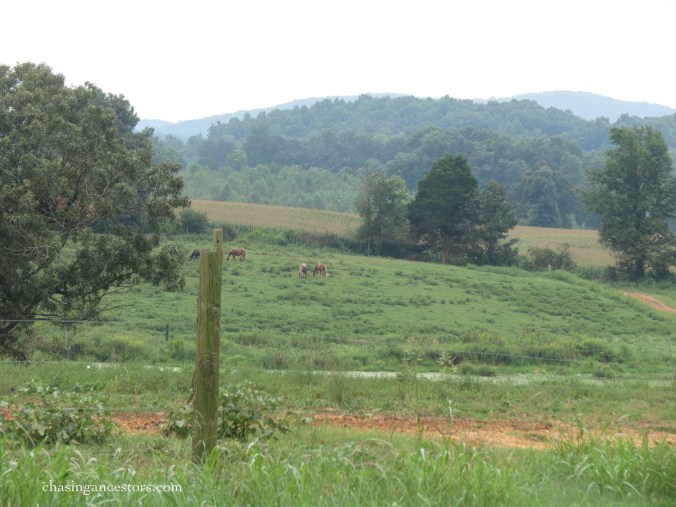
More specifically, the patriarch of the family, William Millikan (1720-1805), was born in Ireland and came to Pennsylvania with members of the Society of Friends. There aren’t many records that verify the specifics of his life. It is said he was born in 1720, but I can’t say I have confirmed that. He married Jane White (?1720-1758) in Chester County, Pennsylvania, in 1751. They had 10 children. It is said that after Jane died, William married a second time to Hannah Rowan, but she died in 1759. He then supposedly married a Jane Rowan. He moved his family to North Carolina sometime around the death of his first wife. He settled first in Rowan county, then in Guilford county, then Randolph county. But he didn’t move, the counties formed around him. Rowan split to form Guilford, then Guilford split to form Randolph in 1779.
William was present at the first meeting of the leadership of the newly formed Randolph County on March 8, 1779. The records of that meeting and following sessions of the Court of Pleas and Quarter Sessions can be found on Familysearch.org.
An excerpt of the first meeting is below:
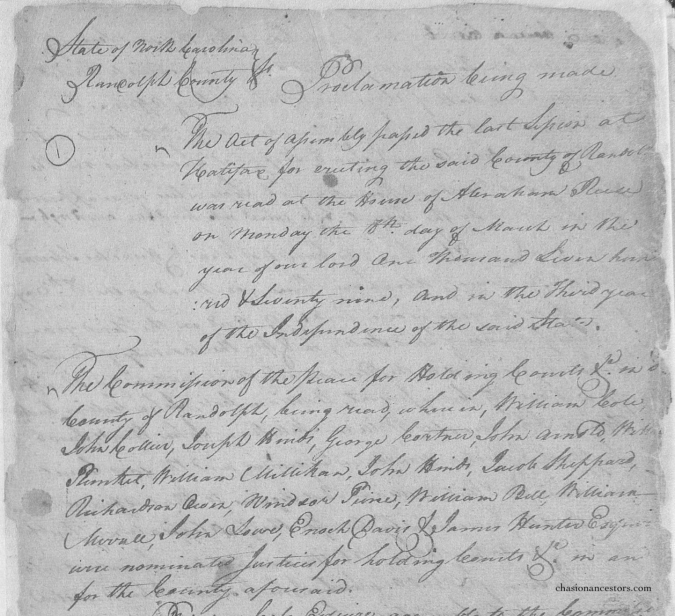
“State of North Carolina, Randolph County
Proclamation being made
The act of assembly passed at the last Session at Halifax for the erecting of the said County of Randolph was read at the Home of Abraham Reece on Monday the 8th day of March in the year of our lord One Thousand Seven Hundred & Seventy nine, and in the Third year of the Independence of the said State.
The Commission of the peace for holding Courts P. in [said] County of Randolph, being read, where in, William Cole, John Collier, Joseph Hinds, George Gartner, John Arnold, William Plunket, William Millikan, John Hinds, Jacob Sheppard, Richardson Owen, Windsor Pierce, William Bell, William Merrell, John Lowe, Enoch Davis & James Hunter, Esquires were nominated Justices for holding Courts P. in and for the County aforesaid.”
William was also appointed as Justice of the Peace on the same day and took the oath of allegiance.1 He was named Register of Deeds and was placed in charge of a tax district. His name is listed in the records of the Randolph County Court of Pleas and Quarter Sessions for the subsequent years. Some of those records even seem to be in his handwriting.
Like many of the members of the Society of Friends (Quakers) he was a pacifist. He did not fight the battles, but it is said that he did believe in the cause and supported the Patriots. As a result of his support, and possibly because of his leadership in the government of the county, he was a target for the Loyalists.
Col. David Fanning was a Loyalist militia leader based in Randolph County, NC. Throughout the years of the Revolution, he led many battles and skirmishes against the Patriots in the region. Both Loyalists and Patriots were ruthless in their fighting, often plundering houses and hanging captured combatants. It seems that Col. Fanning was one of the more renegade leaders of Loyalists. The Patriots would not agree to his terms for peace in the region after Cornwallis’ surrender at Yorktown in 1781. Therefore, on March 10, 1782 Col. David Fanning began his revengeful raid on Patriot leaders in Randolph County. He stated in his own memoir that he and his men had just received the special order of uniforms which were “linnen[sic] frocks, died black, with red cuffs, red elbows, and red shoulder cape also, and belted with scarlet, which was a total disguise to the rebels, which the red was all fringed with white fringe.”2
Col. Fanning then gathered his men to “give a small scourge” to the Patriots. He targeted some leaders of the Patriot militia as well as supporters of the cause. He first went to Col. Andrew Balfour’s house, brutally killed him in front of family members & then moved on.
William Millikan’s home was next. William is said to have lived near Johnsonville, the county seat. William wasn’t home when Fanning and his men arrived. Some sources say that he was tending some cows away from the house and was able to hide from the attack. Finding that William wasn’t in the house, Col. Fanning ordered the house and outbuildings burned. When William’s wife, Jane, carried a prized feather bed out of the house to salvage it, the men threw it back into the flames and when the feathers started to burn they scattered them throughout the house. The men reportedly taunted Mrs. Millikan as she watched her home and goods burn. They then took William’s son, Benjamin with them to lead them to another Patriot’s home.
Stories aren’t clear as to who was targeted next. But eventually, after dark, the band of raiders arrived at Col. John Collier’s home. Some stories say that Benjamin Millikan was present for this encounter and was used to try to lure Collier from the house, saying he had come as a friend. Collier managed to escape but his house was also burned. Fanning and his men finished their bloody scourge at the home of Capt. John Bryant, killing him, but sparing his family. Fanning wasn’t done fighting, however, and continued on, battling the Patriots until September 1782, when he left the Carolinas for Florida. Due to his ruthless ways, he was one of the Loyalists that was excluded from getting a pardon at the end of the war. Col. Fanning’s exploits are well documented in North Carolina history sources.
I did notice that three of the men Col. Fanning went after were members of the leadership for Randolph County. They all knew each other and worked together to establish a new government in the county. Here their names are listed in the record for the Randolph County Court:
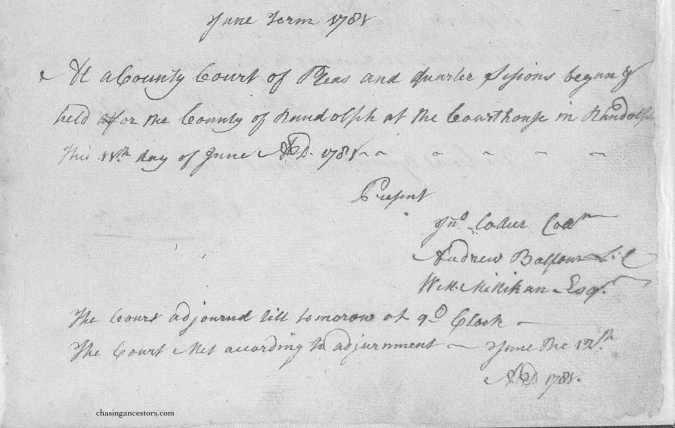
“June Term 1781
The County Court of Pleas and Quarter Sessions being held for the County of Randolph at the courthouse in Randolph this 11th day of June A.D. 1781…
Present
Jno Collier C…
Andrew Balfour …C
Wm Millikan Esq
The Court adjourned till tomorrow at 9 O Clock
The Court met according to adjournment. June the 12th A.D. 1781”
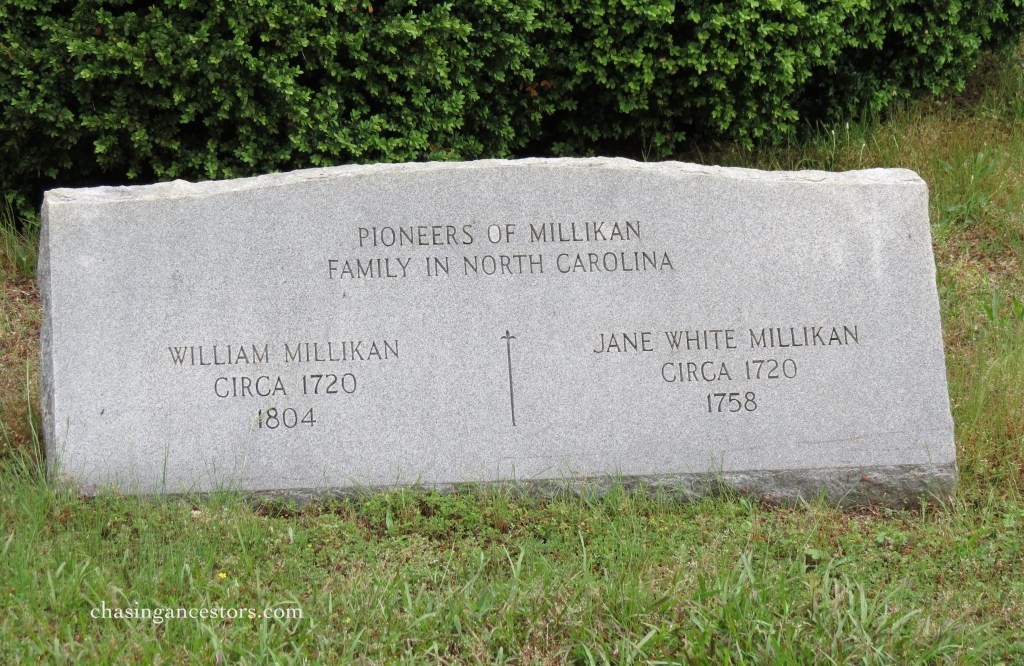
Back to my ancestor, William Millikan. He survived the attack on his home and is said to have taken his family and moved in with his son Samuel until he could rebuild. William is recognized in the DAR books as a supporter of the cause (listed under “Milliken” Patriot # A079802). He continued to be a leader in Randolph County. It is said that he died around 1804. He has markers in both Springfield Friends Meeting & Centre Friends Meeting cemeteries in Guilford County, NC.
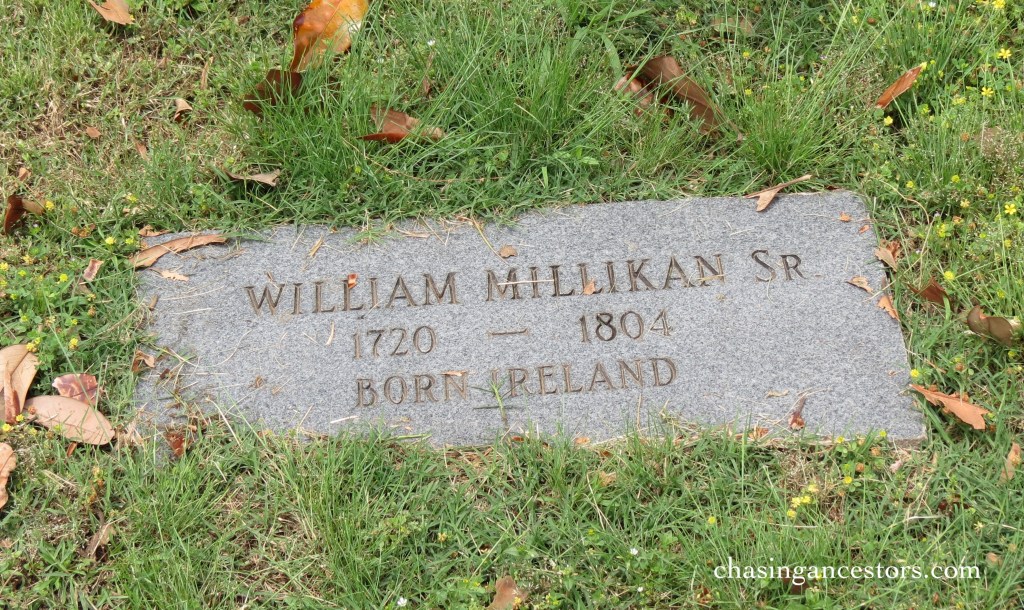
His son, Benjamin (1755-1842), also survived his ordeal. Interestingly, at 27 years, he and Col. Fanning were about the same age when the incident occurred. One story says that Fanning intended to hang Benjamin & another man captured in the raids. While they were hanging the other man, Benjamin managed to escape. Even though he was already married and had started a family by this time, his sons, who carried on the Millikan name, had not yet been born. My GGGG Grandfather, Samuel was born in 1789.
But the Millikan family story from the Revolution doesn’t end there. We have one more family member to mention, William’s daughter, Hannah (1756-1852). She was married to Enos Blair (1750-1834) in 1775 in Guilford County, NC. While she was busy having babies every year or two, she was also devoted to the Patriot cause. The stories told about her indicate how she supported soldiers with food and shelter when needed. It is said that Patriot militiamen would hide in the woods and she would get food, medicine and messages to them. Once when she was captured by the Loyalists, she indicated that she had been helping a sick neighbor. Two stories are more specific about her hiding Patriots. First, she hid two soldiers in her corn crib and sat peacefully shucking corn while the Loyalists searched the farm. Another time, she is said to have hidden a soldier in her home. Col. David Fanning entered, searching for the Patriot, Hannah was sitting on the bed mending the torn mattress. She allowed the search of her home all the while sitting on the hiding place of the soldier. She had hidden him in the mattress and when the Loyalists left, she ripped open the mattress and the Patriot escaped. At some point during the war the Blair’s house & outbuildings were also burned & the family was forced to watch the loss of all of their possessions. Hannah reportedly received a pension from the government for her service to the Patriot forces. She and her husband are also buried at the Springfield Friends Meeting cemetery.
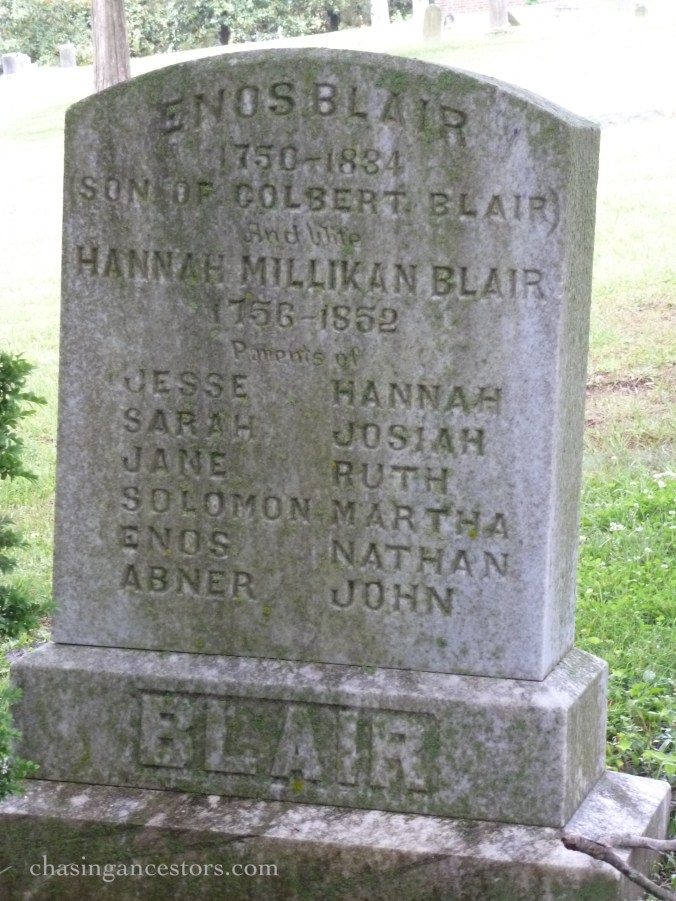
So, other than the movie depicting the response of the hero to fight in battle, the rest of the story somewhat matches the experiences of many “civilians” of the Revolution—houses burned, lives disrupted, friends killed, all the brutality of war literally at their doorsteps. While my pacifist ancestors chose not to raise weapons against others, they couldn’t just sit back and wait for the war to end. Essentially everyone had to choose a side & they chose the side of Independence and did their part to make it happen.
Happy 250th to the United States of America!! From a descendant of North Carolina Patriots.
© MJM 2026
1. The Oath of Allegiance for the State of North Carolina from the Rowan County, NC Courts 1778:
“I do sincerely promise and swear, that I will be faithful and bear true Allegiance to the State of North Carolina and to the powers and Authorities which may be established for the Government thereof not inconsistent with the Constitution, and that I will to the utmost of my power maintain and defend the Same against all attempts whatsoever; and I do declare that no foreign prince, Person, State or potentate, hath our ought to have, any Jurisdiction, Power, Superiority, preeminence or Authority, civil or ecclesiastical, within the Same; and I do Solemnly and Sincerely declare, that I do believe in my Conscience that neither George III King of Great Britain, nor the Parliament thereof jointly with the said King, or Separately, have any right or Title to the Dominion of Sovereignty over this State, or any part of the Government thereof; and I do renounce, refuse, and abjure, any allegiance or Obedience to them, or either of them, or to any person or persons put in Authority by or under him or them; and I do swear that I will to the utmost of my power, defend the said State against all traitorous Conspiracies and attempts whatsoever that shall be made against the same and I will do my utmost endeavor to disclose and make known to the Legislative or executive powers of the said State, all Treasons and Traitorous Conspiracies which I shall know to be carried on or intended against the said State, and I do faithfully promise to the utmost of my power to support, maintain and defend, the Independence of this State against him the said George, and all other persons whatsoever; and all these things I do plainly and sincerely acknowledge and swear, according to the express words by me spoken, and according to the plain and common sense and understanding of the same words, without any Equivocation, mental evasion or secret reservation whatsoever; and I do make this acknowledgement, abjuration, renunciation and promise heartily willingly and truly upon the true faith of a Christian. So help me God.”
2. The Narrative of Colonel David Fanning, (a Tory in the Revolutionary War with Great Britain;) giving an account of his adventures in North Carolina, from 1775 to 1783, as written by himself; Fanning, David, Wynne, Thos. H. et al; 1861; Richmond, VA. Duke University Libraries; archive.org

