Granny & Grandpa

We called my maternal great-grandparents “Granny & Grandpa.” In reality Granny was Amanda (Steinhaus) Beiersdorf (1894-1973) and Grandpa was Herman Beiersdorf (1895-1983). They were born and raised in Sheboygan, Wisconsin; both being first generation descendants of German immigrants. They were each part of large families in the German Lutheran community of Sheboygan. Herman was baptized and confirmed at Immanuel Lutheran Church and Amanda was baptized and confirmed at Bethlehem Lutheran Church. They attended the church affiliated schools, but I don’t think they went to High School. 

In the 1910 U.S. Census, when they were both around 15 years old, they were already working. Amanda was sewing in a glove shop along with her sister, Martha. Herman was wood turning in a chair factory and his brother, Albert was also listed as a laborer in a chair factory. 

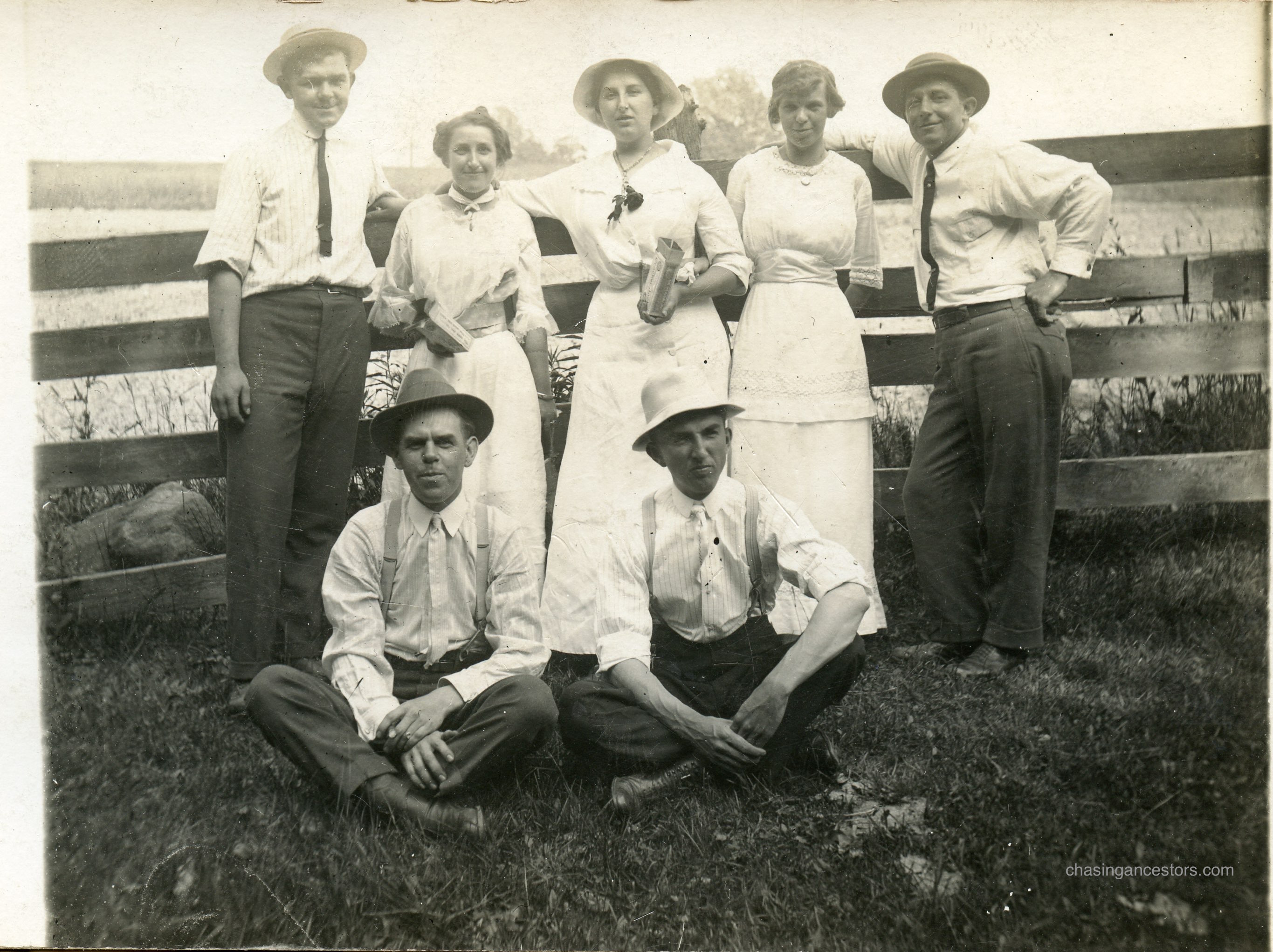
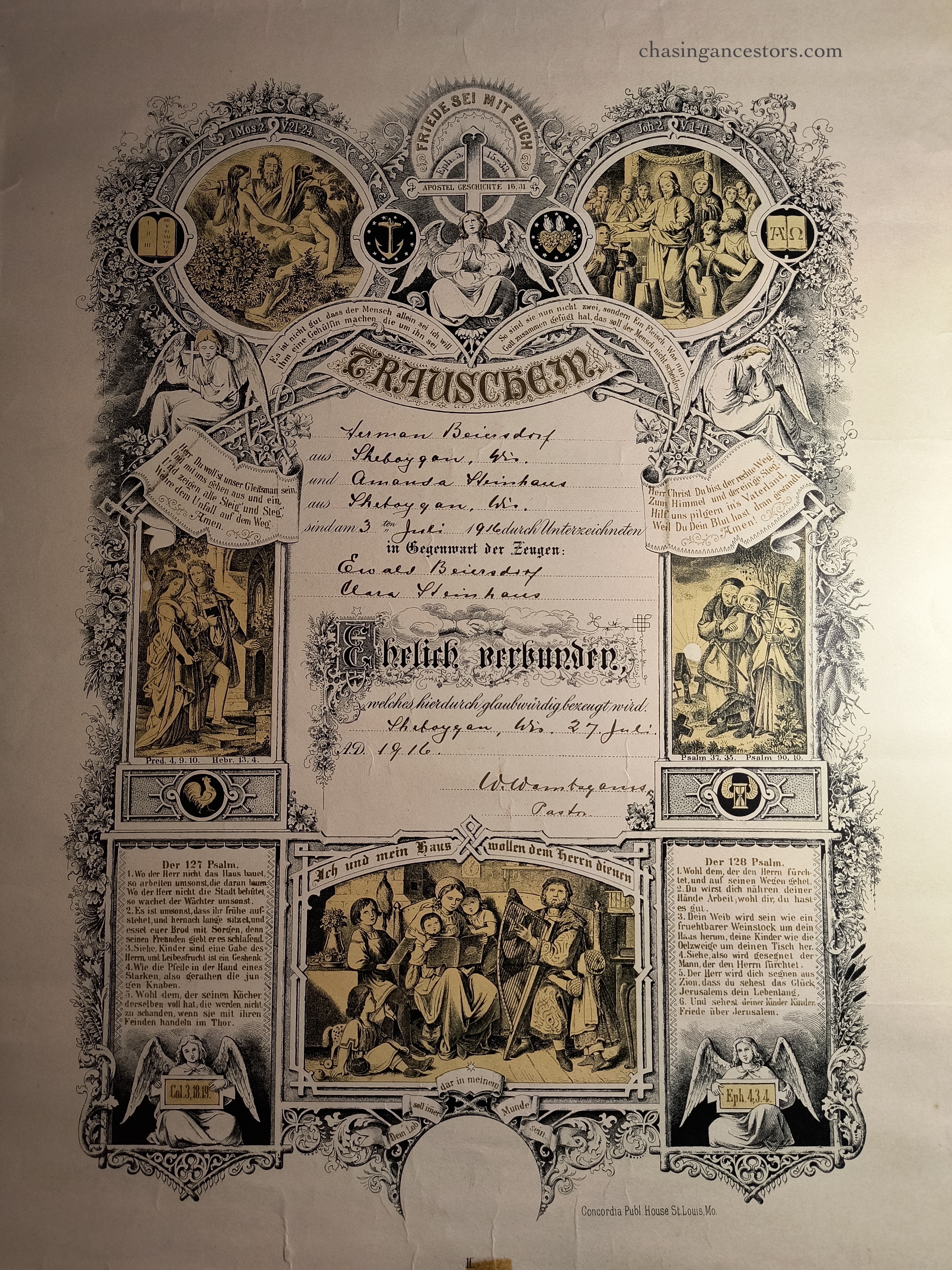
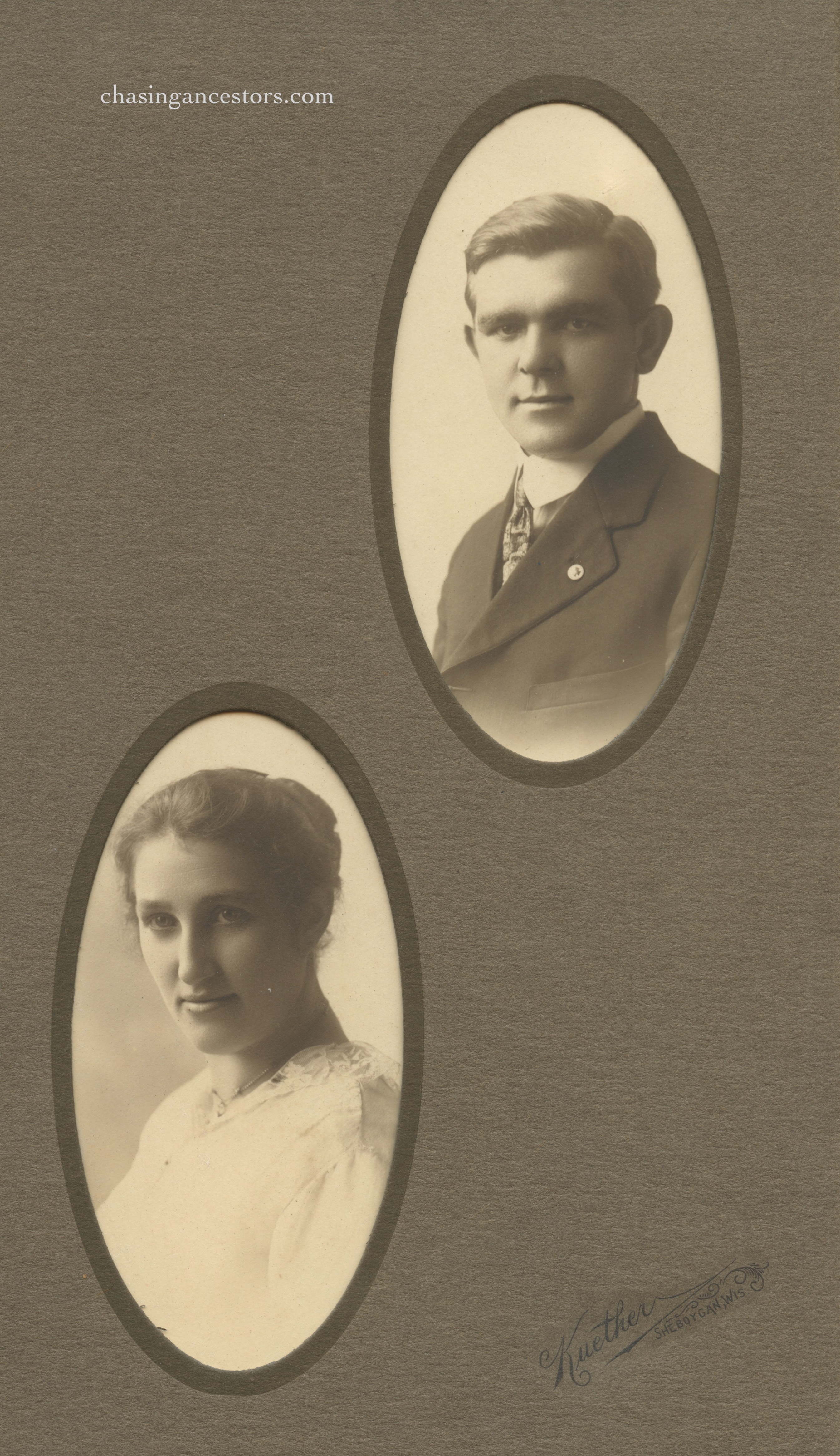
I’m not sure how they met, perhaps through family, friends or Lutheran events in Sheboygan. Regardless, they were married July 3, 1916 in Sheboygan. Their witnesses were his brother, Ewald & her sister, Clara. Their church marriage certificate is written in German. I don’t have a formal wedding picture for them, but I wonder if this served as their wedding photo.
Grandpa kept a few notes of special days through many years in a “1955 desk diary” calendar. He marked a note on February 25 that they moved to Port Washington, WI in 1917. His WWI draft card states that at the age of 22yrs he was a department foreman for the Wisconsin Chair Co. in Port Washington. Herman is listed in the 1920 U.S. Census as a boarder and working as a shop foreman. Amanda is not listed with him and I couldn’t find her in the 1920 census at all. She may have been in Sheboygan visiting relatives and missed the census taker in each city. On August 23, 1920 in Port Washington, their daughter, Lucille was born. The family continued to live there until 1923. He noted that they moved back to Sheboygan March 28, 1923. 

Herman also noted that on October 1, 1923 they had a “new home.” 
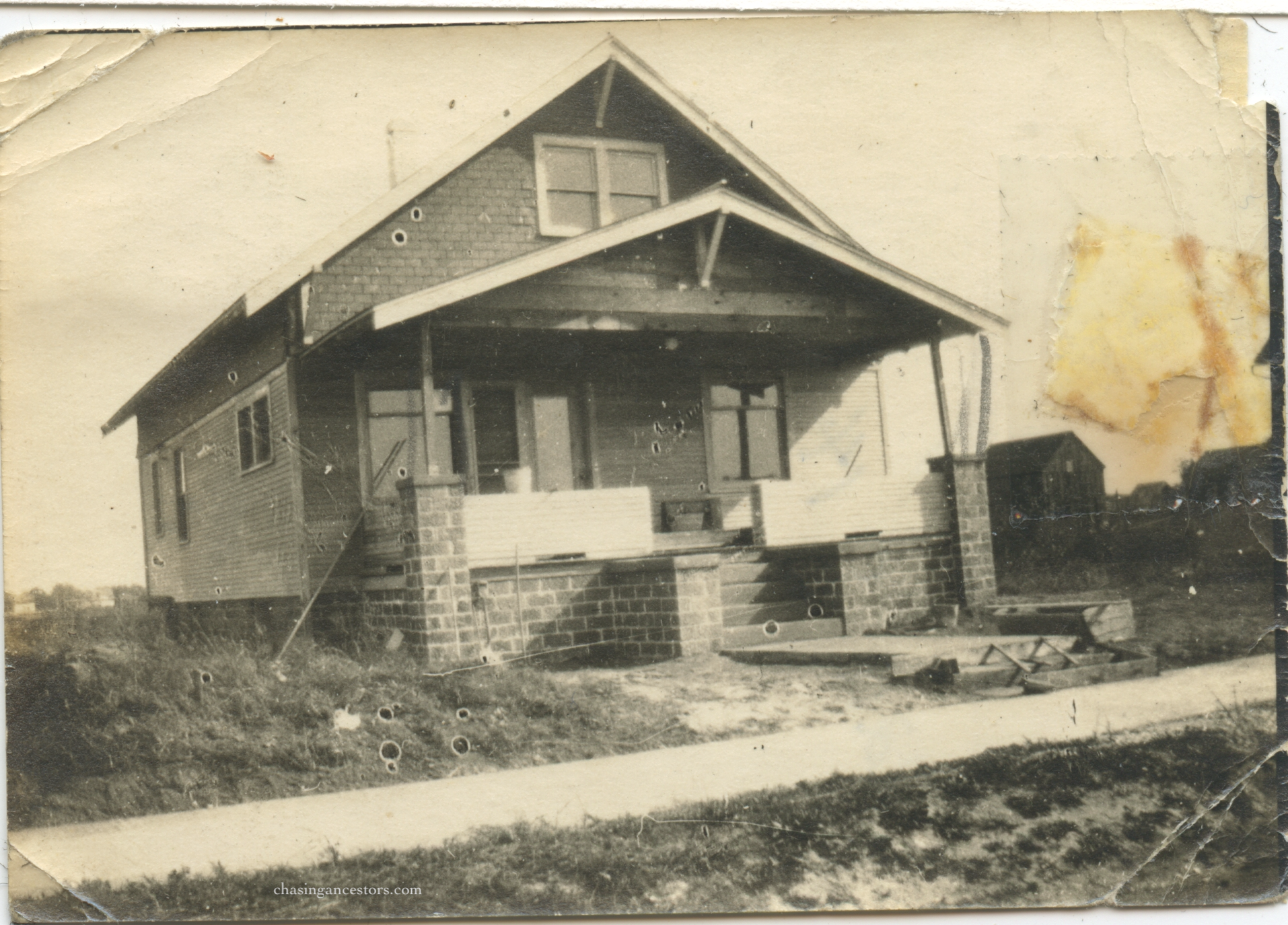
The young family moved into a new house in Wedemeyer’s addition on South 14th Street in Sheboygan. They lived in this house for 50 years. In this home, they hosted family gatherings and “card parties” through the years. They remodeled it a few times; in particular, they enclosed the porch before I remember visiting as a child. On that enclosed porch they had toys for us to play with. The interior stairs were perfect for us as kids to scoot down on our backsides. There was an alley and garage in the back of the house. Posts were set in the ground in the back yard for clotheslines. Mom remembers that they had a wringer washing machine in the basement and as a child she would sometimes help run the clothes through the wringer to the rinse water & through the wringer again to baskets. The clothes were hung on the lines behind the house. The house is still standing.

The 1928 City Directory of Sheboygan has Herman working for the Bemis-Riddell Fibre Company. In the 1930 U.S. Census, the home is valued at $3000. Herman is a laborer in a Fiber Factory. In the 1940 U.S. Census records, Herman is listed as working as a finisher in a Leather Factory. He reported on his WW2 Draft card that he worked for the Armour Leather Company. In 1950, the U.S. Census has Herman listed as a leather finisher for a Tanning Company.

In 1930, there was a newspaper article reporting that Herman Beiersdorf of N. Fourteenth street was sentenced to 90 days in jail for beating his wife. Three days later, The Sheboygan Press printed another article clarifying the address again, stating that Herman Beiersodorf of S. Fourteenth street was not the same man. I guess someone had mistaken Grandpa for the convicted man. 

My Mother remembers that “Grandpa was a gentle man, hard worker, always pleasant to be with.” She said that when he would come home from work, he would change clothes & hang his work clothes in the back hall so the smell wouldn’t get inside the house. I expect the smell was from formaldehyde, which was used in the tanning process. In fact, I remember as a child rummaging through old “formaldehyde barrels” that he had used for storage. Looking back, it may not have been a good idea to reuse those barrels for personal storage.

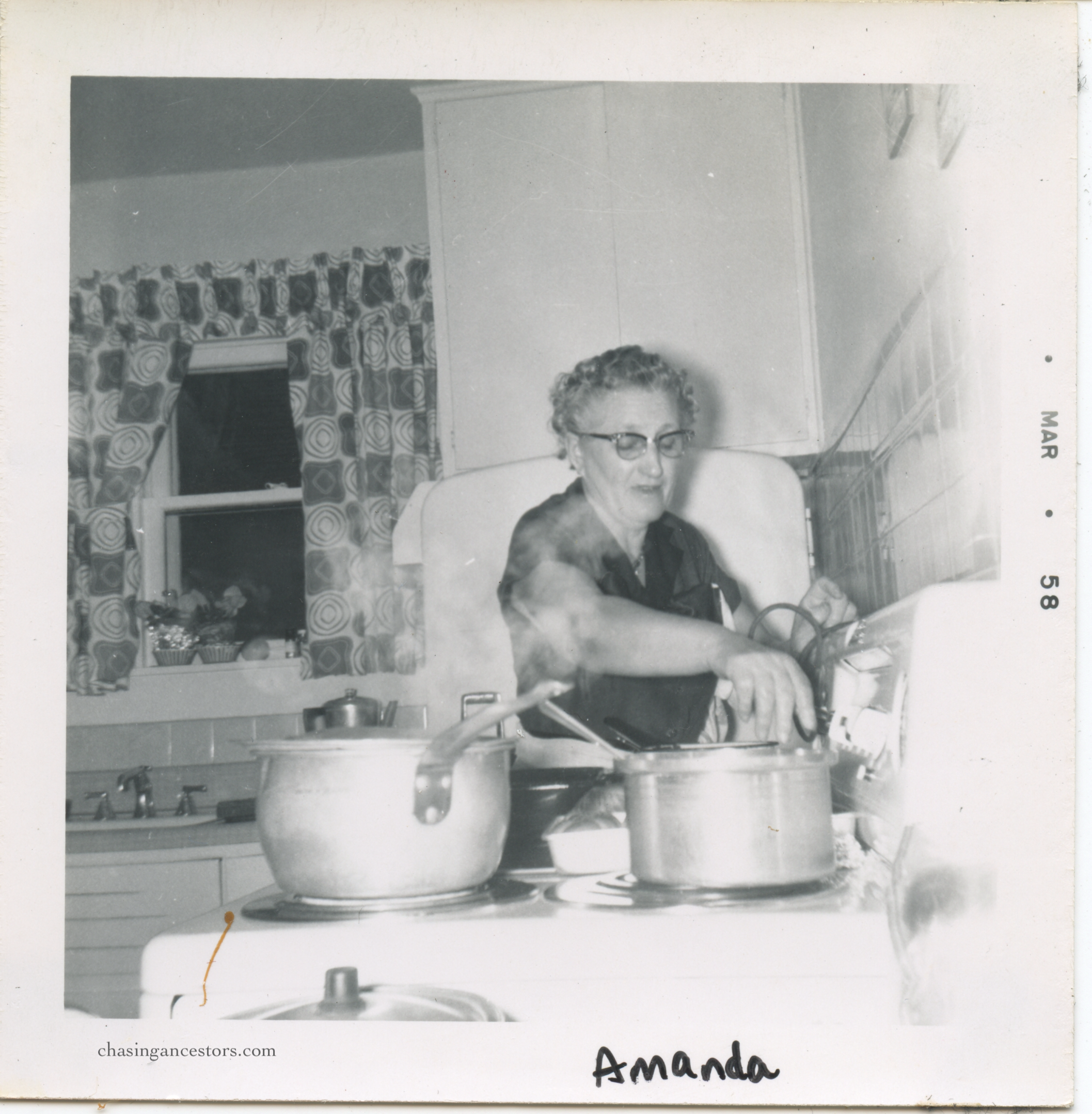
Mom remembers Granny as being “kind, gentle, pleasant, submissive, usually doing something in the kitchen wearing an apron or working in the garden.” She would walk a few blocks to the butcher shop & would order weekend breakfast coffee cake from a local German bakery.
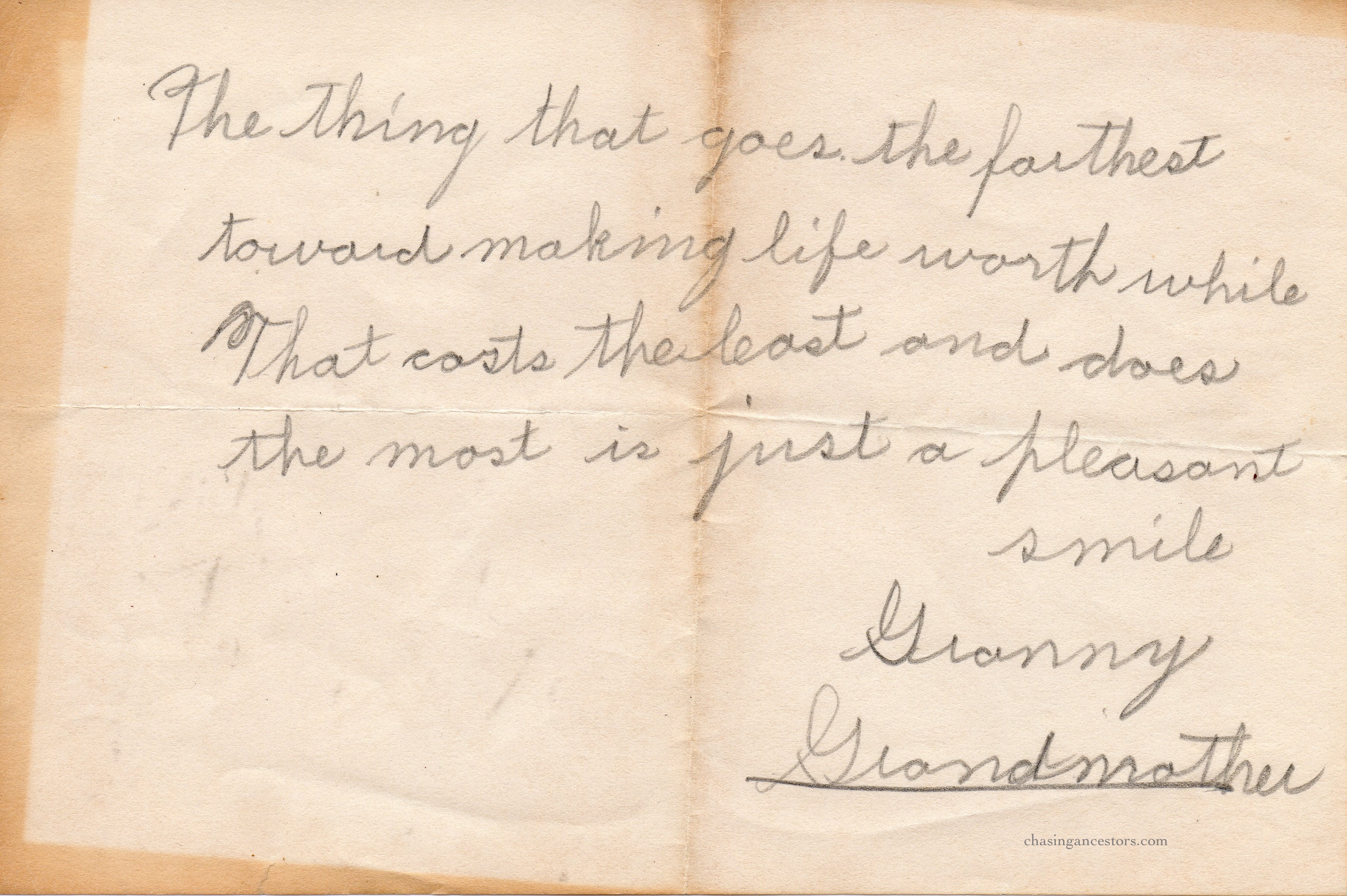
She also told me that Granny didn’t write much and may have been embarrassed by her lack of education. We have only this one note in her handwriting.
The couple started traveling some as they got older. In 1955 they took a “Happiness Tours” trip to New York where they visited Niagara Falls and New York City. They managed to visit their daughter, Lucille’s family in Missouri when the family was stationed there with the U.S. Army. Lucille and her two daughters would also sometimes stay with Herman and Amanda if they were not able to move with Lucille’s husband, John Chvarack.

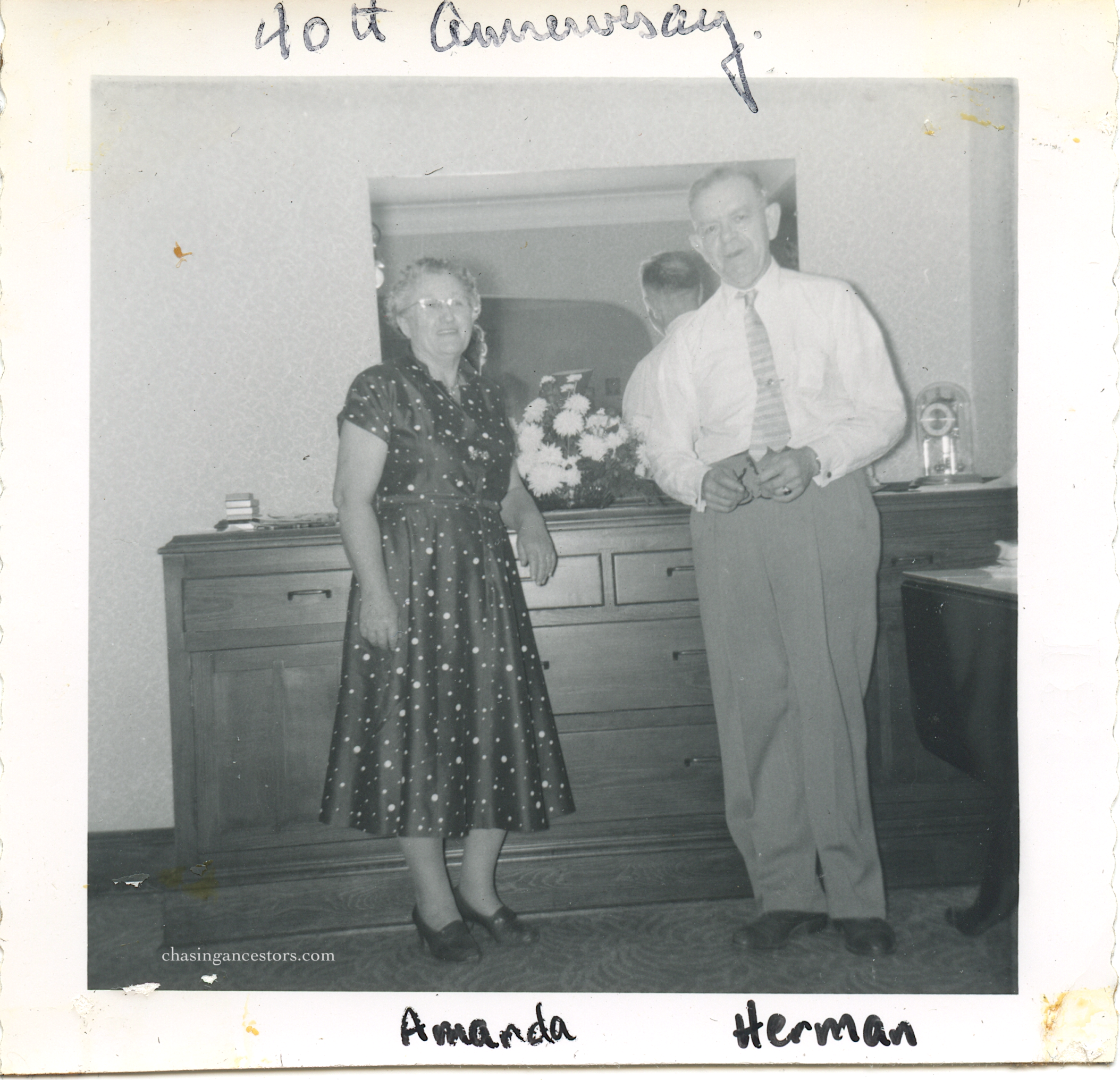
They celebrated their 40th wedding anniversary in 1956.
Herman retired in 1958.

On March 18, 1961, The Sheboygan Press reported that Herman & Amanda were traveling to visit their daughter Lucille Chvarack and family in Frankfurt, Germany. They planned to spend the summer in Europe. While there they planned to visit Holland, Paris, Garmisch, Berchtesgaden & other tourist attractions.
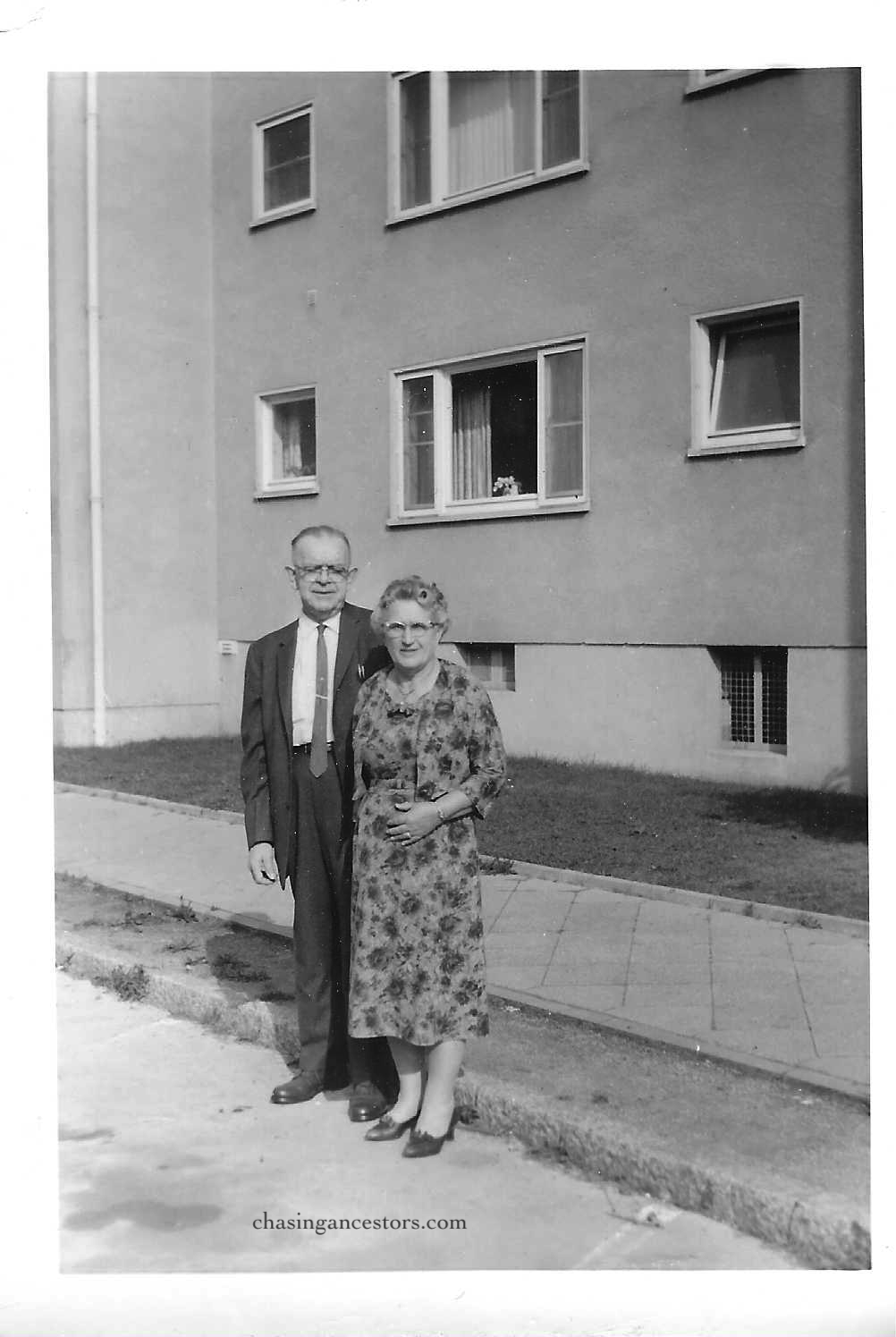
Here they are in front of the apartment  complex where they were visiting. 

They did manage to tour the country, however, the trip did not quite go as they expected. The Sheboygan Press reported on July 19, 1961 that Amanda had a “serious heart attack” while in Germany and was hospitalized at an American hospital. She was to stay in the country for four more months for recovery. The Press also included a mailing address for her in Germany. She did recover from that event and they eventually returned home. 


They spent their 50th wedding anniversary in 1966 with family in San Antonio, TX. Their daughter and family had returned to the U.S. by then and they had two great-grandchildren as well. I remember that Granny and Grandpa would visit us wherever we lived in the U.S.

Amanda died in Sheboygan June 20, 1973 from heart failure. Soon after this, Herman sold the house and moved to Salinas, California to live with his daughter & granddaughter, Lois (1947-1991). I remember visiting them & he always had gum or candy for us if we behaved in church. He liked to laugh & tap us playfully with his cane to get our attention. He spent the rest of his life in California, where he died April 19, 1983 from a stroke. He and Amanda are entombed at the Garden Terrace Mausoleum in Sheboygan. 

© MJM 2026
Turtle Soup

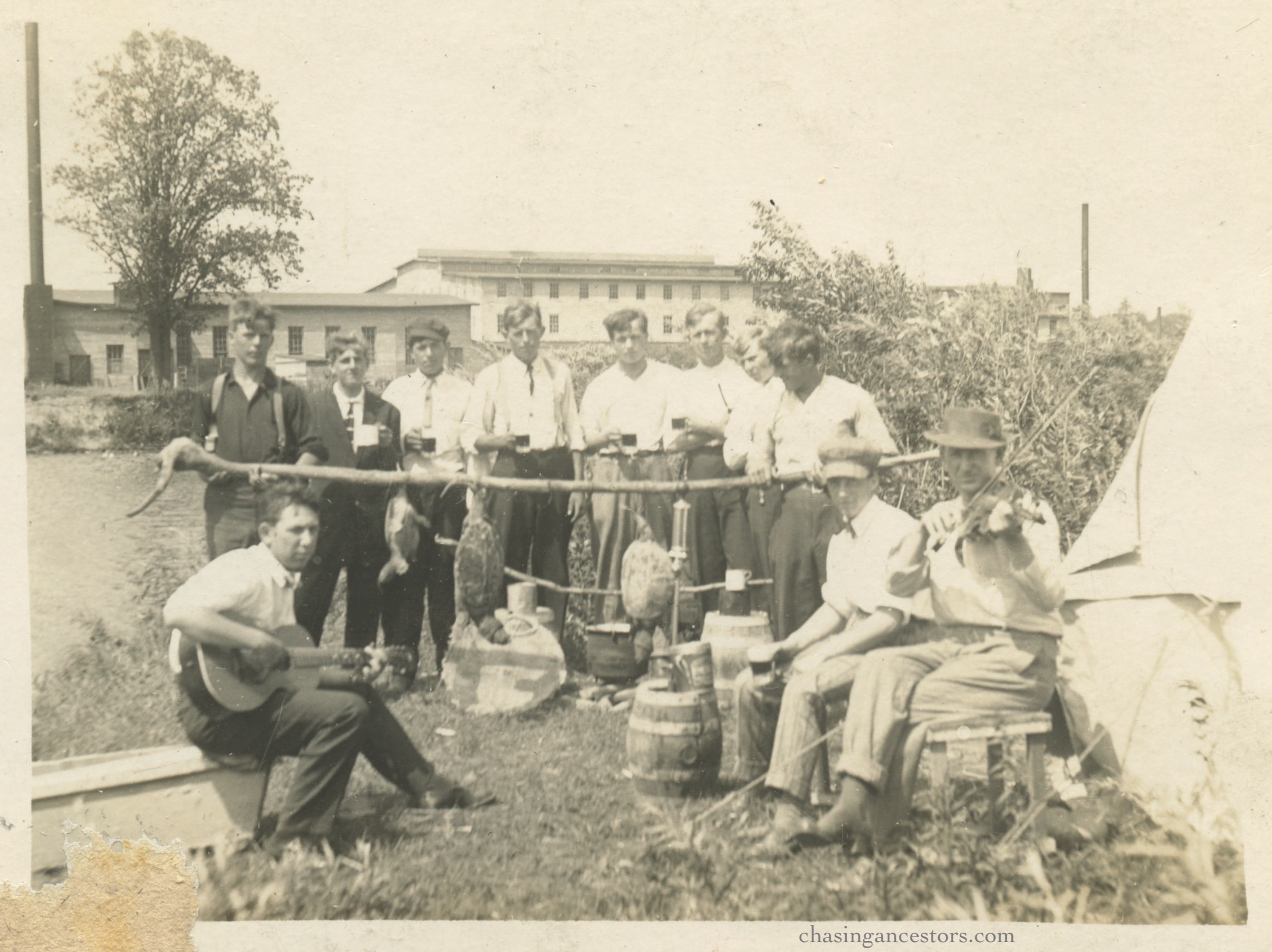
I was going through and scanning the many piles of photographs from my maternal side of the family and came across this picture:

1300groupmenturtlehunt copy

At first I couldn’t quite figure out what was going on in the scene. Taking a closer look, I see that the men are standing at the bank of a river and the one on the left with the guitar is sitting on a boat. Looks like there is a tent on the right side of the frame. Then, looking even closer, I noticed that there were three turtles hanging from the cross bar.

turtlecloseup

And there is what looks like a cooking pot sitting on logs behind the turtle on the right.

So what is this all about? Did people really catch turtles? Were they going to make turtle soup?

First, to set the location. Most of my maternal ancestors lived in Sheboygan, WI. The Sheboygan River runs through the city. I figured I would try to find out if there were any newspaper articles about catching turtles in Sheboygan.

Using Newspapers.com, I found that indeed, people did catch turtles in the Sheboygan River. There were a few references in the Sheboygan Press. A notice from July 9, 1909 stated that turtle season was now open & some large turtles had been caught “up stream.” It stated that “young men enjoy fishing” for the turtles & “Mr. Kempf has purchased 4 large ones which he will serve to his trade on Saturday night.” The next year, on April 22, 1910, there was an advertisement from Kempf’s that said a “Big Turtle Caught. Come and have the first Turtle soup of the Season at Kempf’s.” Another article in 1910 tells of some “turtle fishers” catching a 37 pound turtle in the Sheboygan river. In November 1921, instead of fishing, they were shooting mud turtles off the branches of trees.

There was another article in November of 1947 telling of a man who caught turtles and sold them to customers in New York. He said that snapping turtles would eat the fish in the streams and clearing out the turtles from the streams would improve the trout fishing. Instead of fishing for turtles, he would wade into the shallows and when a turtle was disturbed, he would “clamp a booted foot down on the turtle’s back, hook the prongs of his steel rod under the snapper’s back and lift it up to see which end is which.” Once the hunter determines which is the tail end, he grabs the turtle by the hind leg or tail to pick it up to put in the sack. He seemed to have a lucrative business, selling thousands of pounds of turtles a year.

The Milwaukee Public Library Digital Collection Historic Recipe File includes a recipe for Turtle Soup that was published in the Milwaukee Journal on April 4, 1964. The ingredients for this version of Turtle Soup were peas, carrots, celery, onion, barley, tomato pulp, egg dumplings. The seasoning for the soup included garlic, parsley, bayleaf, salt, pepper and sherry. Cooked turtle meat was added to these ingredients to make the soup. The recipe also includes quite detailed instructions for preparing & cooking turtle. Snapping turtles were the preferred variety over mud turtles which were considered too small. Preparing the turtle seemed like a labor-intensive process.

beerkegcloseup

So, back to the picture. It doesn’t look like these young men had been wading in the water to make their catch. My guess is they used the boat and baited hook and line to catch the snapping turtles.

Looks like they were having a good day of it. Also noted in the picture, almost every one of them is holding a glass of beer. The beer keg is in the foreground of the picture. So I expect they were celebrating a good catch and looking forward to a good meal & a good time with their buddies.

Unfortunately, there was no information with the picture so I cannot identify any of the young men. If they are related to me, they are either of the Chvarack, Beiersdorf or Steinhaus lines. Maybe someday I’ll be able to figure out who they are.

I hope they enjoyed their turtle soup.

©MJM 2022


A Christmas Tradition

In 2008 I sat down and interviewed my maternal Grandmother, Lucille Beiersdorf Chvarack Ash (1920-2011). We talked for over two hours. I asked her what she remembered about all of her relatives—grandparents, aunts, uncles, cousins, her husband, John Chvarack (1916-1967) & his family. Since I hadn’t known any of the folks we talked about, I learned a lot that day. At the end of the interview, she turned the tables and interviewed me. We had a good talk.

Lucille grew up in Sheboygan, Wisconsin. She was the only child of Herman (1895-1983) and Amanda (1894-1973) Steinhaus Beiersdorf. Both of her parents had several siblings who resided in Sheboygan. One of the stories Grandma told me was of the family’s Christmas Eve tradition.

Our entertainment was different than now & like on 13th Street—Christmas and so. We’d start at my Grandma’s, we went to church, came from church—we’d start at my Grandma Steinhaus’ & they would have some candy or little things, not big gifts, but little things, have a Christmas tree & we’d sit around. Then we’d go over there about a block to Ray and Olga’s & their 2 children & we would sit there for about a half hour or so & then we’d go over to my Aunt Ella & Uncle Walter’s & we would do something there–see their Christmas things & they had a piano so they would play a little bit once in a while & from there we went up about a block to visit another aunt and uncle, Martha & Gustav & that was Janet Steinhaus & Don & Kenneth & there we would do the same & we had one more aunt & Uncle Paul & that would be at the last stop–then they would come over to our house–from 13th street over so that was about, oh, maybe 8 blocks or so–they would come over there & then we would all have something– & have–oh coffee & drinks–I think the men had drinks, or had one drink–we would get coffee and then have some refreshments & Mother would always have cookies & cake & that was on Christmas Eve.

Essentially, the Christmas Eve tradition was to attend church services & then visit the homes of each Steinhaus family member in the immediate area “on 13th Street.” 

First, a look at the Steinhaus family:

  • Otto Steinhaus (1869-1954) married Emilie Binder (1867-1940). Their children were:
  • Walter (1891-1962)
  • *Ella (1892-1953) married Walter Axel (1893-1945)
  • *Martha (1893-1934) married Gustav Becker
  • *Amanda (1894-1973) married Herman Beiersdorf (1895-1983)
  • William (1896-1963)
  • Clara (1897-1974) married Rudolph Voigt (1897-1968)
  • *Paul H. (1900-1972) 
  • *Olga (1907-1981) married Ray Steinbruecker (1906-1980)
  • Edwin (1909-1955)

Unfortunately, I don’t think I have any pictures of these gatherings. I do have a picture of some of the Steinhaus siblings mentioned in Grandma’s interview:

Steinhaus family
  • Left to Right, Back Row: Walter Axel, Gust Becker, Herman Beiersdorf, Rudy Voigt, Emilie Steinhaus.
  • Left to Right, seated: Ella Axel, Amanda Beiersdorf, Clara Voigt, Martha Becker & Kenneth
  • Left to Right, children in front: Edwin Steinhaus, Allen Steinhaus, Olga Steinhaus. 

The picture was probably taken in late 1917 or 1918.

Now, to follow the path of the Christmas Eve gathering. Through US Census records and Sheboygan City Directories from the 1930’s, I was able to figure out the addresses of all of the homes mentioned. Each family owned their home. I wonder, if like my Great-grandparents, some were the original owners?

Bethlehem Lutheran Church

1 They started at church. This was Bethlehem Lutheran Church (1121 Georgia Avenue). It was the home church for most of the Steinhaus family. Newspaper articles in the 1930s indicate that there was usually a service at 7pm on Christmas Eve. This was the service that included the Christmas program from the Bethlehem Lutheran School that was attached to the church. While Lucille did not attend this school, I think some of her cousins did. So perhaps through the years, the family would start with watching some of their children in the program. 

2 From the church, they would all head to “Grandma Steinhaus’” home. This would be the home of Otto and Emilie Steinhaus (1437 South 13th St.) In 1930, their youngest son, Edwin, age 21 was still living with them. There they would have “some candy or little things, not big gifts, but little things…”

3 Next, they would go to “Aunt Olga & Ray’s”–Olga & Ray Steinbruecker (1524 South 13th St.). They would stay for about half an hour. 

4 Then on to the next aunt & uncle: Ella and Walter Axel (1617 South 13th St.) Grandma said that they had a piano, so I bet there would be some good music and singing at their place. 

5 Next was the home of Gustav and Martha Becker (1708 South 13th St.). 

6 Then to Paul and Anna Steinhaus’ place (1847 South 13th St.).

7 Finally, they would reach the last stop, Herman & Amanda Beiersdorf’s home (2211 South 14th St.) Refreshments would be served, and after visiting for a while, everyone would return to their own homes. According to Lucille, this migration would take until about midnight, then she and her parents would open their presents. 

All in all, the trip from the church to South 14th St. was about a mile. Sounds like the families would gather every year for the same routine. I wonder if each family had it’s own specialty when it came to refreshments? I also bet they all enjoyed the festivities and decorations at each house. Eventually, more children were added to the families & I’m sure the cousins would compare Christmas wish lists and try to figure out the presents under the trees. Then the grandchildren would come along as the routine continued. With all of them living in such close proximity, it is a sure bet that the families were interacting frequently. My Great-grandparents lived in the house on South 14th St. until Amanda’s death in 1973. I think many of the siblings stayed in their homes most of their lives. So the tradition ended with the passing of the elders. 

I asked my Grandmother if they then slept most of Christmas, since they had such a big night on Christmas Eve. Her response was “No, we’d get up on Christmas & we’d go to church & then for dinner we would go to Grandma Beiersdorf’s…” They would visit with the Beiersdorf siblings at the home of Augusta Beiersdorf (1868-1955). But at least everyone would come to one location, instead of traveling from house to house. As Grandma said, “the house would be full.”

One more thing I forgot to mention. Wisconsin weather in the Winter can be quite harsh. These two pictures of Lucille show some of the snowfall they had. I expect the transit from house to house might have been a little treacherous at times. 

So in this year when it is recommended not to visit family due to the pandemic, I thought it nice to remember another time when Christmas family traditions meant visiting house to house to enjoy each other’s company and the togetherness of family. 

Merry Christmas!

© MJM 2020

Veterans of the Great War

The 11th Hour of the 11th Month, 1918. The time when all fighting would cease in France after the Armistice had been signed that morning. The end to the Great War. That was 100 years ago.

So I figured I would dig through my family history information and honor those ancestors who served during that war.

I already mentioned Fred McKinley (1890-1972), Brooklyn, IN; my Dad’s Great-Uncle on his Paternal side. He served in the US Army from April 27, 1918 to November 1, 1918.

Fred’s cousin, Frank B. Crider (1896-1978), Morgan County, IN. Served in the US Army from July 22, 1918 to January 16, 1919.

Then there was Chester Emmett Boone (1892-1954), Connersville, IN; my Dad’s Great-Uncle on his Maternal side. He served with the US Army 309th Supply Company, Quartermaster Corps, Private, #778964. He departed from Newport News, VA June 6 1918. He left Brest, France June 29, 1919. Arrived July 8, 1919 at Hoboken, NJ, listed as a Private 1st Class.

Chester’s cousin, William Hobart Boone (1896-1991), also served in the US Army. The only information I have about his service is that he served in 1918.

On Mom’s side of the family—they were first generation citizens at the time of the War. I wonder how they felt heading off to Europe to fight against what might have been their own relatives.

First, the brother of my Great Grandmother, Amanda Steinhaus Beiersdorf (1894-1973):

William Steinhaus (1896-1963) from Sheboygan, WI. Served as a Private in the US Army M D, Private, #2822606. Departed from Brooklyn, NY to Europe Sept 17, 1918 with Ambulance Company 342-311. Listed on roster of sick or wounded in Hospital in Bordeaux France 11/16/18 w/ Left Inguinal Hernia.

William’s father, Otto Steinhaus (1869-1954) had two cousins who also served:

Paul Richard Steinhaus (1892-1964), Sheboygan, WI, US Army, Private, #2822617. Departed from New York, NY to Europe Sept 9, 1918 with the 86th Div, 171st Infantry Brigade, Company D, 342nd Infantry. He left Brest, France on June 12, 1919. Arrived in Hoboken, NJ June 20, 1919. He is listed as part of the US Army Machine Gun Company, 55th Infantry.

Herbert August Steinhaus (1895-1957), Plymouth, WI, served with the US Army Field Remount Squadron #318, #2831867. He departed from Newport News, VA on Aug 14, 1918, listed as Acting Corporal. He left Brest, France on June 23, 1919. Arrived Boston, MA July 5, 1919, listed as a Private 1st Class.

Who would have thought when these men came home from their service, that their sons would once again take up arms in another war in Europe.

So, remembering just a few named veterans from my family tree who served during the Great War 100 years ago. I also thank the other veterans who served our country in other times of war and conflict

© MJM 2018

Enjoying a Beautiful Day

This is one of my favorite pictures in my collection:

BeiersdorfGroup

Back Row: Herman Beiersdorf, Amanda (Steinhaus) Beiersdorf, Helen (Bendler) Beiersdorf, Marie (Beiersdorf) Knapton, Eldon Knapton
Front Row: August Beiersdorf, Fred Beiersdorf

These folks are all relatives on my Maternal side of the family. They lived in Sheboygan, WI. The outdoor scene shows water in the background, possibly the Sheboygan River, since there is land visible on the other side.

Herman & Amanda were my Great Grandparents. They were married in 1916. August and Helen were married in 1915. Eldon and Marie were married in 1914. Missing from the picture is Fred’s wife, Mary (Duchow). Perhaps she was taking the picture. Looks like all of them are having a good time.

A couple of other things to note in the photo:

crackerjack


Amanda and Helen are holding boxes.

Closer inspection shows that they are holding Cracker Jack boxes. The popular molasses coated popcorn & peanut candy first came out in 1896. This box design is seen in advertisements from around 1918, before the logo included “Sailor Jack” & his dog, “Bingo.”


Also, Amanda is wearing a bracelet.

bracelet


I’m pretty sure that it is a bracelet that I now have. It is a gold-color bracelet with a nice floral design.

bracelet2

bracelet3


On the inner rim are her initials and the date, 1913. This would have been the date of her high school graduation.

What a cool connection to the picture!

So, that’s about it, a nice photo of a group of siblings and their spouses enjoying a day outdoors. I wonder what they did that day. Did they have a picnic? Or did they get together after some event? Maybe for a walk after Sunday dinner? Who knows. But does it really matter? I’m just glad they posed for the picture so that day could be remembered.

© MJM 2017

Labor Day, Factory Workers in the Family

While most of the early ancestors on Dad’s side of the family were primarily hard-working farmers, those on Mom’s side of the family were factory workers.

They immigrated from Germany and Croatia and settled in Sheboygan, Wisconsin. Sheboygan was a factory town on the shore of Lake Michigan.

So for Labor Day, I figured I would recognize these workers in the family.

First, going back in time: Mom’s parents were Lucille Beiersdorf (1920-2011) & John Chvarack (1916-1967 ). Lucille’s parents were Amanda Steinhaus (1894-1973) & Herman Beiersdorf (1895-1983). John’s parents were Mary Siprak (1876-1960) & Steve Chvarack (1872-1938).

US Census records from 1900 have my great-great grandfather, August Beiersdorf, working as a Coal Handler; his 18 year old son, Fred, was a Band Sawyer; and his 15 year old son, August, was a Factory Hand.

By 1910, August, Sr. had died. His son, Fred still worked as a Sawyer in a Chair Factory, August worked as a Cabinet Maker in a Furniture Factory, son William, 23, was a House Painter, son Albert, 17, worked in a Chair Factory, son Herman (my G-grandfather) at 16 years old was working as a Wood Turner in a Chair Factory.

Based on US Census Records in 1900 &1910, Otto Steinhaus, my great-great grandfather, worked in a chair factory. In 1910, his sons, Walter, 19 & Willie, 14, also worked in a chair factory. His daughters, Martha, 16 & Amanda, 14, (my G-grandmother) worked at sewing in a glove shop.

1n 1910, 1920 and 1930, Steve Chvarack shows up working in a chair factory. He died in 1938. In 1920, his son, Joseph, age 22, was working in a chair factory, & son, George, 20, worked as a shoemaker in a shoe factory.

Seems like it wasn’t until my Grandparent’s generation, the “Greatest Generation”, that children stayed in school at least through High School.

Great Grandpa Herman Beiersdorf retired from Armour Leather Company after 25 years in 1958, but as mentioned earlier, he started working at age 16.

Grandpa John Chvarack worked at a Tannery in 1940. Later, he made a career in the Army

I asked Grandma, Lucille, why she chose to go to Sheboygan Business College. She said she didn’t want to go to college and got a job at a factory where they knit stockings. Said she learned how to “hold your stocking here and go this way and that way and make perfect stitches.” She said she lasted 10 days & then enrolled in the business college. The business education came in handy later when she had to support herself after John’s death.

So there we have a few of the early jobs my maternal ancestors had. Many of them stayed with those factory jobs through their entire lives. Hard to imagine the working conditions in the early 1900’s.

©MJM 2016