The Lectern Bible and the Small Town Church

Several years ago my uncle, Leroy McKinley (1941-2023), gifted me with a box of Bibles. Among the many small personal Bibles were two large Bibles. One was the Erp family Bible & the other was what appeared to be the Lectern or Pulpit Bible from a church. I can’t remember where he said he got this Bible.

The Bible is a large black leather-bound book with reference pages and illustrations. There is no printing date that I could find.

IMG_20240121_115103867_HDR copy

It even contained the bookmark that would have matched the altar paraments.
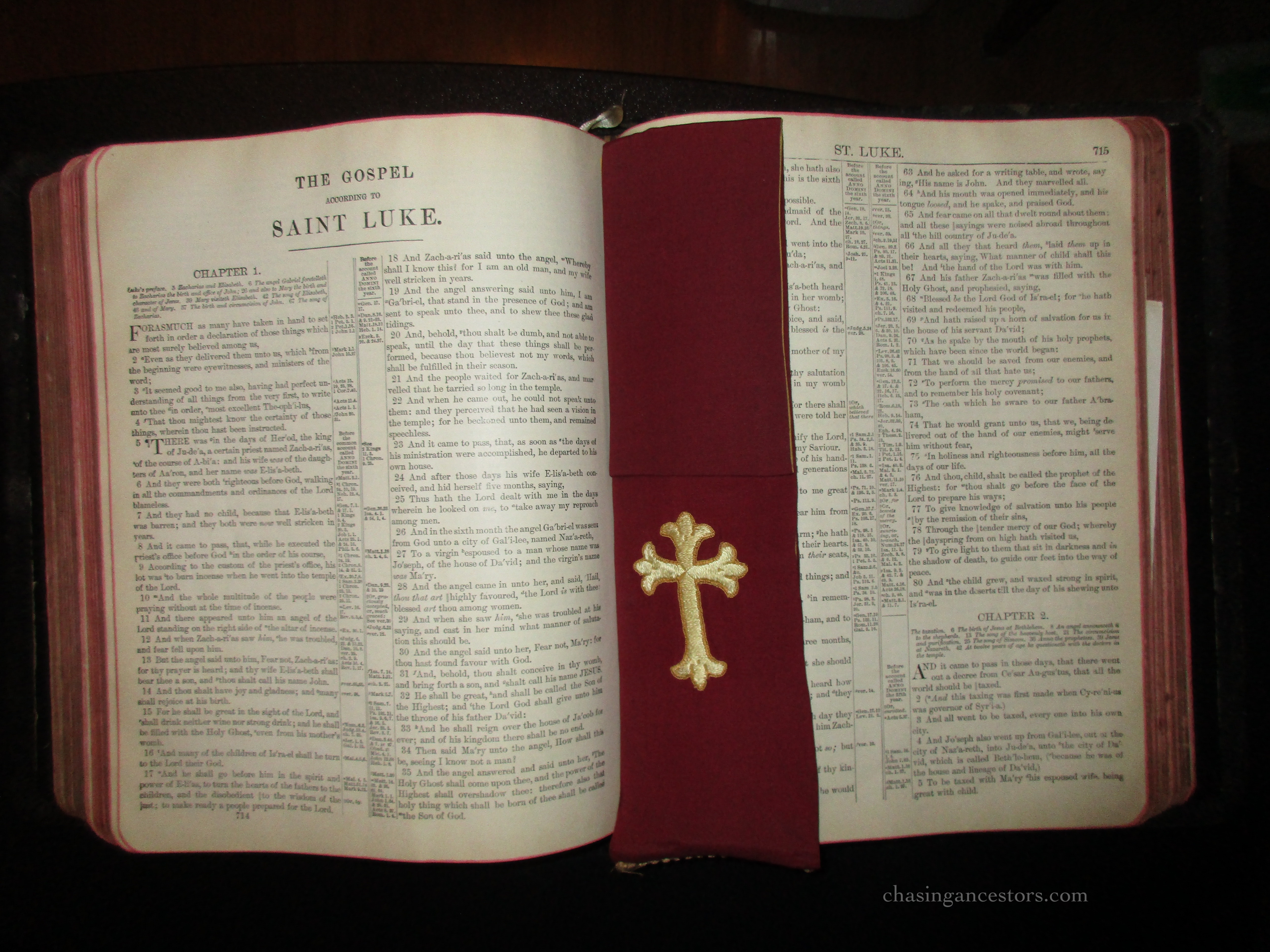
IMG_1654 copy

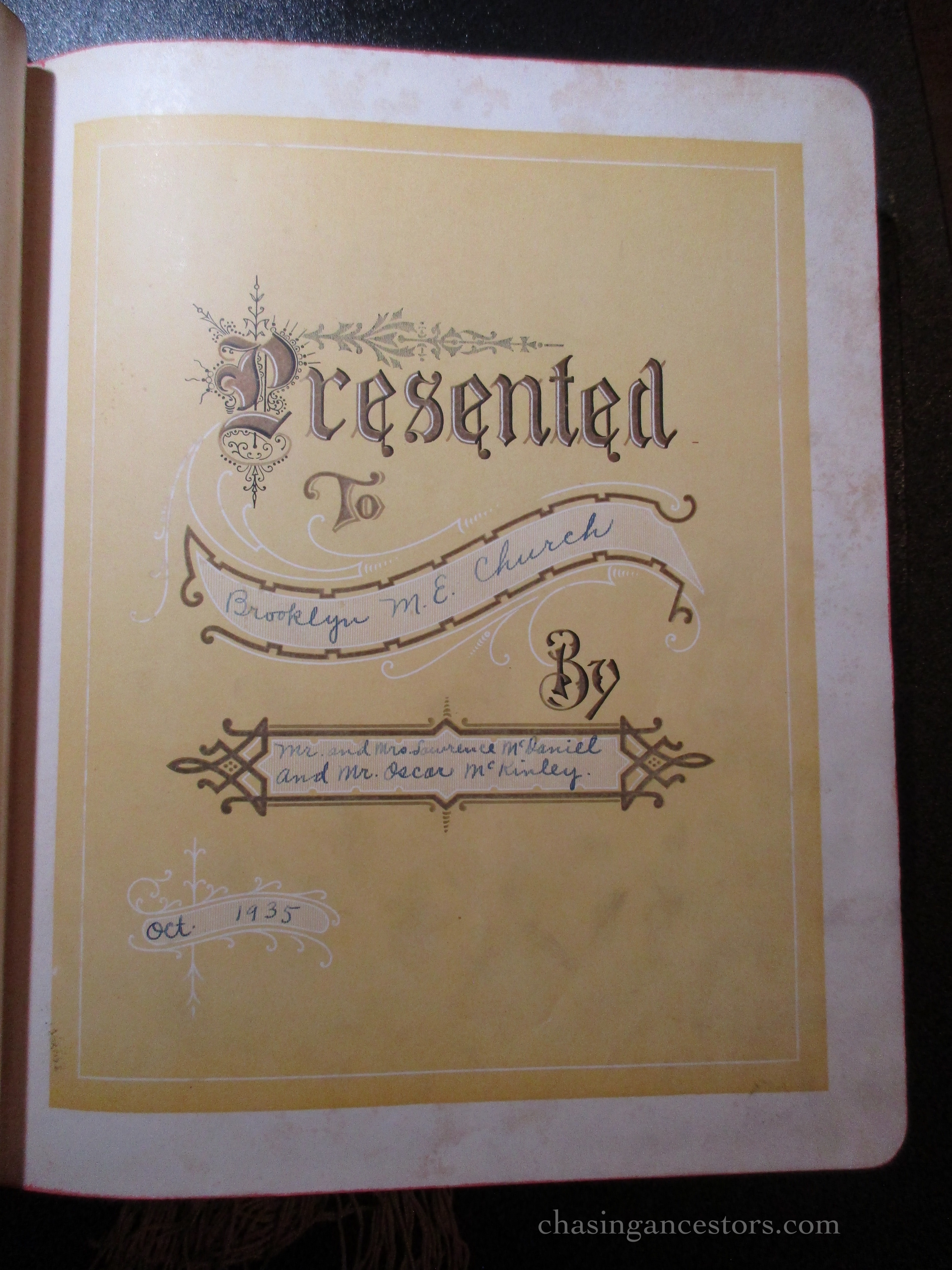
But what first intrigued me about this Bible was the inscription in the front:
IMG_1655 copy

The Bible was presented to Brooklyn M.E. Church by Mr. and Mrs. Lawrence McDaniel and Mr. Oscar McKinley in Oct. of 1935. Oscar McKinley (1887-1969) was my Great Grandfather.

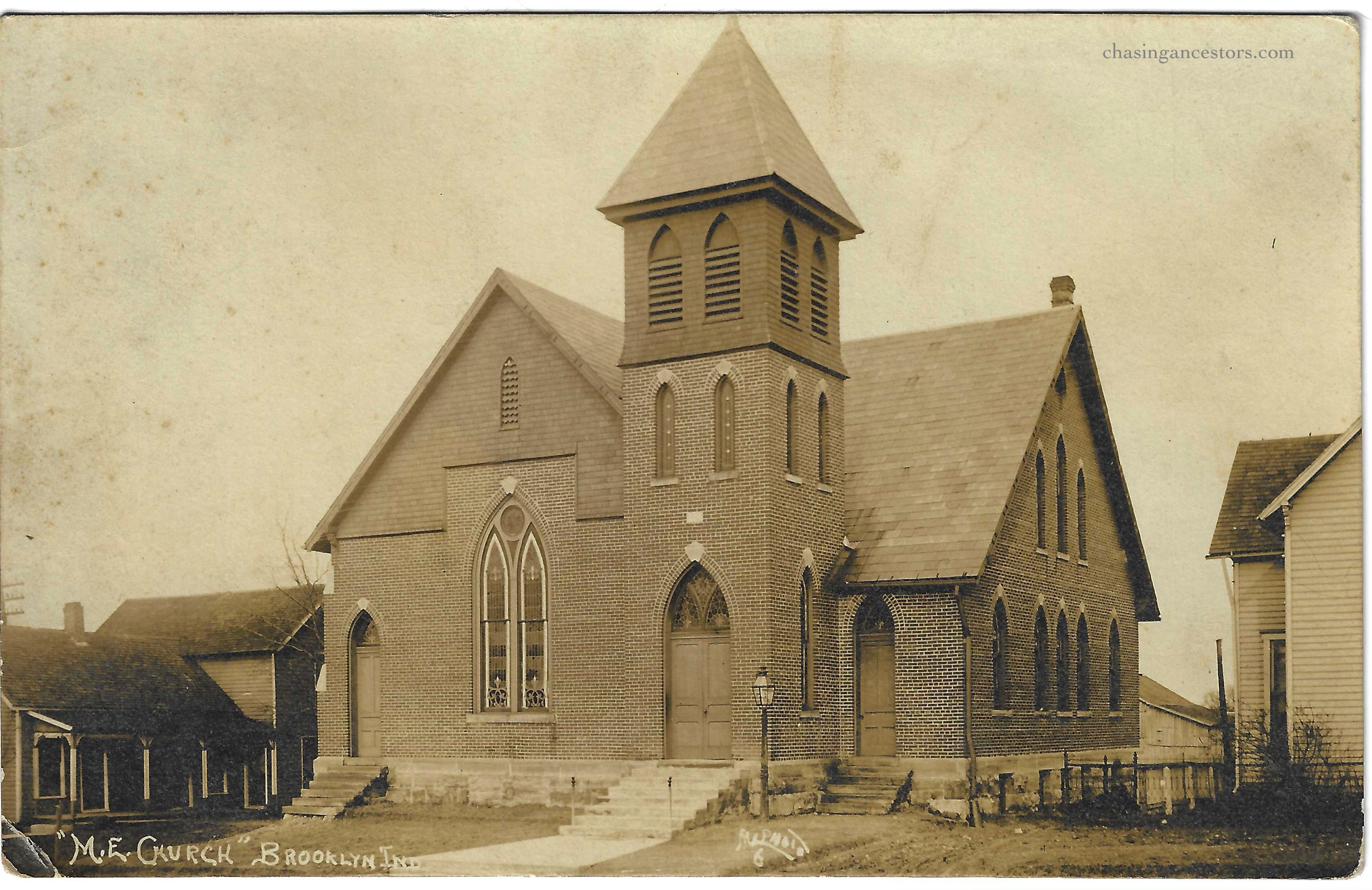
Brooklyn Methodist Episcopal Church was located in Brooklyn, Indiana, a small town in Morgan County. Brooklyn was where my Great Grandfather lived and where my Grandfather, Loran McKinley, Sr. (1916-2003) grew up.
BrooklynMEChurchpostcard copy

This undated postcard picture of the church was in the collection of photographs I received from my Grandfather.

The other fun thing about this Bible is the additional pages that listed the members of the church at the time the Bible was presented.

“Members of the Brooklyn, Ind. M.E. Church at the time this Bible was presented—October, 1935.”
Trustees: J.B. Abrell, Lawrence McDaniel, Oscar McKinley, R.C. Minton, Dr. John S. Spoor, Samuel Swope, H.C. Zenor

Members:
Abrell, J.B, Bertha, Forrest; Bradford, Georgia; Caldwell, Lee, Rilla, Ruby; Copeland, Mrs.
Clara, Lee, Martha; Clark, Minnie.
Clay, Mary, Viola, Ethel, Emma; Dillender, Fred; Edson, Nina, Roger, Robert; Forrester, Sarah, Andrew, Bennie, Ida, William, Mrs. Wm, Richard, Katherine; Fleenor, Maxine, Rex; Gilbert, Laura, Earl, Bill; Griggs, Loren; Hensley, William, Fannie.
Hornaday, Chas, Catherine; Holdaway, Mary E; Jones, Senith, Wallace, Mrs. Mabel; Kincaid, Otis; Matthews, Annie; Morgan, Avis; Morrison, Thelma, Mrs. Harvey; Minton, Carl R., Rose; Moulton, Roy, Mrs. Roy; Monical, F.S., Mrs. F.S.; McNeff, Clyde, Julia, Dorothy, Robert, Leslie. McDaniel, Lawrence, Eva, Sadie; McKinley, Oscar, Loren [Loran]; Plummer, Lillie, Jane; Powell, LeOtis, Beverly, Opal Theresa; Passmore, Josaphine; Riggs, Chester (Eugene, next page); Ritzler, Amelia, Charles; Richardson, Mrs. Dora; Rathrock, Hattie; Simpson, Edith; Rike, Effie; Rike, Mrs.; Rooker, Bernice; Rinker, George, Jr.; Rinker, Geo. W., Eliza, Ida Ann.
Rinker, Eli; Rober, Martha; Riggs, Eugene; Rymerson, Bessie; Swope, Samuel, Mrs. Celia, Clarence; Sanders, Martha; Self, Maude, Harry; Spoor, Dr. John S., Iola; Soots, Frank, Dolly, William; Stafford, Violena; Shelly, T.Z., Mrs. T.Z.; Smith, Mary, S.R., Armina, Betty Lou. Swarens, Rev. A.L. Pastor 1934-1936, Mrs. Mae; Throckmorton, Mrs. Perry; Wall, Hallie; Woodard, Pruah; Williams, Geo, Ida, Garnet; Waltz, Maude, Mary, Roy; Welty, Rose; Wiley, Rosemary, Kathleene, Rose; Young, Mrs. Gerald; Walker, Carl; Wratten, Lottie Mae; Zenor, Harry C., Mrs. Nellie.

I looked at the 1930 and 1940 US Census records on Ancestry.com and found that most of the members of the church lived in the town of Brooklyn. I also learned that some were the only family members listed on the roll, a husband or wife was not listed. I saw that not many children were listed, but I’m not surprised as children were probably not considered members until they reached teen or pre-teen age.

From the census information, I found that the church members had a variety of occupations. There were two telegraph operators for the Penn R.R. Co.; a station agent for the Interurban R.R.; a barber; a few bookkeepers for various industries; several teachers, both male and female, and a school principal and a superintendent. The Postmaster of Brooklyn was a member of the church as was a postal clerk. There were two attorneys, one of which was also a furniture buyer. One member owned and operated a filling station while another owned a garage. Of course there was a Dry Goods store owner. The two main industries in Brooklyn, the Brooklyn Brick Company and the Indiana Drain Tile Company were well represented in the membership w/ laborers as well as the superintendent for the Brick Company and the Secretary/Treasurer for the Tile Company.

I also found a few family connections on the membership roll. First, as mentioned already, my Great Grandfather, Oscar McKinley (1887-1969) was listed along with my Grandfather, Loran (1916-2003) who was 19 yrs old in 1935. Then there were the Caldwells. Lee Caldwell died in 1936 and his widow, Rilla (1894-1982) married Oscar McKinley on January 31, 1941. Oscar had been divorced from his first wife, Gertrude (Portis) McKinley (1888-1967) for several years by then. Another church member, Carl Minton (1867-1936) was an attorney and was a first cousin to Gertrude (Portis) McKinley, my Great Grandmother.

I searched newspapers from the area through Newspapers.com and found more surprising connections to my family. Violena “Lena” Stafford (1878-1968) was married to Benjamin Franklin Stafford (1874-1946) who was a half first cousin once removed to my Grandfather, Loran McKinley. Lena was the sister of another church member, Hallie Wall. Also, Mrs Laura Gilbert (1856-1946) was a 2nd cousin once removed from my Grandfather, Loran. She was the daughter of Noah J. Major who wrote “The Pioneers of Morgan County, Memoirs of Noah J. Major.”

There were other family groups who were part of the membership of the Brooklyn M.E. church. Georgia Bradford was a sister-in-law to Lawrence McDaniel. Maxine and Rex Fleenor were the grandchildren of Senith Jones. Catherine Hornaday was Maude Self’s sister. Mary Smith was the mother of Mrs. Roy (Ethel) Moulton. Hattie Rothrock was the mother of Edith Simpson. Eugene Riggs was the grandson of Charles Hornaday. Mrs. Perry Throckmorton was the mother of Rilla Caldwell. She was also the sister-in-law to Dolly Soots. Rosemary Wiley was the daughter of Jane Plummer. I expect these families celebrated many milestones and mourned losses with each other at the Brooklyn M.E. Church.

So what about the church? Why was the Bible in my possession and not still in the church? What is the history of this church and what happened to it? I searched Newspapers.com and a few other sources to find the answers. There were several articles in the Martinsville, IN Reporter-Times newspaper that chronicled the church’s history.

From what I could find, the Brooklyn Methodist Episcopal Church congregation was established in 1821 and first met in a shed on someone’s land. The first brick structure may have been erected in 1869 & was replaced by the present building in 1895. The stained glass windows were donated by prominent citizens who were members of the church. There were modifications made to the building through the years as noted in later photographs.

In 1908 they ordered 75 hymnals and organized a Sunday-school orchestra. In 1914, the congregation raised $500 for repairs to the church. There was a Ladies Aid society that had regular meetings and sold food and desserts at local fairs. One meeting in November, 1932 had the ladies “tacking two comforts” that they presented to a family who had lost their home to a fire.

In January of 1934, the church was the location of the funeral of Jap Miller, the “mayor of Brooklyn.” Mr. Miller was made famous by James Whitcomb Reilly in his poem, “Jap Miller down at Martinsville.” He also operated a store in Brooklyn.

The church was used for school graduation ceremonies in the 1930’s, both for the Clay township high school and the 8th grade graduates. It also hosted exhibits for the 4-H clubs and Home Economics clubs. In 1943, there was a sewing and cooking exhibit and home canning demonstration.
img479BrooklynMEchurchgroup copy

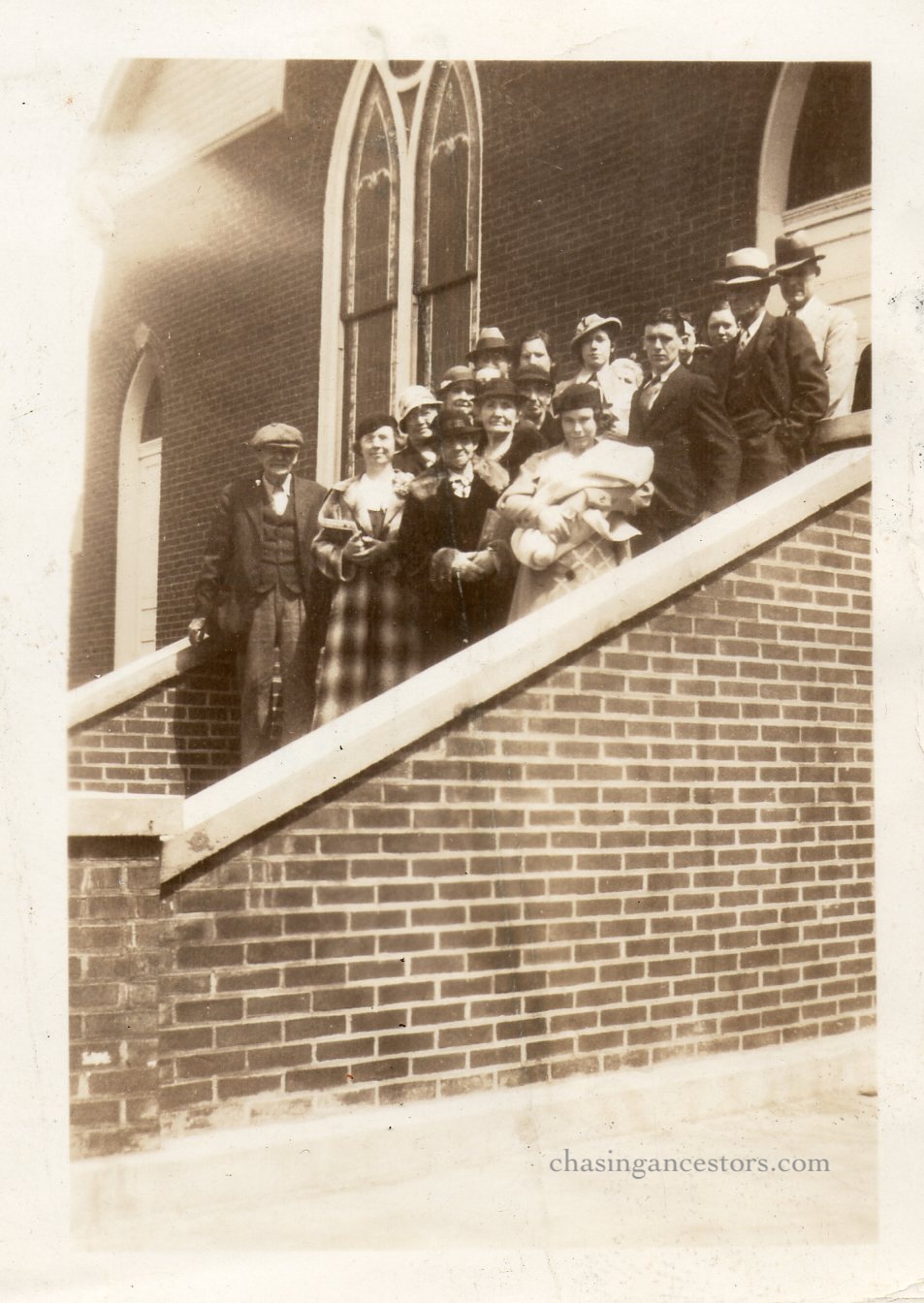
This undated photo was also in my Grandfather’s collection. I wonder if it commemorated the baby’s baptism. There was no identification given for any of the people in the picture, although I think my Great Grandfather, Oscar McKinley is the man at the top of the stairs in the light colored suit. This picture also shows how the stairs were modified from the earlier picture.

There was a special service held in August of 1940 to dedicate new memorial hymnals. Many were donated either in memory of or in honor of someone dear to them by the members of the congregation listed on the 1935 roll.

In the 1940’s they shared services with Monrovia Methodist Church in Monrovia, IN. The newspaper would indicate whether morning or evening services were at Monrovia. The attendance in March of 1942 was 72.

The first WWII casualty from Brooklyn was 20 year old Charles Arnold, Jr, who died in Italy. His memorial service was held in the church on January 16, 1944.

In September of 1945, the church had a special homecoming service and picnic to celebrate the 50th Anniversary of the morning worship period. So I guess the Bible may have been presented in 1935 in honor of the 40th Anniversary.

The church held ice cream socials and taffy pulls and spelling bees as well as other activities through the years. Revivals were also held at the church.

On May 25, 1969, the church closed as it could not meet the obligations to the denomination. Many children attended the church at that time and the assessment for financial obligation was determined by the number of people on the rolls. According to an article in The Martinsville Reporter- Times from June 2, 1969, and an article in The Martinsville Democrat June 6, 1969, the Sunday school attendance outnumbered the regular worship attendance by 2 to 3 times. Worship attendance was averaging around 30 people, while the rolls listed 142 names. The church was assessed $14.83 for each person on the roll & $33 for each $100 paid to the pastor. The church was reported to be financially solvent at that time, but not able to keep up the obligation to the Methodist Conference. Options to merge with other congregations were turned down for various reasons; as well as the possibility of staying open only as a Sunday school congregation. Apparently no deed could be found for the church, so the Conference was not able to claim the property.

The article from the Democrat mentioned a lady, Mrs. Frank Soots, age 83, who had been a member of the church since her childhood and who was present when the church doors closed. She was actually Dolly Throckmorton Soots & she was listed with her husband on the church roll from 1935.

The church building was used by other denominations & religious groups through the succeeding years. It is now listed on a Realtor site for sale as a commercial site. The address is 9 N Church St. Several photographs are posted of the interior and exterior of the building.

20240513brooklyninmechurchbldg1-copy

I took this picture a week ago on a recent trip through the area. The building is a bit run down, the stained glass windows are long gone & the yard is overgrown. It is just a building. The people who passed through its doors from generation to generation to gather as community to worship their Lord are the real legacy of Brooklyn M.E. Church.

©MJM 2024

Another Connection to a Revolutionary War Soldier

The website, Fold3.com is a great resource for finding military records. One such record is the pension file for Ebenezer Minton, my paternal GGGG Grandfather. The pension file is the principal source for most of Ebenezer’s vital statistics. However, just as I mentioned in an earlier post about a soldier of the Revolution, the papers in the pension file are a little difficult to read.

To begin with, the file contains an affidavit from Peter Johnston, a judge of the General Court of Virginia, Lee County. He reported that Ebenezer Minton, aged 59, made a declaration before him in order to obtain a Revolutionary War Soldier’s pension:

EbMintonRevWarClip1

On this first day of September in the year one thousand eight hundred and nineteen before me Peter Johnston—one of the Judges of the General Court of Virginia appointed by law to perform the judicial duties of the thirteenth circuit which comprehends the county of Lee personally presented himself Ebenezer Minton of the county of Lee and state of Virginia, aged fifty nine, and on oath made the following declaration in order to obtain the benefit of the Act of Congress entitled “An act for the relief of certain persons engaged in the land and naval service of the United States in the war of the revolution”…

In summary, Ebenezer stated that he enlisted August 11, 1777 in the “Third Regiment of Cavalry on Continental establishment commanded by Colonel George Baylor of Virginia” and served under Captain Churchill Jones. He served for 3 years, then re-enlisted “in the same Regiment, then commanded by Colonel William Washington for the war & remained in service until the end of the war when he was regularly discharged.” For the most part, the fighting ended with the surrender of Cornwallis in October 1781 & the war was officially over with the signing of the Treaty of Paris in September 1783, so Ebenezer served for 6 years. He stated that “from his reduced circumstances, he stands in need of the assistance of his country for his support.”

So from this first statement, since he stated he was 59 years old in 1819, we can estimate Ebenezer’s birth year as 1760. Which also means that he was 17 years old when he enlisted in 1777!

Ebenezer’s statement also included a list of some of the Battles he was involved in:

That he was at the surprise of the American detachment, composed, in part, of his regiment, at Paoli in the State of Jersey; at the defeat of Colonel Abraham Buford, at the battle of Cowpens, at the battle of Guilford, at the second battle of Cambden, and at the battle of the Eutaw Spring.”

An additional statement before the Lee County court on September 26, 1820 gives more detail of Ebenezer’s service:

EbMintonRevWarClip2

This clip indicates that he was enlisted under “Fitzpatrick of the Dragoons.” So what were the “Dragoons?” In essence, they were the cavalry–prepared to fight from horseback or on foot.

The summary of Ebenezer’s service follows:

After enlisting, he states he “marched under Fitzpatrick to Fredericksburg in Virginia and was placed in the Third Troop of Cavalry Commanded by Capt Churchill Jones in the Regiment commanded by Col. Baylor. That he wintered in Fredericksburg the winter of 1777 and in the Spring following he marched to the north and was in the surprise at Paoli, where Col Baylor was badly wounded and never again joined the Regt. And Major Clough was killed.”

According to the American Battlefield Trust website, <battlefields.org>, the surprise attack at Paoli was on September 20, 1777. So I guess Ebenezer was a little off on his timeline as this occurred a month after he enlisted, not the next Spring. This is also know as the “Paoli Massacre” as it was a surprise attack by the British late at night on the camp of the Continental Army near Paoli Tavern in Pennsylvania.

Ebenezer’ statement continues: “That after the said surprise and defeat the Command of the Regiment was given to Col. Washington. That he continued in Washington’s Regiment of Cavalry until the end of the war.” This Colonel William Washington was second cousin to George Washington.

His 1820 statement indicates that he was “at Monks Corner,” which was a battle that took place on the outskirts of Charleston, SC, April 14, 1780. Again, the Loyalists and British undertook a surprise attack at 3 A.M. and most of the Continental forces were driven away. They lost their horses to the British in this battle. This led to the eventual British capture of Charleston.

He also stated he was at “the defeat of Buford.” Also known as “Buford’s Massacre,” this battle took place May 29, 1780, after the British had taken Charleston. Three columns of British soldiers easily overtook the single line of Continental forces near the North and South Carolina border. Again a British victory.

He was at “the battle of Cowpens,” which took place January 17, 1781 in South Carolina. This time the Continental troops formed 3 successive lines against the British attack. The Light Dragoons were sent to meet the British. It was considered the “most decisive American victory of the War for Independence.” The tide was turning for the Continental Army.

Then he stated he was at “the battle of Guilford.” This was the battle of Guilford Courthouse in Greensboro, North Carolina on March 15, 1781. General Charles Lord Cornwallis commanded the British forces. The Continental Army again formed 3 lines with the Light Dragoons in the 3rd line. While it was a British victory, they lost 25% of their troops and were unable to pursue the Continental forces. Cornwallis moved on to Virginia.

The next battle mentioned in Ebenezer’s statements was “the second battle of Camden,” which took place in South Carolina April 25, 1781. The British had already won a victory at this same spot in the Summer of 1780, and again were victorious.

The final battle mentioned is “the Battle of Eutaw Springs.” This took place near Charleston, SC on September 8, 1781. With this battle, the British eventually abandoned their position and withdrew to Charleston.

As mentioned earlier, Cornwallis surrendered in October 1781, thus ending the fighting. Ebenezer definitely saw the defeat and victory of war. I expect he matured quickly through those years. When he “was discharged on the Santee River in South Carolina” and returned home, he was still considered young at 22 years old.

According to the 1820 statement, Ebenezer obtained a pension certificate from the Secretary of War October 8, 1819. Certificate #15,306.

I’m not sure why he made the statement in 1820 when he had already received his certificate, perhaps he was petitioning for additional funds. Regardless his statement includes his financial status:

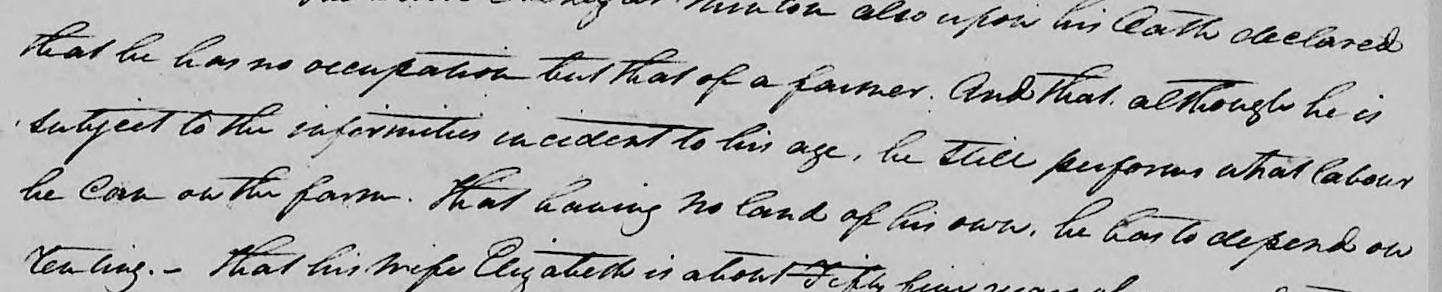
EbMintonRevWarClip4

…that he has no occupation but that of a farmer. And that although he is subject to the infirmities incident to his age, he still performs what labour he can on the farm. That having no land of his own, he has to depend on renting.”

He lists his personal property as:

One mare and colt, and two other mares, five cows & calves, four two year old heifers, one yearling steer, Twenty seven head of sheep, twenty eight head of hogs, mostly small, two Bareshear ploughs, two pair of horse gear, three cleavers, two shovel ploughs & single trees, four old asses, five weeding hoes, two mattocks, one double tree, one handsaw & drawing knife, one auger, one large kettle, two pots, two ovens, two pot racks, one pair shovel & tongs, two pewter dishes, eighteen old pewter plates, fifteen delf[t] plates, five knives & forks, one set cups and saucers, one cream mug, one coffee pot, one sugar bowl, one set table spoons, four water pails, one rifle gun, one churn, nine old tea cups, one old saddle, one smoothing iron, & one iron wedge.”

He states he has debts amounting to $166.

Then for a family historian, the best bit of information, he lists the names and ages of all of his family members living in his household:

EbMintonRevWarClip5

He lists his wife, Elizabeth, who is 55 years old. His five children living with him: Isaac, 17; Ebenezar, 15; Liddy, 13; Betsey, 11; and Vardeman, 9. He also had “two orphan grandchildren to raise,” Washington, 7 and Preston, 5. What a wealth of information! Finding names of family members from the 1820’s is difficult, as Census records only list the head of household and # of people in the household by age. Obviously, Ebenezer also had at least one more son not listed who had died, leaving the two grandchildren.

Additional paperwork in Ebenezer’s pension file confirmed that he did receive a pension of $8/month.

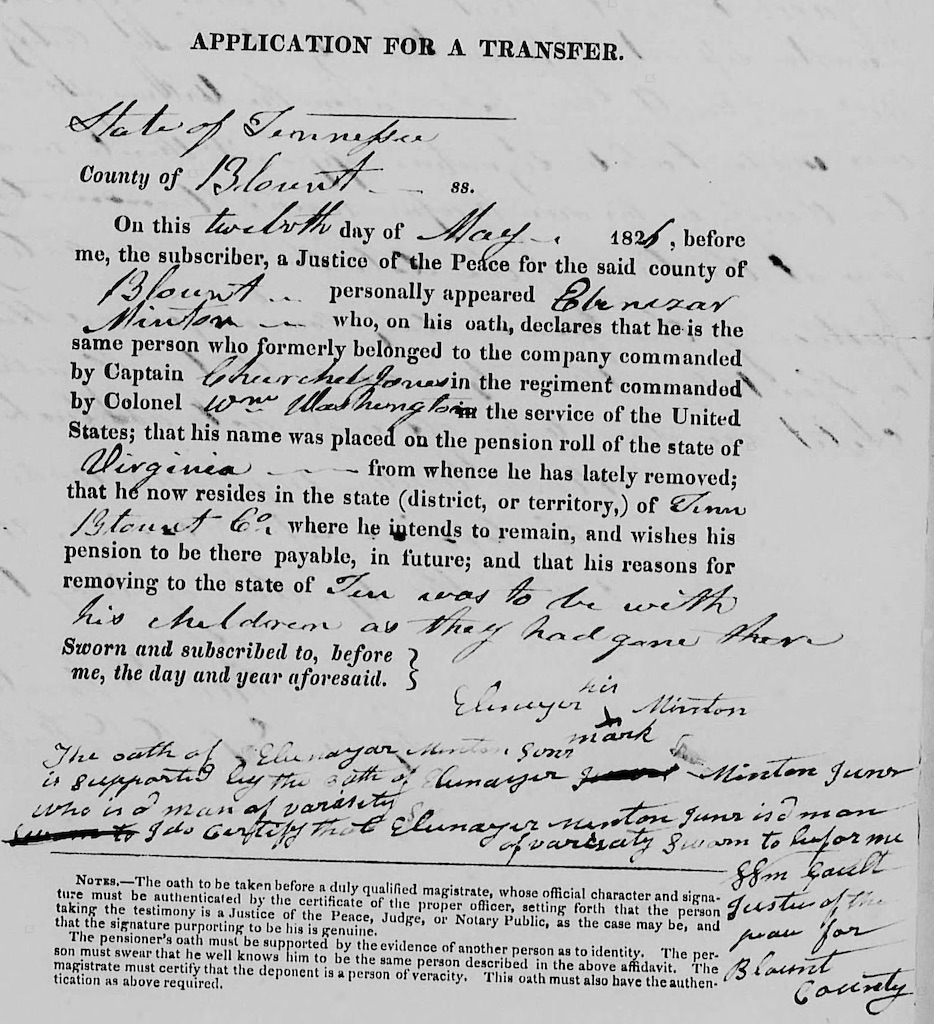
But that’s not the end of Ebenezer’s story. His file also contained an Application for Transfer, dated May 12, 1826.

EbMintonRevWarClip6

Ebenezer requested to transfer his Pension payment from Lee County, Virginia to Blount County, Tennessee. He stated he had moved to Tennessee to be with his children, who had also moved there. Looking at the map, Lee County, Virginia is on the border with Tennessee, in the area of the Cumberland Gap. Blount County, Tennessee is just south of Knoxville, in Eastern Tennessee. Interestingly enough, when I did a search for Blount County, TN, I came across a picture of a memorial marker at the Blount County Courthouse in Maryville, TN.

EbMintonRevWarClip7

The memorial was erected “In Memory of Soldiers and Patriots of the American Revolution who Settled in Blount County.” Ebenezer’s name is listed on the back of the memorial.

On Ancestry.com, I found a little more information about Ebenezer. He was apparently awarded 100 acres of Bounty land in 1794 as this certificate confirms:

EbMintonRevWarClip8

However, by 1820, he states he does not own any land. So perhaps he sold his bounty land to a speculator. I have not been able to find out any more information about the location of this land.

One final record from Ancestry.com was the Tennessee Pension Roll record showing that Ebenezer was entered to the Tennessee roll in March of 1826. His last payment is recorded as March 1838. This would indicate that Ebenezer passed away sometime between March and September of 1838, which is when the next entry would have been recorded.

According to the Find-a-Grave website <www.findagrave.com>, Ebenezer was buried in an unmarked grave at the Third Creek (Baptist) Church in Knoxville, Tennessee. Per church records, he died April 24, 1838. He was 78 years old. It is also indicated that he was a charter member of the church.

So that’s the story of Ebenezer Minton, private in the Continental Army, Light Dragoons. One of the average citizens who as a young man helped found this country, the United States of America.

And how do I fit into the line of Pvt. Ebenezer Minton? He had a son, Ebenezer, Jr. (1805-1877). Ebenezer, Jr. had a daughter, Mariah (1846-1923). She married George Portis (1839-1916) & they had a daughter, Gertrude (1888-1967). Gertrude married Oscar McKinley (1887-1969), they were my Great-Grandparents. Ebenezer, Jr. and his family moved from Knoxville, to Wilbur, in Morgan County, Indiana.

© MJM 2020


An Unfortunate Accident

One of the data-bases in the Ancestry.com collection is “Indiana, Death Certificates, 1899-2011.” Naturally, I have used this collection to try to find the death certificates for my many Indiana ancestors. The certificates can help fill in some of the connections—such as parent’s names, spouse’s name, occupation, dates of birth and death. Obviously, the death certificate also includes the cause of death. Most of the time, I’ve found the cause to be pretty standard—cardio vascular problems, respiratory problems, cancer, etc. Occasionally, I find a more intriguing cause of death…

Burton Minton was the son of Thomas Minton (1844-1916) and Eliza Ann Cummings (1845-1927). He was born in the community of Wilbur, IN December 6, 1870. He was a nephew of my GG Grandmother, Mariah (Minton) Portis (1848-1923). He was a farmer & trader. He was a member of the Poplar Grove M.E. Church. Burton married Vesta Fowler December 24, 1890. He and Vesta had 9 children and lived in the Wilbur community together for 57 years.

Burton’s Death Certificate from Ancestry.com indicates that he didn’t die of “natural causes.”

BertMintonDC1

BertMintonDC2

Incidentally, his name is spelled “Berton” on the death certificate. I found his obituary in the Morgan County, IN Library. It was not sourced so I’m not sure what newspaper it came from. It stated that “his buggy overturned about 10:30 Monday night on the Baltimore Road.” He was found Tuesday morning. He died “at 3:30 Tuesday afternoon in the Robert Long Hospital in Indianapolis.” He had never regained consciousness. The obit. also stated that searchers had looked “through the night” for Burton. “The parties had passed along the county road beside which Mr. Minton lay after his buggy had slipped off a culvert, but the buggy had turned over in such a deep spot that it was not seen at night…” It also reported that Burton “had evidently crawled about 30 feet along the gully.” He was found about 3 miles north of Wilbur and had reportedly been traveling home from Monrovia, IN.

The first time I read his obituary several years ago, I really had no idea who he was. I skimmed it and didn’t think much more about it. Because he died in a horse and buggy accident, I figured he died in the early 1900’s. Obviously, I didn’t look at the date written on the obit. Burton died May 3, 1949; well into the age of the automobile. Hard to imagine someone was still traveling by horse and buggy. I would guess he didn’t have much light on the roadway at that time of night as well. Anyway, the unfortunate accident claimed his life and added another sad story to the family history.

© MJM 2018

Thirteen Children in a Cabin 3 Logs High

Mariah (Minton) Portis sitting in front of the cabin in which she had 13 children.

img110

Caption on back of photo: George Portis erected this house near the year 1870 near Wilbur, Morgan Co. Ind. These logs were yellow Poplar. Mr Portis hewed these logs by hand, they were 3 ft through after they were finished. This house was build in the hollow West of Wilbur. This is Mrs. Portis 1920.

There is a news clipping, I’m not sure what newspaper it came from, nor when it was written. Josephine Foster reported on the historic photo. She mentions some attributes of the structure of the cabin. First, there were no windows (except the one high up in the loft). The lack of windows helped keep intruders out. Also the doorway is very short as was common in early cabins. To me it looks like there was a shed added on to the left of the main building. The community of Wilbur, where they lived, is now a cross roads in west central Morgan county in Gregg Twp.

George Portis was born Dec. 15, 1839 (some sources say 1830) in Davidson County, NC. Mariah Minton was born June 30, 1848 in Knox County, TN. They were married Jan. 29, 1865 in Morgan County, IN. George died in 1916 and Mariah in 1923. They are buried in Bethel Friends Church cemetery.

George & Mariah Portis had 13 children:

  • Ezekiel, born in 1866 and lived 5 days
  • Sarah, born in 1868, lived just over a month
  • (Miles J.) Bradley (1871-1929)
  • Silas J. (1872-1933)
  • Bertha Ann (1875 or 76-1940) twin
  • Burton F. (1875 or 76-1934) twin
  • Usher L. born in 1879, lived less than a year
  • Clyda, born in 1880 and lived just over a year
  • Pearl A. (1882-1895), died at 13 years
  • Elbert L. (1884-1952)
  • Gertrude (1888-1967)
  • Georgetta (1892-1962)
  • Earl, born in 1895, lived 1 month

Of the 13, only 7 lived to adulthood. But that is still plenty in such a small cabin!

George and Mariah are my great-great Grandparents. Their daughter, Gertrude, married Oscar McKinley Feb 15, 1908 in Morgan Co. IN.

Sometime in the mid 1900’s George and Mariah moved to Brooklyn, IN and lived in the same house as Gertrude and Oscar. The house in Brooklyn is where my Grandfather, Loran was born.

© MJM 2016