Dear Cousin Mattie…

As I have mentioned before, my Grandmother, Margaret Millikan McKinley (1917-2007), kept many family papers and photographs. Some of what she saved were letters from various family members. I wonder why some letters were saved and many more were discarded. But I am grateful for those letters that give a glimpse of family life & maybe even a little more insight into family relationships. Here is one such letter:

HJL1890en copy

The envelope indicates this letter was sent to Martha E. Millikan, Sheridan, Ind. (Hamilton Co.)

It was sent from Moffits Mills, NC with the postmark of Oct 1, ’90.

Note the 2¢ stamp! Things have really changed!

MarthaEMillikancrop copy

Martha E. Millikan was Martha Ellen (Barker) Millikan. She was born May 25, 1858 in Randolph County, North Carolina. She moved to Hamilton County, Indiana in 1866, with her parents, Elihu Barker (1822-1910) and Hannah Jane (Allen) Barker (1825-1899); and siblings, Amelia Ann (1855-1890), John Gurney (1860-1942) & William Capres (1865-1880). She married Lewis Elwood Millikan (1855-1949) in 1882. Lewis and Martha or “Elwood” and “Mattie” as they were commonly known, were my Great-Great Grandparents. Mattie died Feb. 27, 1932.

As for the letter in the envelope, the handwriting is beautiful! I’ve heard that cursive isn’t taught much anymore in school, so I wonder if young people can even read this. 

On the top right of the first page, it says “Kemps Mills, NC” while the postmark said “Moffit’s Mills, NC.” I found only one map online that shows the location of these two places. The map is dated to 1873 and hand-drawn by J.W. Bean & can be found in the digital archive of the University of North Carolina.(https://dc.lib.unc.edu/cdm/ref/collection/ncmaps/id/223) Essentially these communities were centered around family-owned grist mills on Richland Creek about 10 miles southeast of Asheboro, NC. My guess is that the Post Office was at Moffit’s Mill at the time the letter was written. 

The transcribed letter:

Kemp’s Mills, N.C.

9 mo. 29th 1890 

Dear Cousin Mattie:–

Thy interesting letter of 8 mo. was duly received. Were truly glad to hear from so many of our relations. We are in usual health:–all able to help in the common cares of life. Our relations are mostly well so far as we know except Simeon Barker, we hear is quite sick. I was at Uncle Seth’s in last month:–They seemed lively enough considering their age & were able to get out to Quarterly Meeting at Marlboro. Suppose you have heard of their son, Benjamin’s death.

It was brother Jno’s right arm that was taken off. There was a tumor on it near the shoulder which was thought to have been caused by a severe bump he received from the plow handle while 

[pg 2] plowing several years ago. During the past year or so, the tumor increased so rapidly in size, and hurt so much, that it became evident something had to be done more than outward appliances, so he went to what is said to be the best Surgical Hospital in Phila. to have it removed. When they commensed the operation all the doctors agreed that in order to save his life the arm would have to be severed, which they did by unjointing at the shoulder. In thirty days he was able to leave the Hospital. Has got well and enjoys good health but has not been home:–Writes that he hopes to visit us sometime at least. He is employed by Rhoads & Co. 229 Market St. Phila. to keep books and help clerk in a Rubber & Belting store. Has learned to write tolerably well with his left hand, also can operate the typewriter. We miss him much but are 

[pg 3] glad to know he is doing well where he can enjoy life perhaps better than here considering his condition.

The Teacher’s Institute at Asheboro commences today but I am not expecting to teach this winter so have not gone, much as I enjoy attending. Brother Jno. and I both attended last fall. We have an abundance of rain. Wheat was very light last year and if the rain continues, it will be difficult to get any sowed soon. People here have good corn. No peaches the past summer worth relating and only a moderate apple crop. Late ones are rotting; we have been canning and preserving some of ours. Cotton fields are looking white and ready to pick; have ours partly picked out. There is a fine crop of persimmons beginning to ripen but we make little use of them except that the pigs eat them.

How is Cousin Amelia and family? 

[pg 4] I believe thee did not write anything in thy last letter about them. I would be pleased to visit thee and others but do not know that I can do so soon. Mother often talks of writing to relations in Ind. Aunt H. Hockett in particular, knowing her lonely condition but can not see and write so well as when younger. 

Aunt Catharine Barker was here not long ago on a visit; seems and looks real cheerful but cannot hear very well.

Gideon and Asenath Cox staied with us two nights. I believe they honestly think Texas the place to live. Thee may let thy father’s folks read this if they wish to hear about brother’s arm.

It is nearly bedtime so no more at present. Write soon. Thy cousin, H.J. Littler

Jno’s address is 229 Market St. as I have written, but he says so many letters come to the store that he prefers having letters directed to his lodgings which is at 480 N. 5th St. Phila. Penn. I think he would be pleased to hear from any of you. H.J.L.

The letter was written by Mattie’s cousin, H.J. Littler on September 29, 1890. It was written in response to Mattie’s letter a month earlier. Note the use of “Thee” & “Thy” which were commonly used by Quakers in speaking to their close relatives. 

H.J. Littler turns out to be Hannah Jane Littler (1863-1945). Her Mother was Tamar (Barker) Littler (1827-1919) who was the sister of Mattie’s father Elihu Barker. Hannah was a teacher, which may explain her beautiful handwriting. 

Hannah mentions several family members in her letter, many of them Barker cousins. I had some notes regarding this family, but had to verify some information so I used Ancestry.com, Findagrave.com and Newspapers.com to clarify the details of the relationships. 

Enoch Barker was the patriarch of this family. He was born in 1776 in Guilford Co, NC & he married Elizabeth Davis November 23, 1800 in the Holly Spring meeting house in Randolph County, NC. Elizabeth was born in 1782 in Chatham Co, NC. She died in 1834 and Enoch died in 1848. From what I know, they were both lifelong residents of North Carolina. They lived and raised their family in the community near the Holly Spring Friends (Quaker) meeting house. Their children were: Sarah (1801-1846), Daniel (1803-1892), Nicholas (1805-1886), John (1807-1890), Isaac (1810-1820), Seth (1812-1894), Mary (1815-?), Hannah (1818-1899), Elihu (1822-1910), and Tamar (1827-1919). 

Starting at the beginning of the letter, Hannah mentions Simeon Barker, who was probably her cousin. He was born in 1835 to Nicholas Barker (1805-1886) and Catharine Cox (1806-1896). I expect this Catharine was the “Aunt Catharine Barker” mentioned later in the letter. She would have been 84 years old when she visited Hannah. 

She then mentions “Uncle Seth” and his son, Benjamin. Uncle Seth Barker (1812-1894) was married to Margaret Cox (1812-1891). Seth and Margaret would have been in their late 70’s at the time Hannah wrote this letter. The “Quarterly Meeting” was a regional meeting of Quakers held at the Marlboro Meeting House in Sophia, NC. Their son, Benjamin, was born in 1850 and died June 6, 1890. He was 40 years old and left a wife, Esther and family.

Hannah’s brother, John Oxley (“Jno” is an abbreviation for John), was having a rough time with the surgical amputation of his right arm at the shoulder. He spent 30 days in the hospital. But as Hannah wrote, it seems he had recovered well after the surgery and was adjusting to his disability and was working as a clerk & bookkeeper. John Littler was born July 2, 1859. He is listed in the 1880 census as being a student at the Westtown boarding school in Westchester, PA. The school was founded by Philadelphia Quakers. This explains how he ended up in the Philadelphia area. He died September 8, 1891.

Hannah then mentions the status of farming in the region. Sounds like they were having a good year for some crops while others were hampered by the weather. 

Hannah asks about “Cousin Amelia.” This would be Mattie’s sister, Amelia Ann Barker. She was born in Randolph County, NC September 24, 1855. She married Simeon Fesmire (1852-1925) in 1889 but as Simeon’s obituary stated, “she only lived 11 months” after they were married. She died November 29, 1890, only 2 months after Hannah’s letter was written. 

Then there is “Aunt H. Hockett” who lived in Indiana. Hannah Barker Hockett (1818-1899) was married to Mahlon Hockett (1808-1885) in Holly Spring MH in 1858. He was a widower with 4 children. From what I can tell, they had no additional children. They moved to Rush County, IN sometime before the 1880 US Census was taken. He died there in 1885. According to my Grandmother’s notes, Hannah later lived with her brother, Elihu near Sheridan in Hamilton County, IN, not far from where Mattie and Elwood lived.  

At the end of the letter, Hannah mentions Gideon and Asenath Cox, from Texas. Asenath was Hannah’s cousin, daughter of Daniel Barker (1803-1892). She was born in 1829 and married Gideon Cox (1822-1892) in 1858. She was his second wife. They moved to Estacado, TX in 1881, following his son, Paris Cox who had a vision of establishing a Quaker community there. Gideon & Asenath would have been in their 60’s when they visited the folks back home. Gideon died in Texas & Asenath died in Whittier, California, where she had been living with their son, Manley. One more family relationship: Gideon’s half-brother, Thomas was the husband of Sarah Barker Cox (1801-1846), Hannah’s aunt. The Cox and Barker families had many branches and intermarried through many generations so these relationships are somewhat difficult to decipher. 

So again, I wonder why this letter was kept through the years, but I’m glad it was. It shows how over 130 years ago the family was able to stay connected while living so far apart from each other. 

© MJM 2024

The Cabin on the Battleground, Part 2

P1020676 copy

In the 1960’s descendants of John Allen (1749-1826) donated the family cabin to the state of North Carolina with the stipulation that it be placed at the Alamance Battleground Historic Park. As I was researching that cabin & the connection to my family, I also found there was a connection to that battleground as well.

aP1020697 copyFirst, the Alamance Battleground. What happened on this site? What battle is commemorated here? According to the Friends of the Alamance Battleground website <alamancebattleground.org>, “The Battle of Alamance was fought on Thursday, May 16, 1771. It pitted two groups of North Carolinians against each other. There were approximately 2,000 backcountry farmers called Regulators and around 1,000 militia troops (citizen soldiers) under the command of Royal Governor William Tryon involved in the two-hour battle.”

From what I have found on the internet, the Regulators were a group of farmers in the inland Piedmont region of North Carolina. The website, ExploreSouthernHistory.com, states that the Regulators were opposing increased taxes & “oppressive government officials.” There were apparently “arbitrary seizures” of property & possessions by these government officials. They were also angry about not being able to “meet with their representatives or to petition for redress of their grievances.” Sounds a little similar to the “taxation without representation” argument that came up with the American Revolution. I also read that the Regulators were upset that laws and regulations that were made to benefit the coastal farmers didn’t equally benefit the inland farmers. While the Regulator movement initially tried peaceful means like petitions & appeals to the government, when they couldn’t get help, they eventually became more disruptive. Governor William Tryon was the regional representative of the English government.

According to the above mentioned websites, the Regulators were defeated in about two hours on that day in May, 1771 at Alamance Creek. Even though they outnumbered the militia, they were no match for the superior military resources of the militia. The Regulators did not have military leadership and many men fled before the battle began. Six of the captured Regulators were later hanged. After this battle, there was continued retribution toward the Regulators, with homes and farms burned and men arrested. Many Regulators fled to other regions of the country.

It is said that the Regulator movement “planted the seeds of the American Revolution.” However, many Regulators are said to have been Loyalists in the Revolution. They wanted representatives to hear and address their grievances, but not a total break with England. Also, some of the militia fought on the side of the Revolution.

So, now that we know the basics of what happened at the Alamance Battleground, how does that connect to the Allen family? Why would their house fit into this setting? In one sense, John Allen would have been an example of the Piedmont farmer who was represented by the Regulators. He no doubt was aware of what the Regulators were fighting for. I do not know if he joined the cause.

One of the leaders of the Regulator movement, though, was Herman Husband (1724-1795). According to findagrave.com, he was a spokesman & negotiator for the cause. He briefly represented the Piedmont in the legislature, was expelled on a false charge of libel and arrested, then released. His book about the Regulator movement, An Impartial Relation of the First Rise and Cause of the Recent Differences, published in 1770 is currently available in reprint. Due to his Quaker beliefs, Husband reportedly fled before the fighting at the battle at Alamance. Herman Husband’s third wife was Amy Allen (ca1743-1829), who was the daughter of John Allen (1721-1754) & Phebe Scarlet Allen (ca1721-1815) & sister to John Allen (1749-1826), who owned the house that was moved to the battleground. So here is somewhat of a connection between the Allen family and the battleground, even though Herman Husband did not participate in the battle.

Another connection is Harmon Cox (ca1723-1813). He was a member of the Regulators. He reportedly hosted meetings of the group at his mill-house in the region. He was present at the battle at Alamance. His powder horn is on display at the battleground. A photo of this powder horn can be found on the ExploreSouthernHistory.com site. He was captured and found guilty of treason, sentenced to hang, but was pardoned by Governor Tryon. Harmon’s daughter was Hannah (1751-1823), who married Samuel Allen (1751-1834), the son of John Allen (1721-1754) & Phebe Scarlet Allen (ca1721-1815). Incidentally, Samuel and Hannah are direct line ancestors of mine as mentioned in the previous post.

So, John Allen’s siblings were directly connected to the Regulator movement. His sister, Amy, was married to Herman Husband and his brother, Samuel, was married Hannah, the daughter of Harmon Cox. I guess it does make sense that the Allen house would find a fitting home at the Alamance battleground site.

© MJM 2021


A Sad Story…

I like reading old newspapers. At times I have found tidbits that have helped fill in the gaps of my family history research. The social columns weren’t just for the wealthy. Each week, there would often be reports of who was on the sick list, who visited whom, as well as any social gatherings in the community. I think there were “reporters” who told the newspaper of the local events in the smaller communities the paper served. My Grandmother told me that the newspaper would call folks to see if they had any news. Now that many old newspapers have been digitized and indexed, finding the information is a lot easier than it was in the past, when it required a trip to the library in whatever community I was researching in order to browse through microfilm copies of the papers. I have used Newspaperarchive.com for much of my Indiana newspaper research as it has the papers from Morgan and Hamilton Counties which correspond to the areas where Dad’s ancestors lived. I recently started a subscription to Newspapers.com as well. They were having a special offer & I was curious to see if their collection could give me any additional information on both Maternal and Paternal ancestors.

Of course, as I do with any new data collection, I plugged an ancestor’s name into the search box to see what they came up with. In this case, I searched for my GGG Grandfather, Clark Millikan (1824-1926).

One result was the following article dated Friday, September 29, 1899, from the Marshall County Independent, published in Plymouth, Indiana:

Afflicted with Black Diptheria—Westfield, Ind.–About two weeks ago Clark Millikan’s family returned home from the west, and on Sunday last one of the daughters 14 years old, took sick and died. Others of the family are reportedly dangerously ill with the same disease, which is said to be black diphtheria of the most malignant type. The people in that section are greatly alarmed. Every precaution is being taken to prevent a spread of the disease.

Diphtheria–caused by a bacteria & spread by respiratory droplets. An infected person would be contagious for 2-3 weeks. The disease is noted for the formation of a thick grey (or black) coating over nasal tissues, tonsils and throat which then caused breathing difficulty. Also, toxins released by the bacteria could affect the heart. From what I found, there were some treatments available for the disease in the mid 1890’s but it wasn’t until the mid 1920’s that the development and use of vaccinations helped decrease the prevalence of the disease.

So who was the 14 year old girl who died? I remembered a visit my folks and I made to a relative’s home. She had information on another branch of Clark Millikan’s descendants. Clark was married to Lydia Hinshaw (1833-1917). Their daughter, Alice (1864-1926), married Owen Dudley Cox (1861-1894). They had 2 daughters, Estella and Carrie. The lady we visited was Carrie’s daughter-in-law. She showed us the Cox family Bible.

Inside was a family photo of Estella, Owen, Carrie and Alice. Owen died when the girls were young, Estella was 8 and Carrie was 6.

OLYMPUS DIGITAL CAMERA

Cox Family: Estella, Owen, Carrie, Alice

Another item in the Bible was an obituary. I don’t know what newspaper it came from.

StellaCoxObit

My assumption is that Estella Cox was the girl mentioned in the first article. Her obit. states that she contracted the disease from the children of Clark Stout who was her Uncle. He was married to another one of Clark Millikan’s daughters, Anna (1869-1945). The little children would have been Lester (5 yrs old) and LaRue (3 yrs old). Even though the first article mentions a trip “West” and the obit mentions a trip to North Carolina, I don’t think it matters where they had visited. Regardless, the dreaded Diphtheria came back with them.

One more thing about Estella Cox. She doesn’t show up in the US Census records. She was born after the 1880 US Census and died before the 1900 US Census. (The 1890 Census records were destroyed.) So only looking at US Census records, we wouldn’t even know she existed. Other records would have to be used to help prove the family connections.

She is listed in a couple of Quaker Meeting records from Eagle Creek Monthly Meeting in Hamilton County, Indiana.

First, the family was accepted into membership in 1893:

EagleCreekMMHamiltonCoINMensMinutesOwenCox

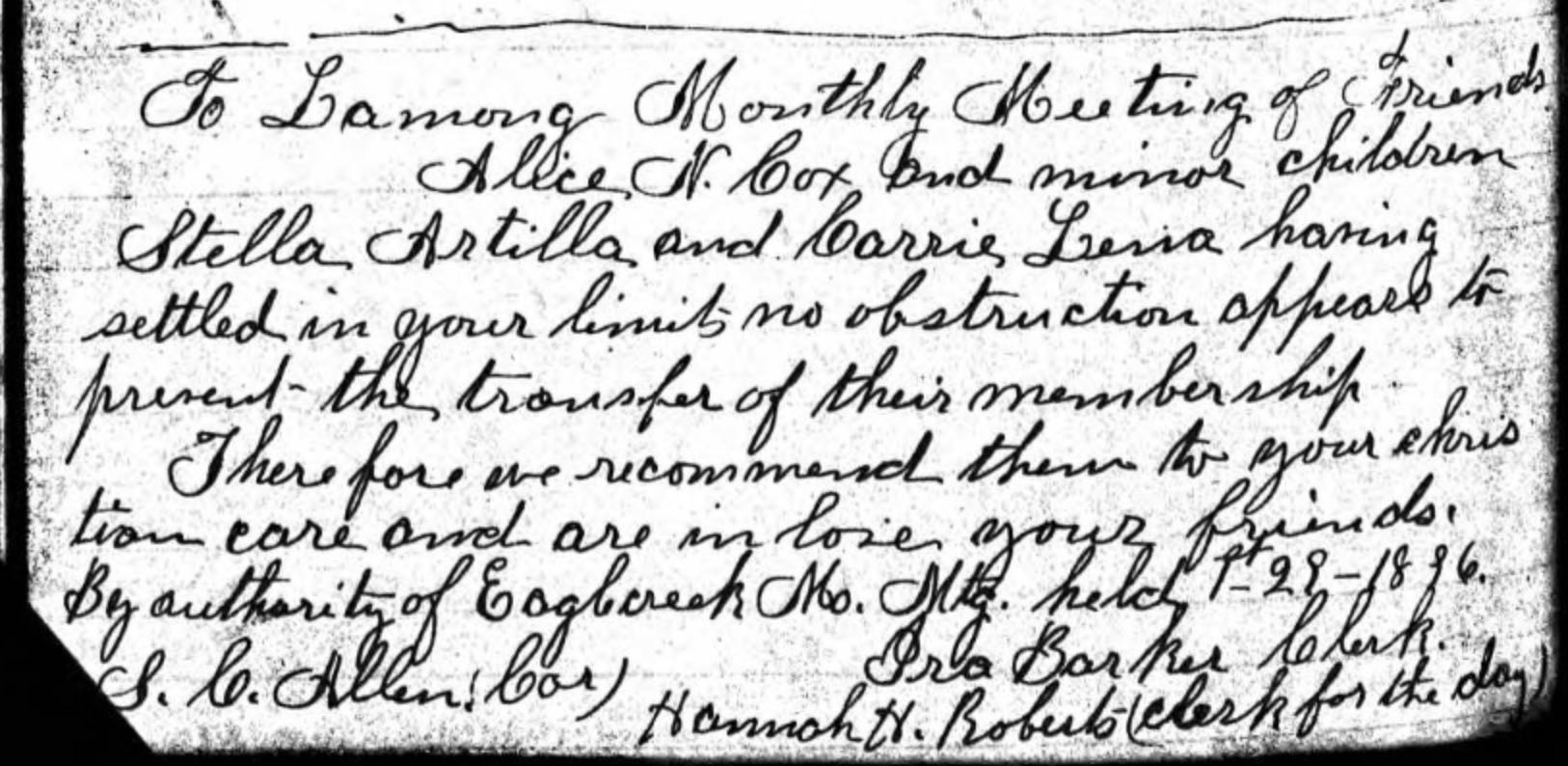
Then, after Owen’s death, Alice and her children moved to Lamong Monthly Meeting. They were living with Alice’s father, Clark:

EagleCreekMMHamiltonCoINCertifofRemovalAliceCox

The Cox family lived with their share of sorrow, with the loss of Owen and Estella. It’s also sad to think that the family members who traveled, probably to visit other relatives, never expected to return from their trip with a disease that infected their cousin and caused her death. I can’t imagine how the family coped with that. Alice lived with her father the rest of her life. Carrie, who was 11 years old when she lost her sister, eventually trained to be a nurse.

© MJM 2017


Allen’s “brother & sister,” Emberson & Millie Cox

Continuing from the last post; Allen Erp sent a letter from Murfreesboro, TN in 1863 to Emberson & Millie Cox. He called them “brother & sister” in his letter. The thought is that since Allen & his wife, Sarah, could not read or write, someone wrote the letter for him & he sent it to a family member.

Walter Emberson Cox (1822-1879) was married to Millie Alexander (1834-1921). They lived in Sugar Creek Twp. of Clinton County, Indiana. They are buried in Hills Baptist Church Cemetery. Walter served in the US Army, Company F of 30th Indiana Infantry from October 26, 1864 to August 15, 1865.

Allen Erp was married to Sarah Alexander, so Millie and Sarah were sisters. Sounds simple, doesn’t it?

However, there is some confusion out there about the Alexander families.

From what I have found, the father of both Sarah and Millie was William P. Alexander (1810-1863), his wife was Elizabeth Stogsdill. William P. is buried in Hills Baptist Church Cemetery.

William P.’s father was William Alexander (ca1777-1855), wife was Mary Hargis.

William & Mary had several children, how many is not clear. He is also often listed as Sarah Alexander’s father. I’m not sure what sources people use for this information, but it is the predominant theory. One problem is that the first Census to name all members of the household was the 1850 US Census and by then Sarah is married to Allen Erp and out of her father’s household.

The 1850 US Census for Clinton Co, IN has several Alexanders listed, including a few Williams and another Sarah Alexander of about the same age as my Sarah (she fits as being a wife of one of the Williams). And again, Sarah and Allen are already married by 1850 and show up in the same area of Clinton County as many of the Alexanders.

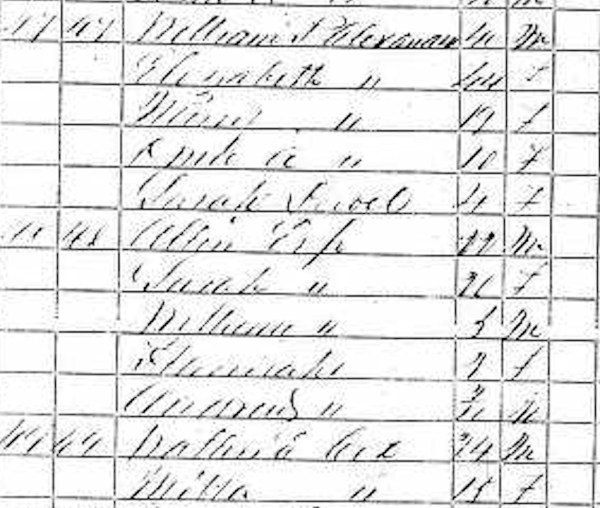
Also, the US Census record for William P. Alexander in Clinton County, IN, shows him and his wife Elizabeth; a 19 yr old daughter, Mary; 10 yr old daughter Oma A; and another 4 yr old girl named Sarah “Leioel”. So I guess people figure that this Sarah would be William P.’s daughter and it wouldn’t make sense to have another daughter named Sarah. The Census record is very difficult to read. But I did notice that the enumerator only listed 2 names when he was indicating first and last names, otherwise he used first name and an initial. So perhaps Sarah “Leioel” was a neighbor or family member who was visiting the home. I can’t find any similar names in the rest of the local Census region yet. So, still looking.

1850 US Census, Clinton County IN, Sugar Creek Twp.(from Ancestry.com)

1850ClintonCoCensus

  • William P Alexander 40
  • Elizabeth 44
  • Mary 19
  • Oma A 10
  • Sarah “Leioel” 4
  • Allen Erp 22
  • Sarah 21
  • William 5
  • Hannah 2
  • Andrew 2/12
  • Walter E Cox 24
  • Milla (Millie) 15


The Erps and Alexanders came from Pulaski Co, KY and moved to Clinton Co, IN.

Anyway, William P. and Elizabeth are listed as Sarah Alexander Erp’s parents in the family Bible record of her marriage, on her Death Certificate and in her obituary. Millie Cox is listed as her sister in the obit. Millie was still alive when Sarah died in 1912, so I doubt this listing was a mistake.

So, Walter Emberson Cox was Brother-in-law to Allen and Sarah, with Millie being Sarah’s sister.

Sarah and Millie had other siblings: Mary (1831-1907) who married Sam Boyer, Sr.; Nancy (ca 1833-1900) who married Nelson Louks; Malinda A. (1837-1848); Naomi America (1840-1857); then the mysterious Sarah “Leioel”.

Not much of a story here except a learning experience researching the family history.

So adding a few generations to the tree: William & Mary (Hargis) Alexander—son William P. & Elizabeth (Stogsdill) Alexander—dau Sarah Alexander & Allen Erp—dau Sarah Alzada Erp & Alva Boone—dau Mary G. Boone & Arza Millikan—dau Margaret P. Millikan & Loran McKinley—son (my father)–me.

© MJMcK 2016